
TL;DR
The bid-ask spread is the cost of trading right away, and slippage is the extra cost (or occasional saving) when the final price moves away from the price you expected. Spreads tend to widen and slippage tends to grow when markets are thin or volatile. Limit orders let you cap the price you pay, but they may not fill. Knowing both costs helps you understand the full price of a trade.
Many Canadians notice that the crypto price they see on a search engine is not exactly the price they pay or receive when they trade. That gap is not a mistake. It comes from how markets match buyers and sellers. This guide explains in plain language how order books work, how to calculate the bid-ask spread, what causes slippage, and how order types affect your costs. It also explains how Netcoins builds its spread into the price you see.
How a Crypto Order Book Works
An order book is a live list of all the buy orders (bids) and sell orders (asks) waiting to be filled for one trading pair, such as BTC/CAD.
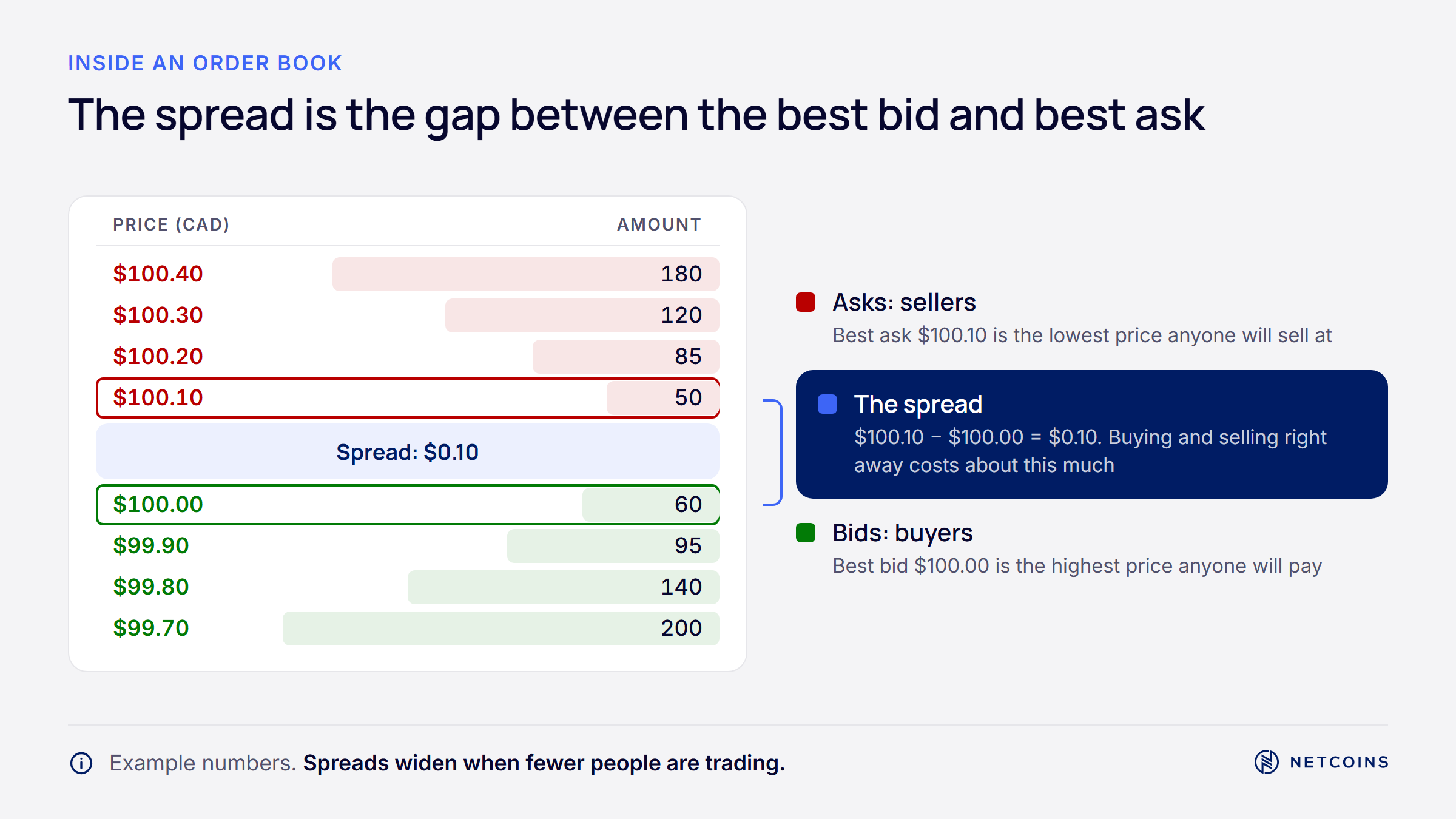
On many trading venues, orders go to a matching engine, software that pairs compatible buy and sell orders. Bids show the most a buyer is willing to pay for a given amount. Asks show the least a seller is willing to accept. Orders are usually ranked by price first, then by time: the highest bid and lowest ask sit at the top, and if two orders share a price, the earlier one is usually filled first.
The "price" quoted in the news is usually the last trade. It tells you what happened a moment ago, not what the next trade will cost. Your actual price depends on the orders available when your trade is filled.
Here is a simplified order book for a hypothetical token priced in Canadian dollars:
- Ask: $100.50 for 150 tokens
- Ask: $100.25 for 100 tokens
- Best ask: $100.10 for 100 tokens
- Best bid: $100.00 for 50 tokens
- Bid: $99.90 for 200 tokens
- Bid: $99.75 for 300 tokens
In this example, the most anyone will pay right now is $100.00, and the least anyone will accept is $100.10. That $0.10 gap is the spread.
A "deep" order book has a lot of volume at prices close to the top, so it can absorb larger trades with smaller price changes. A "thin" order book has small orders and wider gaps between price levels, so even modest trades can move the price.
If you are new to buying crypto, our step-by-step guide to buying Bitcoin in Canada explains account setup, identity verification, and Interac e-Transfer funding before you get to the trade screen.
What Is the Bid-Ask Spread?
The bid-ask spread is the difference between the best ask and the best bid, and it is the cost of buying or selling immediately instead of waiting.
If you want to buy right away in the example above, you pay the best ask of $100.10. If you want to sell right away, you receive the best bid of $100.00. Buying and immediately selling would cost you the $0.10 spread, before any other fees.
Spreads exist partly because market makers, the traders and firms that post both bids and asks, take on the risk of prices moving while they hold inventory. The Bank of Canada describes an asset as liquid when it can be traded at low cost, in large quantities, in a short time, without a significant effect on its price. When market makers can trade easily, the bid-ask spread stays tight [Source].
Several factors widen or narrow spreads:
- Trading activity: Pairs with many active buyers and sellers usually have tighter spreads.
- Volatility: When prices move quickly, market makers face more risk, so they often widen spreads or pull orders.
- Asset size: Smaller, less-traded tokens usually have thinner order books and wider spreads.
- Pricing model: Some platforms show a separate trading fee, while others build their costs into the spread.
To compare spreads across assets, use a percentage. A common formula is:
- Absolute spread = best ask minus best bid
- Percentage spread = (absolute spread ÷ best ask) × 100
Some analysts divide by the midpoint between bid and ask instead, which gives a very similar result for small spreads [Source].
Here is why the percentage matters. Asset A has an ask of $50,000 and a bid of $49,950, so the spread is $50, or 0.1%. Asset B has an ask of $1.00 and a bid of $0.95, so the spread is only $0.05, but that is 5%. Asset B is far more expensive to trade relative to its price, even though its dollar spread looks smaller.
What Is Slippage in Crypto?
Slippage is the difference between the price you expected when you placed an order and the average price you actually received.
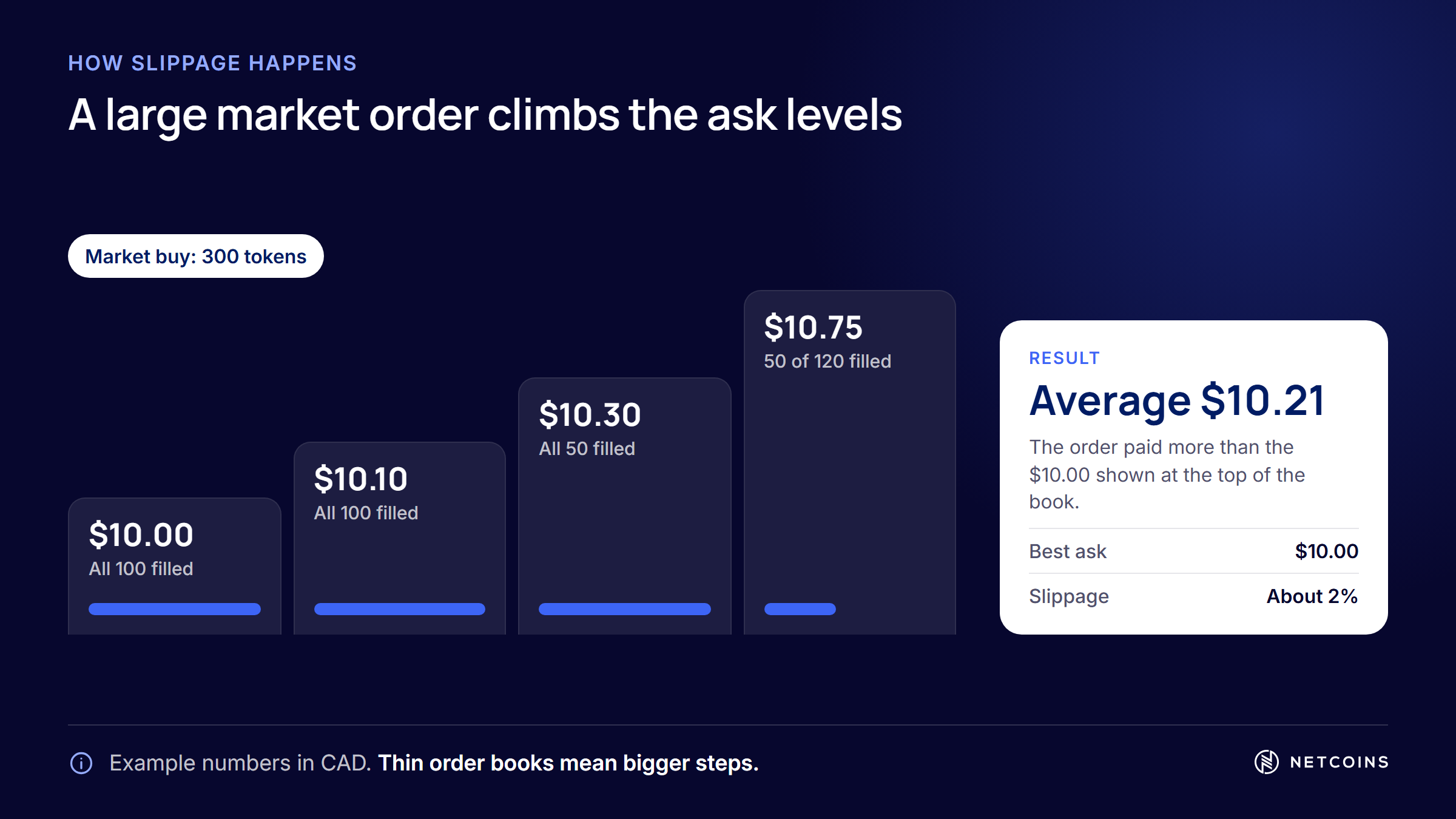
It usually happens for two reasons. First, the price can move between the moment you submit an order and the moment it fills, especially in fast markets. Second, your order can be larger than the volume available at the best price, so it "walks the book" and fills at progressively worse prices.
Here is a hypothetical example. A trader in Calgary places a market order to buy 300 tokens, expecting to pay $10.00 each, or $3,000.00 in total. The order book looks like this:
- Level 1: $10.00 for 100 tokens (all 100 filled, $1,000.00)
- Level 2: $10.10 for 100 tokens (all 100 filled, $1,010.00)
- Level 3: $10.30 for 50 tokens (all 50 filled, $515.00)
- Level 4: $10.75 for 200 tokens (50 filled, $537.50)
The total cost is $3,062.50, an average of about $10.21 per token. The extra $62.50, or about 2.1%, is slippage caused by the order's own size.
Slippage can also be positive. If the market moves in your favour before your order fills, you may get a better price than expected. In practice, large market orders in thin markets tend to experience negative slippage more often.
Slippage is not the same as a fee, and it is not necessarily a sign that anything went wrong. It is how order books respond to size and speed. Bank of Canada research notes that price impact is especially relevant to anyone making large trades or several trades in a short time [Source].
Liquidity, Market Depth, and Volatility
Liquidity is how easily an asset can be bought or sold without moving its price much, and market depth shows how much volume is waiting at each price level.
Researchers often describe liquidity in four parts: tightness (how small the spread is), depth (how much can trade without moving the price), immediacy (how quickly a trade can happen), and resilience (how fast prices recover after a large order) [Source]. Crypto markets show all four, and they can change quickly.
A depth chart plots the total bids on one side and total asks on the other. A steep "wall" shows a lot of volume at one price level. A flat, shallow slope shows thin liquidity, where a modest order can move the price several levels at once.
Liquidity also changes with conditions. In a Bank of Canada study of Government of Canada bonds, average bid-ask spreads widened sharply during the global financial crisis and rose again during later stress events, then improved [Source]. Crypto markets can behave similarly: during major news or sharp price swings, market makers may widen spreads or pull orders, so the same trade can cost more than it would on a calm day.
For a trader in Toronto, this means the cost of a trade depends on more than the headline price. The asset, the trade size, the order type, and market conditions all matter. Wide spreads and thin order books are especially common in smaller tokens, which can also have sharp price swings.
Market Orders, Limit Orders, and Large Trades
A market order fills right away at the best available prices, while a limit order fills only at your chosen price or better.
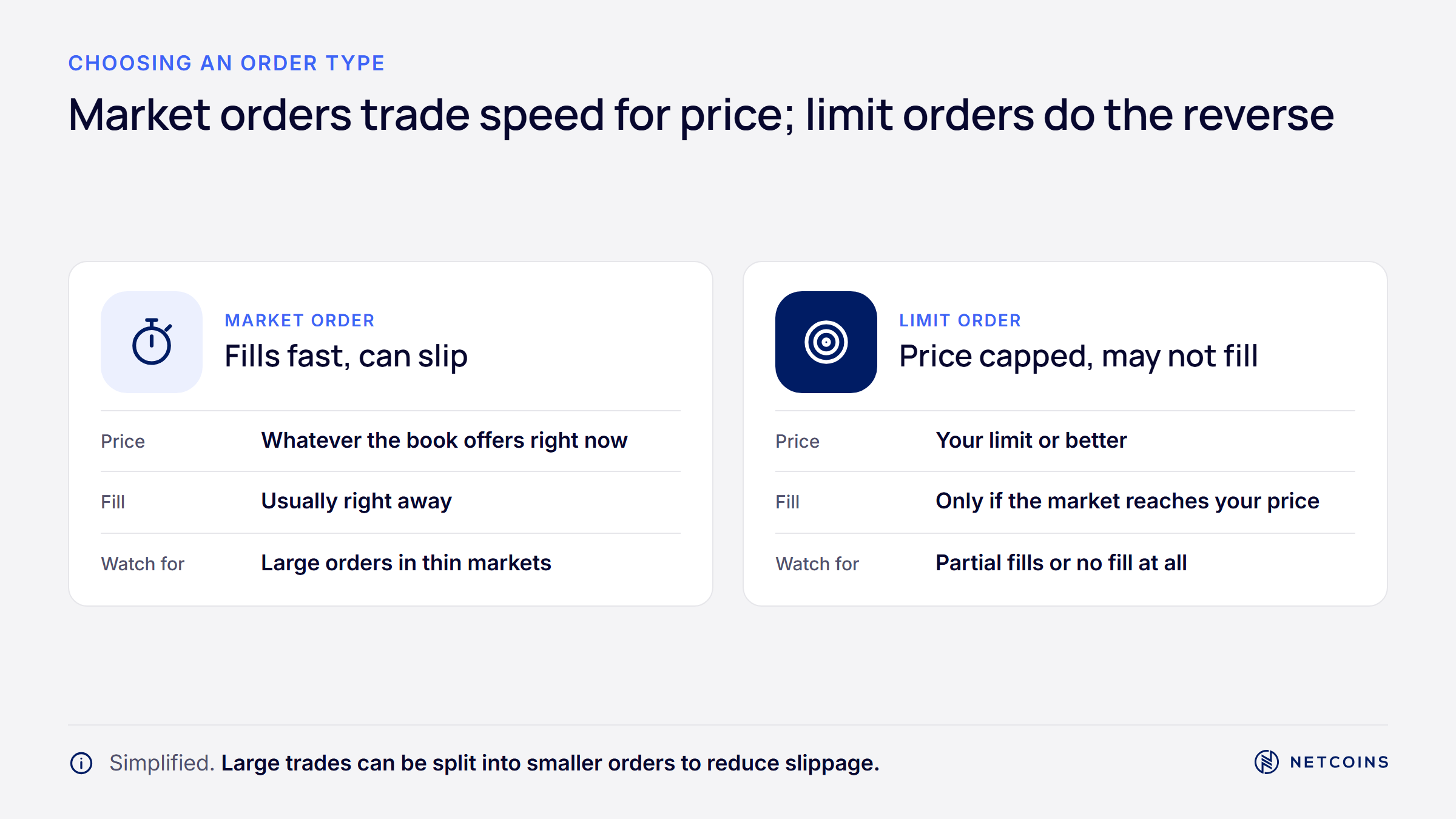
Market orders put speed first. They cross the spread and take liquidity from the order book until the order is filled. That makes them simple and fast, but it also exposes you to slippage, especially for large orders, thin markets, or fast-moving prices.
Limit orders put price control first. A buy limit sets the most you will pay, and a sell limit sets the least you will accept. A limit order will not fill at a worse price than your limit, so it caps negative slippage. The trade-off is that it may fill only partly, or not at all, if the market never reaches your price.
Key differences at a glance:
- Goal: Market orders aim for speed; limit orders aim for price control.
- Slippage: Market orders can slip; limit orders cannot fill worse than the limit.
- Fill certainty: Market orders usually fill if there is liquidity; limit orders may not fill.
- Effect on the book: Market orders remove liquidity; resting limit orders add it.
Some general practices traders use to manage execution costs include checking the spread before trading, using limit orders when timing is not urgent, avoiding large market orders in thin markets or during major news, and splitting large orders into smaller pieces over time. None of these remove risk, and splitting orders can expose you to price changes between each piece.
For very large trades, some investors use an over-the-counter (OTC) desk instead of a public order book. They request a quote for the full size, and if they accept it, the trade is agreed at that price. This can reduce market impact, but the dealer's spread is built into the quote, quotes are usually valid only for a short time, and settlement terms vary by provider. Netcoins offers OTC trading for large orders with dedicated account managers.
How Netcoins Pricing Works
On Netcoins, the price you see includes Netcoins' spread, which is how Netcoins is compensated for a trade, and Netcoins does not charge a separate trading fee on top of it [Source]. The Netcoins help centre says the same: Netcoins displays an all-in price that includes its spread and does not charge additional trading fees [Source].
Crypto platforms use different pricing models. Some charge a separate trading fee, such as a percentage per trade or different "maker" and "taker" fees, on top of the market price. Others, including Netcoins, build their costs into the spread, so the buy and sell prices you see already include them.
This model is simpler to read, but it does not mean trading is free or commission-free. The spread is a cost to you and compensation to the platform, and it is not shown as a separate line item. A practical way to see it is to compare the buy price and the sell price for the same asset at the same moment. The gap between them is roughly what it would cost to buy and immediately sell. That gap can be wider for smaller tokens or during volatile periods.
Other costs depend on how you move money. Interac e-Transfer deposits and withdrawals are free [Source]. Bank wire deposits of $3,000 CAD or under carry a $30 processing fee, while larger wire deposits are free [Source]. Bank wire withdrawals of $25,000 CAD or under carry a $50 processing fee [Source]. Sending crypto to an external wallet carries a flat withdrawal fee that covers blockchain network fees, and the fee is shown on the preview screen before you confirm [Source]. Fees can change, so check the Netcoins fees page for current details.
Netcoins also supports limit orders, so users can set the price they are willing to buy or sell at instead of using an instant trade. According to the Netcoins help centre, a limit order is not guaranteed to execute, a buy limit can be set at most 50% below the current price and a sell limit at most 50% above it, and an order stays open for up to one year unless it fills or you cancel it. Limit orders execute at Netcoins' market price for the asset, not the mid-market price, so the spread still applies [Source].
For a user in Halifax converting CAD to bitcoin, the main questions are the same on any platform: what the quoted buy and sell prices are, how they compare, and what deposit, withdrawal, or network fees apply. Reviewing the final confirmation screen before you submit is the simplest way to see the price you will pay.
Slippage in DeFi: Front-Running and MEV
On decentralized exchanges, slippage has an extra risk: other parties can see your pending trade and act on it before it is confirmed.
On public blockchains such as Ethereum, pending transactions often sit in a public waiting area called the mempool. Maximal extractable value (MEV) is the value that can be extracted from block production by including, excluding, or reordering transactions [Source].
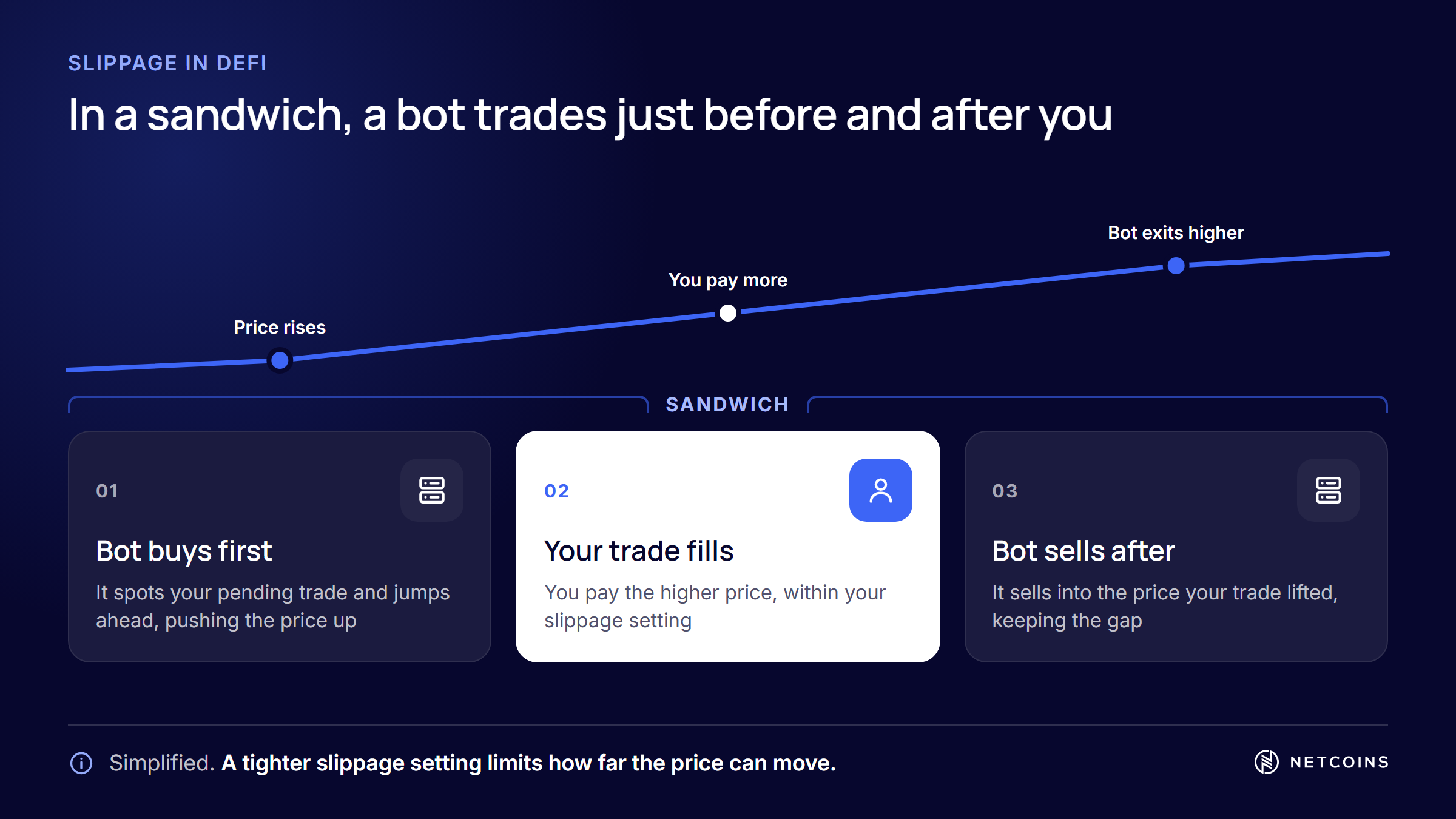
One common MEV strategy is the "sandwich." A bot watches the mempool for a large DEX trade, buys just before it to push the price up, lets the user's trade fill at the worse price, then sells right after for a profit [Source]. The user experiences this as extra slippage.
DEX users usually set a "slippage tolerance," the maximum price change they will accept. A tolerance that is too high gives sandwich bots more room. A tolerance that is too low can cause the trade to fail, which may still cost a network fee. Some wallets and apps offer private transaction routing to reduce exposure, but no setting removes the risk completely.
Centralized trading platforms work differently. Orders are matched inside the platform instead of being broadcast to a public mempool before they fill, so this specific type of front-running does not apply in the same way. Centralized platforms carry other risks, such as custody and counterparty risk, so it helps to understand both models.
If you are exploring DeFi, our guide to what DeFi is and how it works for Canadians covers the wider risks, and The Beginners Guide To Ethereum explains how Ethereum transactions and gas fees work.
People Also Ask About Bid-Ask Spread and Slippage
What causes the bid-ask spread to widen?
The bid-ask spread usually widens when liquidity falls or volatility rises. With fewer active buyers and sellers, there are fewer orders near the top of the book, so the gap between the best bid and best ask grows. During major news or sharp price moves, market makers face more risk, so they often widen their prices or pull orders. Smaller, less-traded tokens also tend to have wider spreads than large, actively traded assets. A wider spread means a higher cost to trade immediately.
Is it possible to completely avoid slippage in crypto?
You can limit negative slippage, but you cannot remove every trading cost. A limit order will not fill at a worse price than the one you set, so it caps negative slippage. The trade-off is that the order may fill only partly, or not at all, if the market moves away from your price. You still pay the spread when your order trades against other orders, and any fees that apply. Market orders, especially large ones in thin or fast markets, are more likely to slip.
How is the bid-ask spread calculated as a percentage?
Subtract the best bid from the best ask, divide the result by the best ask, and multiply by 100. For example, if the ask is $100 CAD and the bid is $99 CAD, the spread is $1, and $1 divided by $100 is 0.01, or 1%. Some analysts divide by the midpoint between the bid and ask instead, which gives a very similar answer for small spreads. Percentages make it easier to compare costs across assets with very different prices.
Why do smaller altcoins have higher slippage?
Smaller altcoins usually have fewer active traders and less volume waiting in the order book. That means each price level holds only a small amount, so even a modest market order can use up the best prices and fill at worse ones. These tokens often have wider spreads too. Thin liquidity can also make prices swing sharply, which adds to the risk. Checking the spread and order size before trading, and considering a limit order, can help you understand the potential cost.
Does high liquidity guarantee low slippage?
No, high liquidity reduces slippage for typical trade sizes, but it does not guarantee it. A deep order book can absorb ordinary orders with little price change. However, very large orders can still move through several price levels, and sudden news or market stress can cause liquidity to disappear quickly as market makers pull orders. Research on bond markets shows that spreads and price impact can rise sharply during stress events, and crypto markets can behave in similar ways.
Frequently Asked Questions
Does Netcoins charge a trading fee?
Netcoins does not charge a separate trading fee. According to its fees page, the price you see includes Netcoins' spread, so Netcoins' compensation for the trade is built into the quoted buy and sell prices. That spread is still a cost to you, even though it is not shown as a separate amount. Other fees may apply depending on how you move money, such as a flat crypto withdrawal fee to cover network fees or a processing fee on some bank wire deposits and withdrawals. Fees can change, so check the Netcoins fees page for current details.
What is the difference between a maker and a taker?
A maker places an order that rests on the order book, such as a limit order that does not fill right away, which adds liquidity. A taker places an order that fills immediately against resting orders, such as a market order, which removes liquidity. Some platforms charge different fees to makers and takers. Platforms that build costs into the spread may not use separate maker and taker fees, but the spread still applies when your order fills.
How does a matching engine decide which orders fill first?
Most matching engines use price-time priority. Price comes first: the highest bids and the lowest asks are filled before others. If two orders have the same price, the one that arrived first is usually filled first. This creates a consistent order of execution in the order book. Not every platform uses a public order book, and some quote prices to users directly, so the exact process depends on the platform's pricing model.
How do OTC desks handle large trades?
An OTC desk gives a client a quote for the full size of a large trade instead of sending the order through a public order book. If the client accepts the quote, the trade is agreed at that price, which can reduce the market impact a large order might cause. The dealer's spread is built into the quote, quotes are usually valid for a short time, and settlement terms vary. OTC trading still carries price, counterparty, and settlement risks.
Can slippage ever benefit a crypto trader?
Yes, slippage can be positive. If the market moves in your favour between the moment you place an order and the moment it fills, you may buy at a lower price or sell at a higher price than expected. Positive slippage is less common for large market orders in thin markets, which more often move through worse prices. It is not something to rely on, because the market can just as easily move against you.
Quick Glossary
Bid: The highest price a buyer is currently willing to pay for an asset.
Ask: The lowest price a seller is currently willing to accept for an asset.
Bid-ask spread: The gap between the best bid and the best ask.
Slippage: The difference between the expected price of a trade and the average price actually received.
Liquidity: How easily an asset can be traded without moving its price much.
Market depth: How much volume is waiting to be filled at each price level in an order book.
Limit order: An order to buy or sell only at a chosen price or better.
MEV (maximal extractable value): Value extracted from block production by including, excluding, or reordering transactions.
Key Takeaways
- The bid-ask spread is the cost of trading immediately, and it is easiest to compare across assets as a percentage.
- Slippage is the gap between the expected and actual price, often caused by large orders, thin order books, or fast markets.
- Liquidity can disappear quickly during stress, so spreads and slippage can rise when markets are volatile.
- Limit orders cap negative slippage but may not fill; market orders fill fast but can slip.
- On Netcoins, the spread is built into the quoted price and is how Netcoins is compensated; there is no separate trading fee, but the spread is still a cost and other fees may apply.
Closing
The bid-ask spread and slippage are part of every trade, even when a platform does not charge a separate trading fee. Understanding how order books, liquidity, and order types work makes it easier to see the full cost of buying or selling crypto. None of this reduces the risk of price changes, and crypto prices can move sharply in either direction. To see how buying works from start to finish, from funding your account in CAD to placing an order, read how buying crypto in Canada works, step by step.

About Netcoins
Established in 2014 in Vancouver, British Columbia, Netcoins is a registered Restricted Dealer with the provincial securities commissions and a registered Money Services Business (MSB) with FINTRAC. Netcoins is owned by Surge Digital Inc. (formerly BIGG Digital Assets Inc.), a publicly traded company listed on the TSX Venture Exchange (TSXV: SRGE), and complies with applicable public company regulatory.
The information provided in the blog posts on this platform is for educational purposes only. It is not intended to be financial advice or a recommendation to buy, sell, or hold any cryptocurrency. Always do your own research and consult with a professional financial advisor before making any investment decisions. Cryptocurrency investments carry a high degree of risk, including the risk of total loss. The blog posts on this platform are not investment advice and do not guarantee any returns. Any action you take based on the information on our platform is strictly at your own risk. The content of our blog posts reflects the authors’ opinions based on their personal experiences and research. However, the rapidly changing and volatile nature of the cryptocurrency market means that the information and opinions presented may quickly become outdated or irrelevant. Always verify the current state of the market before making any decisions.