
TL;DR
A memecoin is usually a standard token contract (ERC-20 on Ethereum or SPL on Solana) with a chosen supply and set of permissions, paired with another asset in a liquidity pool. CoinGecko data on one large Solana launchpad shows 68.67% of tokens stopped trading on their first day. Knowing how these tokens are built helps you spot the warning signs.
Memecoins are everywhere on social media, and many Canadians wonder how a joke can become a tradable token overnight. Part of the answer is that widely available tools have made token creation fast and low-cost. This guide explains how memecoins are created so you can understand how they work and where the risks are. It is not a guide to launching or promoting a token, and it does not give step-by-step instructions. You will learn about blockchains, token supply, smart contracts, liquidity pools, and the red flags to watch for.
What Is a Memecoin, and How Is One Made?
A memecoin is a cryptocurrency token whose trading activity is driven mainly by internet culture, humour, and community attention rather than a product or service. Technically, it is usually a standard token built with the same tools as any other token on its blockchain. What sets it apart is the story around it, not the code.
Most memecoins do not have their own blockchain. Instead, they live on an existing network as a smart contract, which is a program stored on a blockchain that runs automatically. If you are new to how these networks record data, our guide to what a blockchain is and how it works covers the basics before you go further.
At a high level, memecoin creation involves four stages: choosing a blockchain, deciding the token's supply and how it is divided, deploying a token contract (often from a standard template), and adding the token to a liquidity pool so it can trade. This guide looks at each stage from a buyer's point of view, because the technical choices made at each stage also affect how risky the token is.
The number of new tokens has grown very quickly. CoinGecko reports that GeckoTerminal listed 428,383 crypto projects in 2021 and nearly 20.2 million by 2025, a jump it links to the ease of launching tokens on launchpads [Source]. For buyers anywhere in Canada, from Halifax to Victoria, that means a very large and fast-growing pool of tokens to sort through.
That ease is exactly why understanding the process matters. A token that took little effort to create can be abandoned just as quickly. The same technical settings that make a token quick to launch can also be used to take money from buyers. When you know what each setting does, marketing claims become easier to check against what the code actually allows.
It is also worth separating memecoins from other tokens. A utility token is designed to give access to a product, such as paying fees in an app or voting on a protocol. A memecoin usually has no such role. Its trading activity depends on attention, which can fade within hours. That difference shapes almost every risk discussed later in this guide.
Which Blockchains Memecoins Use: Ethereum, Layer 2 Networks, and Solana
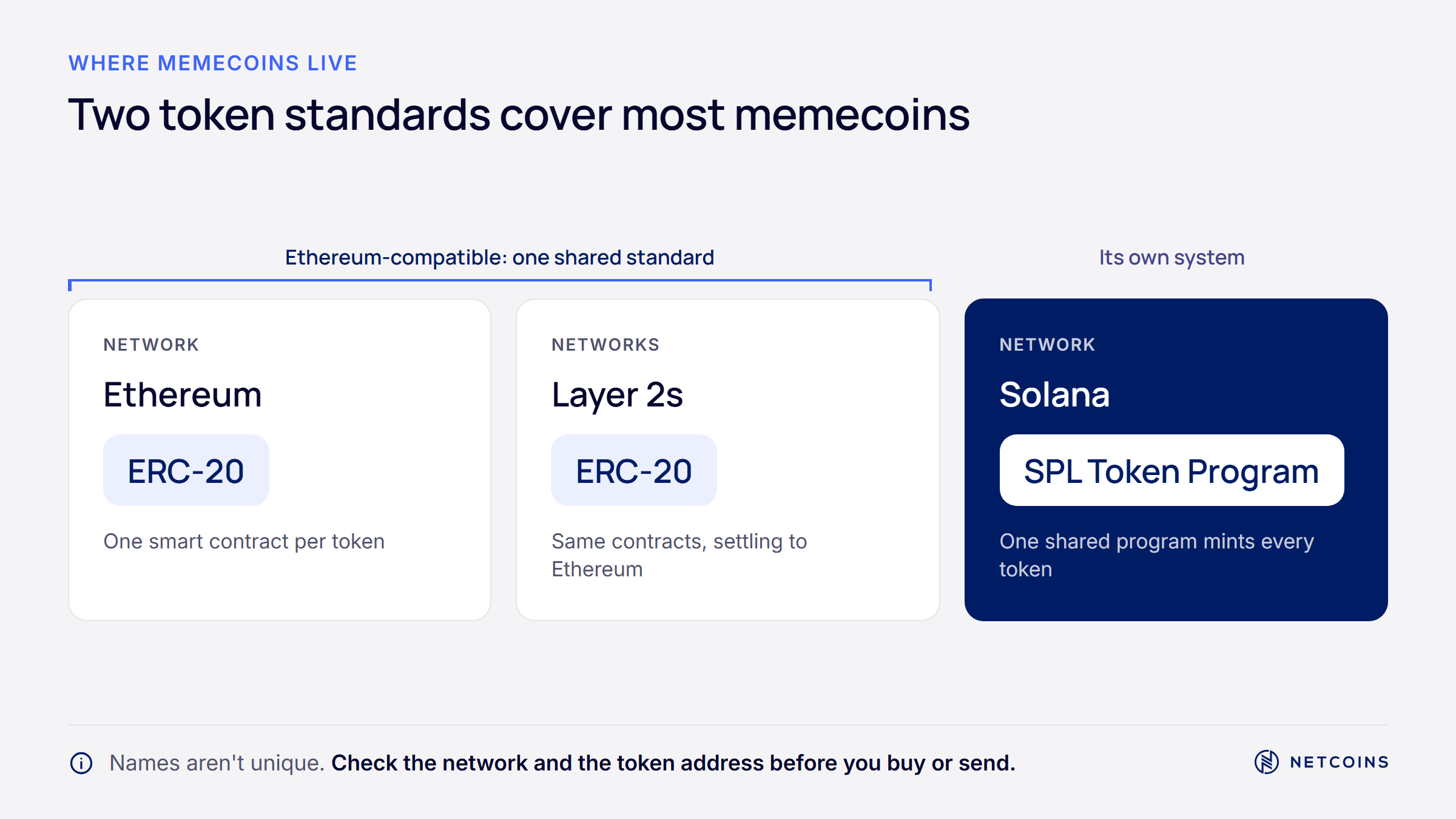
The blockchain a memecoin is built on decides its token standard, its transaction fees, and which wallets and apps can use it. Most memecoins are built on Ethereum, Layer 2 networks built on top of Ethereum, or Solana. Each network has trade-offs in cost, speed, and risk, and none of them makes a token safer to buy.
On Ethereum, fungible tokens follow the ERC-20 standard, which lets them work with a wide range of wallets and apps. Every action on Ethereum costs a fee called gas, paid in ETH. Gas fees change with network demand, so the same action can cost very little on a quiet day and much more during busy periods.
Layer 2 networks process transactions separately and then post data back to Ethereum. They are compatible with Ethereum tools, so ERC-20 tokens can usually run on them, often with lower fees. Layer 2 networks also add their own risks, including bridge, operator, and smart-contract risk, so lower fees do not mean lower overall risk for users.
Solana takes a different approach. It uses its own token program, called the SPL Token Program, and is designed for high speed and low fees. According to Solana's documentation, each transaction pays a small base fee per signature, with an optional priority fee on top [Source]. Our beginner's guide to Solana explains how the network works in more detail.
Low fees have a side effect. When creating a token costs very little, far more tokens get created, and many are abandoned or made with bad intent. This is one reason Solana has become a centre of memecoin activity. For buyers, cheap creation means more noise, more copycats, and more scams to sort through.
For context, ETH and SOL are commonly bought with Canadian dollars on crypto trading platforms. Using them with on-chain apps usually requires a self-custody wallet. With self-custody, you generally control the private keys and transactions, subject to the wallet, network, smart-contract and other technical characteristics involved. You are also responsible for keys, backups, and transaction mistakes, and a mistake on-chain usually cannot be reversed.
Tokenomics: Supply, Decimals, and Allocation
Tokenomics is the design of a token's supply, how that supply is divided, and any rules that change it over time. For a memecoin, the key settings are total supply, decimals, allocation, and whether new tokens can be created later. These settings are usually visible on-chain, so they are one of the first things worth checking.
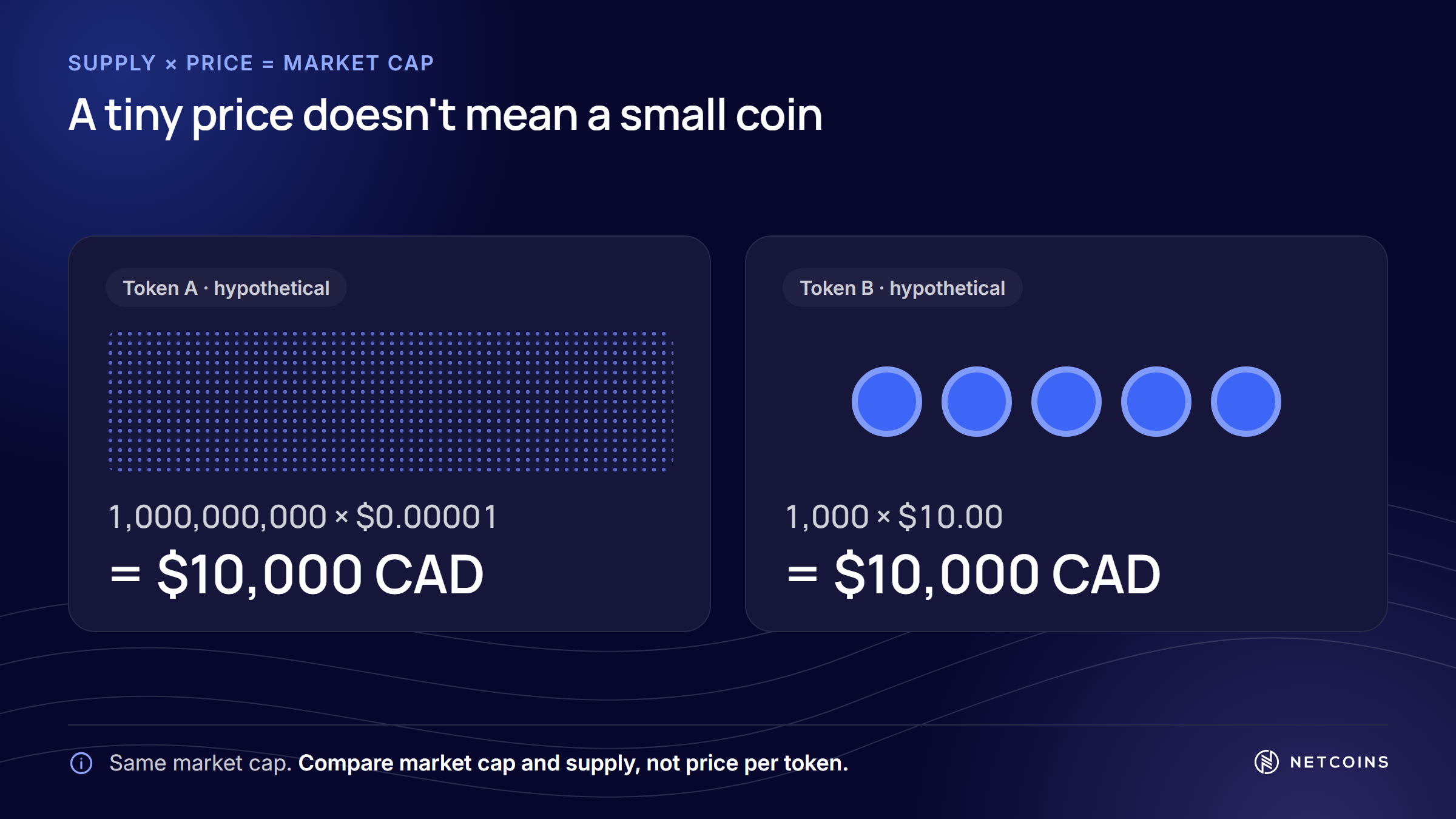
Total supply is the number of tokens created. Many memecoins use a very large round number, such as one billion. A large supply lets each token trade at a tiny price, which can make it look cheap. Price per token on its own says nothing about value. What matters is market capitalization, which is the price per token multiplied by the total number of tokens in circulation.
Here is a simple Canadian example. A token priced at $0.00001 CAD with a supply of one billion has a market capitalization of $10,000 CAD. A different token priced at $10 CAD with a supply of 1,000 has the same market capitalization. The first one is not "cheaper" in any meaningful way. It just divides the same total value into many more pieces.
Decimals control how finely a token can be divided. Blockchains store balances as whole numbers, so a decimals setting tells wallets where to place the decimal point. OpenZeppelin, a widely used library of smart contract templates, uses 18 decimals by default for ERC-20 tokens, mirroring how ETH is divided [Source]. On Solana, the number of decimals is stored in each token's mint account [Source].
Allocation describes who receives the supply at launch. Some creators put most or all of the supply into a liquidity pool for public trading. Others keep a share for the team, a treasury, or early backers. Team tokens are sometimes placed in vesting contracts, which release them over time after an initial waiting period called a cliff. Vesting can reduce the risk of a sudden sale, but it does not remove it.
Some contracts include extra rules. A mint function lets a designated account create new tokens after launch, which can dilute existing holders. A transfer tax takes a percentage of each transaction and sends it to another wallet. These features are not always harmful, but they give the creator ongoing power over the token. When a creator keeps that power, buyers are relying on the creator's future behaviour.
Tokenomics is also where marketing and reality can split. A project may describe itself as "fair" or "community-owned" while a few wallets hold most of the supply. Reading the allocation on a public block explorer, rather than trusting a website or social post, gives a clearer picture of who can move the market.
Smart Contracts: How ERC-20 and SPL Tokens Work
A memecoin is usually built from a standard token template rather than written from scratch. On Ethereum and compatible networks, that template follows ERC-20. On Solana, tokens are created through the shared SPL Token Program. Knowing how each works explains which permissions a creator keeps and which ones buyers should check.
ERC-20 was proposed in November 2015 by Fabian Vogelsteller as a standard interface for fungible tokens on Ethereum [Source]. It defines basic functions such as transferring tokens, checking balances, reading total supply, and approving another address to spend tokens on your behalf. Because every ERC-20 token shares these functions, wallets and apps can support new tokens without custom work.
Standard templates, such as those published by OpenZeppelin, are widely used for ERC-20 tokens and can include optional features that change what the token's controller can do [Source]:
- Burnable: lets holders permanently destroy their own tokens. Burning reduces supply, but it does not by itself support or raise a token's price.
- Capped: sets a maximum total supply that minting cannot exceed.
- Pausable: lets an administrator stop all transfers. This can help in an emergency, but it also gives one party the power to freeze trading.
Many developers publish their contract's source code on a block explorer so anyone can read it. A contract that is not verified this way is much harder to review, and many analysts treat it as a warning sign. Anyone in Toronto, Calgary, or anywhere else can look up a token's contract address on a public explorer and see whether its code is published.
Solana works differently. Instead of a separate contract for each token, one shared Token Program manages all tokens. Each token is identified by a mint account, which stores its supply, decimals, mint authority, and freeze authority [Source]. Mint authority is the account allowed to create more tokens. If no mint authority is set, the supply is fixed and no more tokens can be minted.
Freeze authority is the account allowed to freeze individual token accounts so they cannot send or receive the token. Solana's documentation states that if a mint's freeze authority is revoked, accounts for that token can no longer be frozen [Source]. A token that still has freeze authority lets one party stop specific holders from selling.
Revoking these permissions removes specific risks, but it does not make a token safe. A token with a fixed supply and no freeze authority can still fall to zero if large holders sell or interest fades. Permissions tell you what the creator can still change. They say nothing about whether anyone will want to hold the token tomorrow.
Liquidity Pools, AMMs, and Bonding Curve Launchpads
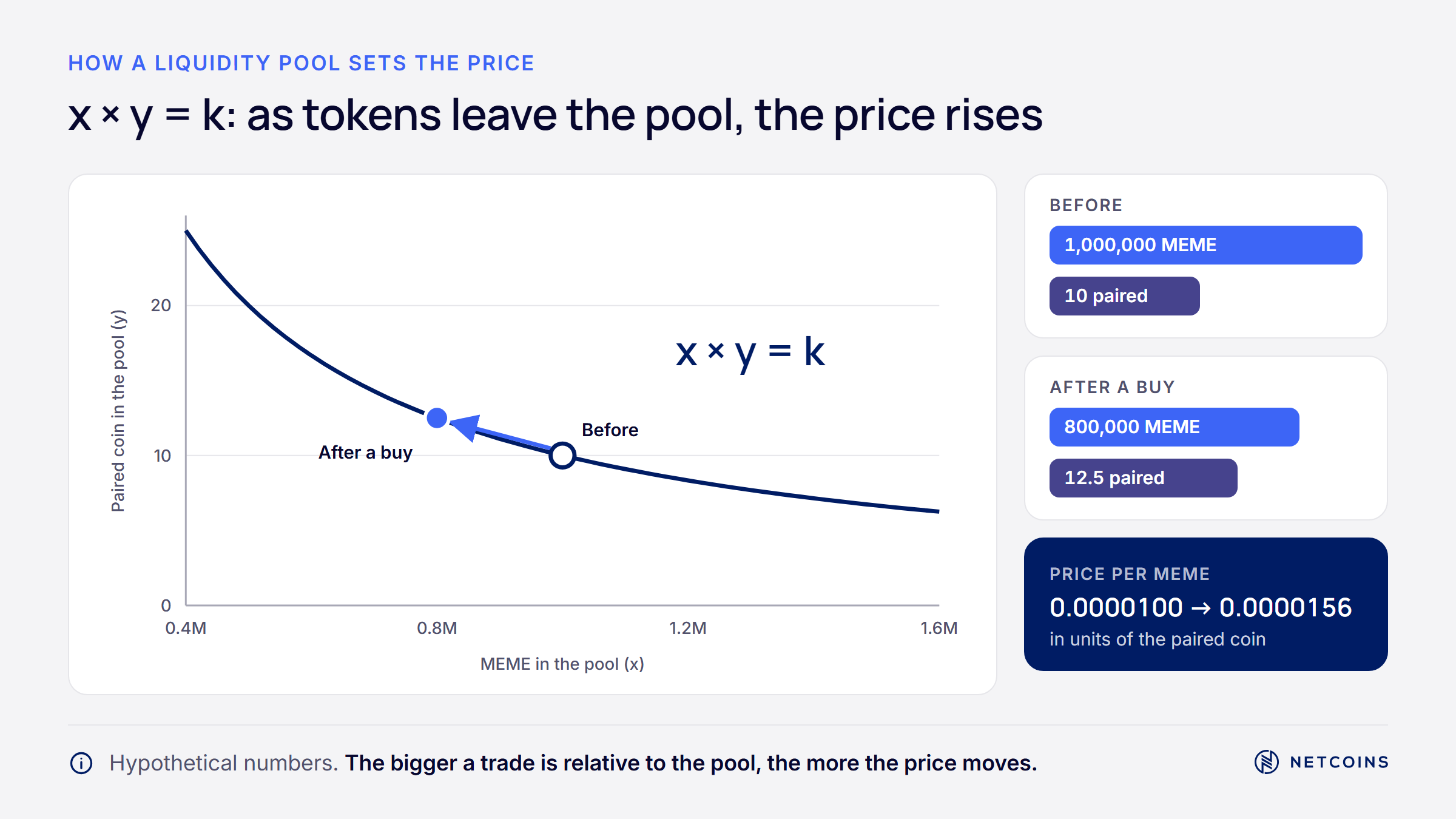
A newly created token cannot trade until someone provides a market for it. For most memecoins, that market is a liquidity pool on a decentralized exchange, or a bonding curve on a launchpad. Both use formulas instead of human market makers to set prices, which is why prices can move sharply on small trades.
Traditional markets match buyers and sellers through an order book. Many decentralized exchanges use an automated market maker (AMM) instead. An AMM holds two assets in a pool and lets anyone trade against it. Our beginner's guide to decentralized finance (DeFi) explains how these protocols work without a central operator.
Uniswap's documentation describes the most common AMM formula as x × y = k, where x and y are the two reserve balances and k must stay constant through each trade [Source]. The same documentation notes that larger trades, relative to the pool's size, get worse prices than smaller ones, and that version 2 of the protocol applies a 0.30% fee to trades.
Here is a simplified, hypothetical example. Suppose a pool holds 1,000,000 tokens alongside ETH worth about $2,000 CAD. The price works out to roughly $0.002 CAD per token. When someone buys tokens with ETH, the pool holds more ETH and fewer tokens, so the price rises. When someone sells, the opposite happens. In a small pool like this, a single large sale can push the price down steeply.
Whoever adds liquidity to a pool receives liquidity provider (LP) tokens, which represent their share of the pool. Uniswap's documentation notes that LP tokens can be redeemed for the underlying assets at any time. If a token's creator keeps those LP tokens, they can withdraw the pool's assets and leave buyers with a token no one can easily sell.
Some creators lock LP tokens in a time-locked contract or send them to an address no one controls. Locking helps, but it is not a guarantee. Locks expire, some lock contracts have their own flaws, and a locked pool does not stop large holders from selling their tokens into it. A lock removes one exit for the creator, not every risk for the buyer.
Bonding curve launchpads work differently. The launchpad sells tokens directly from a formula that raises the price as more tokens are bought and lowers it as tokens are sold. If enough tokens are bought, the token "graduates" and its liquidity moves to a regular AMM pool. CoinGecko notes that only about 1% of tokens on the launchpad it studied graduate this way [Source].
For a buyer anywhere in Canada, the practical point is the same for both models. Price is set by a formula and by the size of the pool. Thin liquidity means small trades can cause large price swings, and it may be hard to sell at any reasonable price when interest drops.
Why Most Memecoins Fail: What the Data Shows
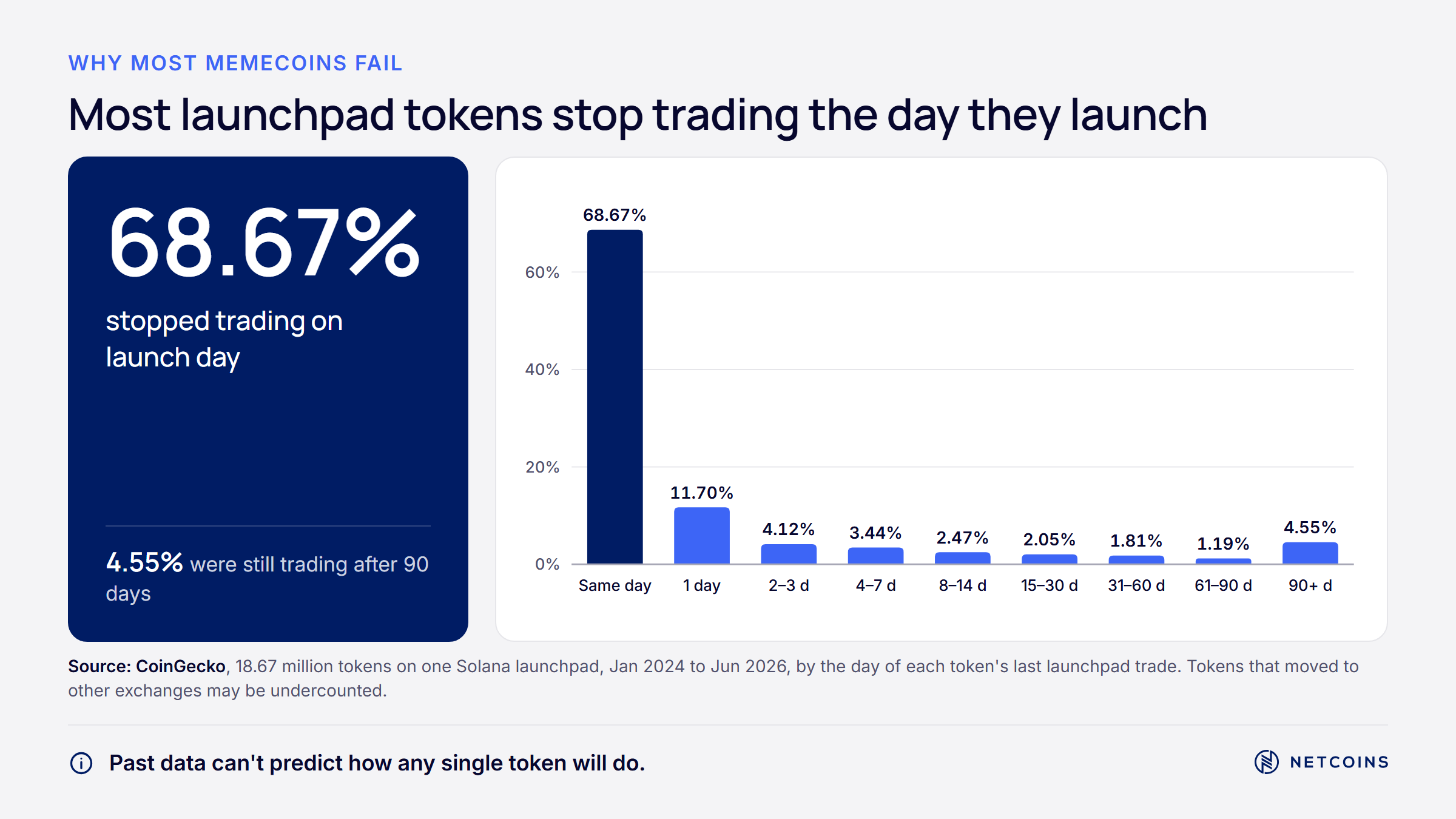
Most memecoins stop trading very quickly. The largest public dataset on this comes from CoinGecko's analysis of Pump.fun, a Solana launchpad. It found that 68.67% of the 18.67 million tokens it studied, launched between January 14, 2024 and June 18, 2026, recorded their last trade on the same day they were created [Source].
The drop-off continues after day one. In the same study, 80.37% of tokens had stopped trading by the end of their first full day, and only 4.55% were still trading after 90 days. CoinGecko notes that its data only tracks trades on the launchpad's bonding curve, so tokens that graduated to other exchanges may have lived longer than recorded. With a graduation rate near 1%, that caveat affects only a small share of tokens.
The pattern is not limited to one launchpad. A separate CoinGecko study found that 53.2% of all cryptocurrencies listed on GeckoTerminal had stopped trading, and that 11.6 million tokens failed in 2025 alone [Source]. CoinGecko links much of this to easy launchpad token creation and to turbulence in the memecoin sector.
Ownership is often highly concentrated too. Academic researchers who built the Memecoin Ecosystem Fragility Framework found that, in several established memecoins they studied, the top 100 addresses held roughly 73% to 90% of supply, and some politically themed tokens exceeded 98% [Source]. When a few wallets hold most of a token, one large sale can move the price sharply.
The same research describes memecoin prices as highly sensitive to attention and sentiment. That means prices can react strongly to social media activity that has nothing to do with any product or cash flow. It also means interest can disappear as fast as it arrived.
These figures describe what has happened historically. They do not predict what any individual token will do, and future market conditions may differ. What the data does show is that failure is the most common outcome for new memecoins, not the exception. For a Canadian who puts even $50 CAD into a brand-new token, the historical record suggests it is more likely to stop trading within a day than to last three months.
It is also worth noting what these numbers leave out. They count tokens, not people or dollars, so they do not show how much money was lost. They also do not separate honest projects that faded from deliberate scams. The next section looks at the scams.
Rug Pulls, Honeypots, and Other Red Flags
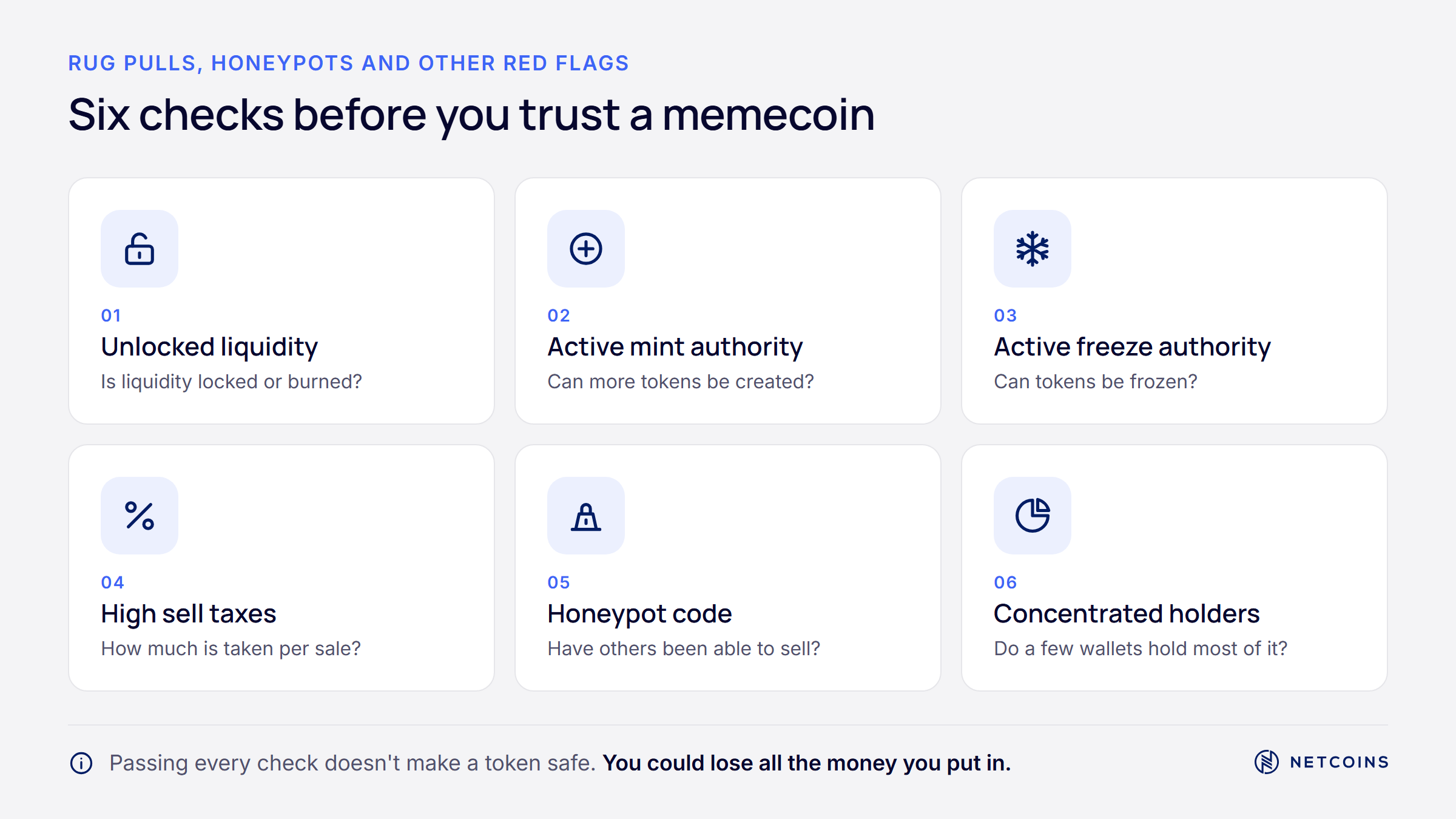
Beyond ordinary failure, some memecoins are built to take buyers' money. Common scam designs include rug pulls, honeypots, hidden minting, and upgradeable contracts that can be changed after launch. Knowing how each works makes the warning signs easier to spot, though no check can rule out every risk.
Fraud is a serious problem in Canada. In 2025, the Canadian Anti-Fraud Centre received over 112,000 fraud reports involving more than $704 million in reported losses, and investment fraud was the top category by dollar loss at $351 million [Source]. These figures cover all investment fraud, not only memecoins, but they show the scale of the risk.
Here are the most common memecoin scam patterns:
- Rug pull: the creator withdraws the pool's base assets using LP tokens they kept. Buyers are left holding tokens that cannot be sold at any meaningful price.
- Honeypot: the contract lets people buy but blocks or heavily taxes selling, for example with a hidden blacklist or a sell tax close to 100%.
- Hidden minting: the contract appears to have a fixed supply, but code lets the owner create new tokens and sell them into the pool.
- Upgradeable (proxy) contracts: a legitimate design that lets developers change a contract's logic. In the wrong hands, it can be used to swap in harmful code after launch.
Several checks can help you spot these patterns:
- Is the contract source code verified on a public block explorer?
- Can the supply still grow? Look for an active mint authority or mint function.
- Can holders be frozen? On Solana, check whether freeze authority is still active.
- Is liquidity locked, and until when? A lock that ends soon offers little protection.
- How concentrated is ownership? A few wallets holding most of the supply is a warning sign.
- Are sell taxes or transfer limits unusually high?
Automated contract scanners can flag some of these issues quickly. A clean result only means that common harmful patterns were not detected. It does not guarantee the token is safe, and it cannot detect coordinated selling or social engineering. For more on how scammers target Canadians, see our guide to common Bitcoin scams in Canada.
If you trade any crypto asset, check whether the platform you use is registered with the applicable Canadian securities regulators, and review its custody, fee, and risk disclosures. Registration does not mean a regulator has approved or endorsed a platform, and it does not make crypto lower risk. You can read how Netcoins approaches account protection on our safety and security page. If you believe you have been targeted by a scam, report it to your local police and to the Canadian Anti-Fraud Centre.
Creating or promoting a token can also raise legal and regulatory issues. This article does not cover them, and anyone considering creating or promoting a token should get independent legal advice.
People Also Ask About How to Create a Memecoin
Why are so many new memecoins created?
So many memecoins are created because launching a basic token takes little time and money, and widely available tools handle most of the technical work. CoinGecko reports that GeckoTerminal listed 428,383 crypto projects in 2021 and nearly 20.2 million by 2025, and links the jump to easy token creation on launchpads [Source]. Low creation cost is also part of why so many tokens are abandoned or used in scams. For buyers, more tokens means more noise to sort through, not more good options.
Are memecoins made with no-code tools safer?
No, a token made with a no-code tool is not automatically safer than one written by hand. These tools fill in a standard template, and the creator may not fully understand the permissions the template sets, such as mint or freeze authority. Buyers cannot assume any token is safe based on how it was built. Whether a token was built with code or a no-code tool, the same checks apply: a verified contract, a fixed supply, locked liquidity, and ownership that is not concentrated in a few wallets.
What is the difference between a memecoin and a utility token?
A utility token is designed to give access to a product or service, while a memecoin mainly relies on community attention. Utility tokens might be used to pay fees in an app, vote on changes to a protocol, or access a network's services. Memecoins usually have no built-in role beyond being traded. Both can use the same technical standards, such as ERC-20 or SPL. Because memecoin trading depends so heavily on attention and sentiment, prices can move sharply and interest can disappear quickly.
Why do most memecoins fail?
Most memecoins fail because they are cheap to create, easy to abandon, and depend on attention that fades quickly. CoinGecko found that 68.67% of tokens launched on one large Solana launchpad recorded their last trade on the day they were created, and only 4.55% traded beyond 90 days [Source]. Concentrated ownership adds to the risk, since a few large holders selling can crash the price. Some tokens are also built as scams from the start. These are historical patterns and do not predict how any single token will behave.
What is a rug pull in crypto?
A rug pull is a scam where a token's creator suddenly removes the pool's liquidity or dumps their holdings, leaving buyers unable to sell at a fair price. In a liquidity-based rug pull, the creator uses LP tokens they kept to withdraw the base assets from the pool. Without those assets, the token has almost no market. Other versions involve hidden minting or a large pre-held supply sold all at once. Locked liquidity, a fixed supply, and spread-out ownership reduce some rug pull risks, but none remove them entirely.
Frequently Asked Questions
How does an automated market maker set a token's price?
An automated market maker sets price from the ratio of two assets held in a liquidity pool. The most common formula, x × y = k, keeps the product of the two reserve balances constant through each trade. When someone buys the token, they add the base asset to the pool and remove tokens, so the token becomes scarcer in the pool and its price rises. Selling does the reverse. Because price depends on pool size, a small pool can see large price swings from a single trade, and large trades get worse prices than small ones.
What does it mean to revoke mint authority?
Revoking mint authority means permanently removing the ability to create new units of a token. On Solana, mint authority is stored in the token's mint account, and if no mint authority is set, the supply is fixed. On Ethereum-based tokens, a similar result comes from contracts with no owner-controlled mint function or a hard supply cap. Revoking mint authority removes one way the creator could dilute holders. It does not protect buyers from other risks, such as large holders selling, liquidity being withdrawn, or interest in the token fading.
Why do creators lock liquidity pool tokens?
Creators lock liquidity pool tokens to show they cannot withdraw the pool's assets for a set period. When someone adds liquidity to a decentralized exchange, they receive LP tokens that can be redeemed for the underlying assets. If a creator keeps those tokens unlocked, they can empty the pool at any time. A lock limits that risk, but only for as long as it lasts. Locks expire, lock contracts can have flaws, and a locked pool does not stop other large holders from selling their tokens into it.
Can a smart contract be changed after it is deployed?
A standard smart contract generally cannot be changed after deployment, but some contracts are built to be upgradeable. Upgradeable contracts often use a proxy design, where users interact with one address that points to separate logic code the developer can replace. This is a legitimate tool for fixing bugs. It also means the rules of a token can change after people have bought it. If a token uses an upgradeable design, it is worth checking who controls upgrades and whether any delay or oversight applies.
How is a bonding curve different from a liquidity pool?
A bonding curve sells tokens directly from a pricing formula, while a liquidity pool trades against assets that someone deposited. On a bonding curve launchpad, the price rises as buyers purchase tokens and falls as they sell. If enough tokens are bought, the token graduates and its liquidity moves into a regular pool on a decentralized exchange. Most tokens never reach that point, which is one reason bonding curve launchpads see so many tokens stop trading within a day.
What is a honeypot token?
A honeypot token is a scam token designed so people can buy it but cannot sell it. The contract may include a hidden blacklist that blocks sellers, a sell tax set close to 100%, or other rules that only apply when someone tries to sell. From the outside, the token may look active because purchases go through normally. Buyers often discover the problem only when they try to exit. Reviewing verified source code, checking for unusual sell taxes, and using automated scanners can help flag honeypots, though no check is complete.
Quick Glossary
- Smart contract: a program stored on a blockchain that runs automatically when its conditions are met.
- ERC-20: the standard interface for fungible tokens on Ethereum and compatible networks.
- SPL Token Program: the shared program that creates and manages tokens on Solana.
- Mint authority: the account allowed to create new units of a Solana token. If none is set, the supply is fixed.
- Freeze authority: the account allowed to freeze token accounts so they cannot send or receive a token.
- Liquidity pool: a smart contract holding two assets that people can trade against at formula-based prices.
- LP token: a token that represents a provider's share of a liquidity pool and can be redeemed for the underlying assets.
- Rug pull: a scam where a creator removes liquidity or dumps holdings, leaving buyers unable to sell at a fair price.
Key Takeaways
- A memecoin is usually a standard ERC-20 or SPL token. What sets it apart is attention and community, not technology.
- Memecoin creation typically involves a blockchain, a supply and permission design, a token contract, and a liquidity pool. Each of these choices affects risk for buyers.
- Revoked mint and freeze authority and locked liquidity remove specific risks, but none of them make a token safe.
- CoinGecko data shows 68.67% of tokens on one large Solana launchpad stopped trading on launch day. Historically, failure has been the most common outcome.
- Rug pulls, honeypots, and hidden minting are common. Check contracts, ownership, and liquidity, and report suspected scams to the Canadian Anti-Fraud Centre.
Understanding how memecoins are created makes it easier to see through hype and judge the real risks. The tools are widely available, but the outcomes are often harsh for buyers, and scams are widespread. To keep building your knowledge, learn how decentralized exchanges and liquidity pools fit into the wider DeFi ecosystem.

About Netcoins
Established in 2014 in Vancouver, British Columbia, Netcoins is a registered Restricted Dealer with the provincial securities commissions and a registered Money Services Business (MSB) with FINTRAC. Netcoins is owned by Surge Digital Inc. (formerly BIGG Digital Assets Inc.), a publicly traded company listed on the TSX Venture Exchange (TSXV: SRGE), and complies with applicable public company regulatory.
The information provided in the blog posts on this platform is for educational purposes only. It is not intended to be financial advice or a recommendation to buy, sell, or hold any cryptocurrency. Always do your own research and consult with a professional financial advisor before making any investment decisions. Cryptocurrency investments carry a high degree of risk, including the risk of total loss. The blog posts on this platform are not investment advice and do not guarantee any returns. Any action you take based on the information on our platform is strictly at your own risk. The content of our blog posts reflects the authors’ opinions based on their personal experiences and research. However, the rapidly changing and volatile nature of the cryptocurrency market means that the information and opinions presented may quickly become outdated or irrelevant. Always verify the current state of the market before making any decisions.