

.webp)
TL;DR The pre-funding problem forces banks to lock idle capital in foreign accounts to keep international transfers moving. Blockchain networks, stablecoins, and bridge assets such as XRP aim to replace that model with on-demand liquidity, settling value in seconds rather than days. For Canadian businesses and senders, that could mean faster and cheaper cross-border payments. When a Vancouver importer pays a supplier in Germany, or a worker in Toronto sends money home to Manila, the funds rarely travel in a straight line. They move through a decades-old network of banks that must hold cash in advance all over the world. That single design choice quietly adds cost and delay to nearly every international transfer. Here is how the system works, and how digital assets propose to change it.
What is the Pre-Funding Problem in Cross-Border Payments?
The pre-funding problem is a structural requirement in traditional finance where banks must place capital in foreign countries ahead of time so international transfers can clear.

When money moves across borders through the banking system, it rarely travels directly from the sender's bank to the receiver's bank. Instead, banks rely on a financial messaging network, most often SWIFT, the Society for Worldwide Interbank Financial Telecommunication. It is important to understand that SWIFT does not move money. It only sends secure payment instructions between institutions. The actual movement of value happens through a separate system called correspondent banking.
Because there is no single global currency and no shared central clearing system, banks build direct relationships with one another. If a Canadian bank wants to pay someone in euros, it needs access to euros. To get that access, the Canadian bank opens an account at a partner bank in Europe and deposits a large balance there in advance. That deposited balance is the pre-funding.
When a Canadian customer sends a wire to Europe, their bank debits the customer's Canadian dollar (CAD) account, updates its own records, and sends a SWIFT message to its European partner. The European bank then deducts the matching amount from the Canadian bank's pre-funded euro account and pays the final recipient. The message is fast. The settlement behind it is slow.
The scale here is enormous. The Financial Stability Board estimates that total cross-border payments reached roughly 200 trillion US dollars in 2024 [Source]. Supporting that volume means banks must forecast demand across dozens of currency corridors and keep money sitting idle in foreign accounts, just in case it is needed. New to crypto and want the basics first? Start with our guide to cryptocurrency for beginners.
How Nostro and Vostro Accounts Trap Global Liquidity
Nostro and vostro accounts are two views of the same account that banks use to track the pre-funded capital they hold for one another in foreign countries.
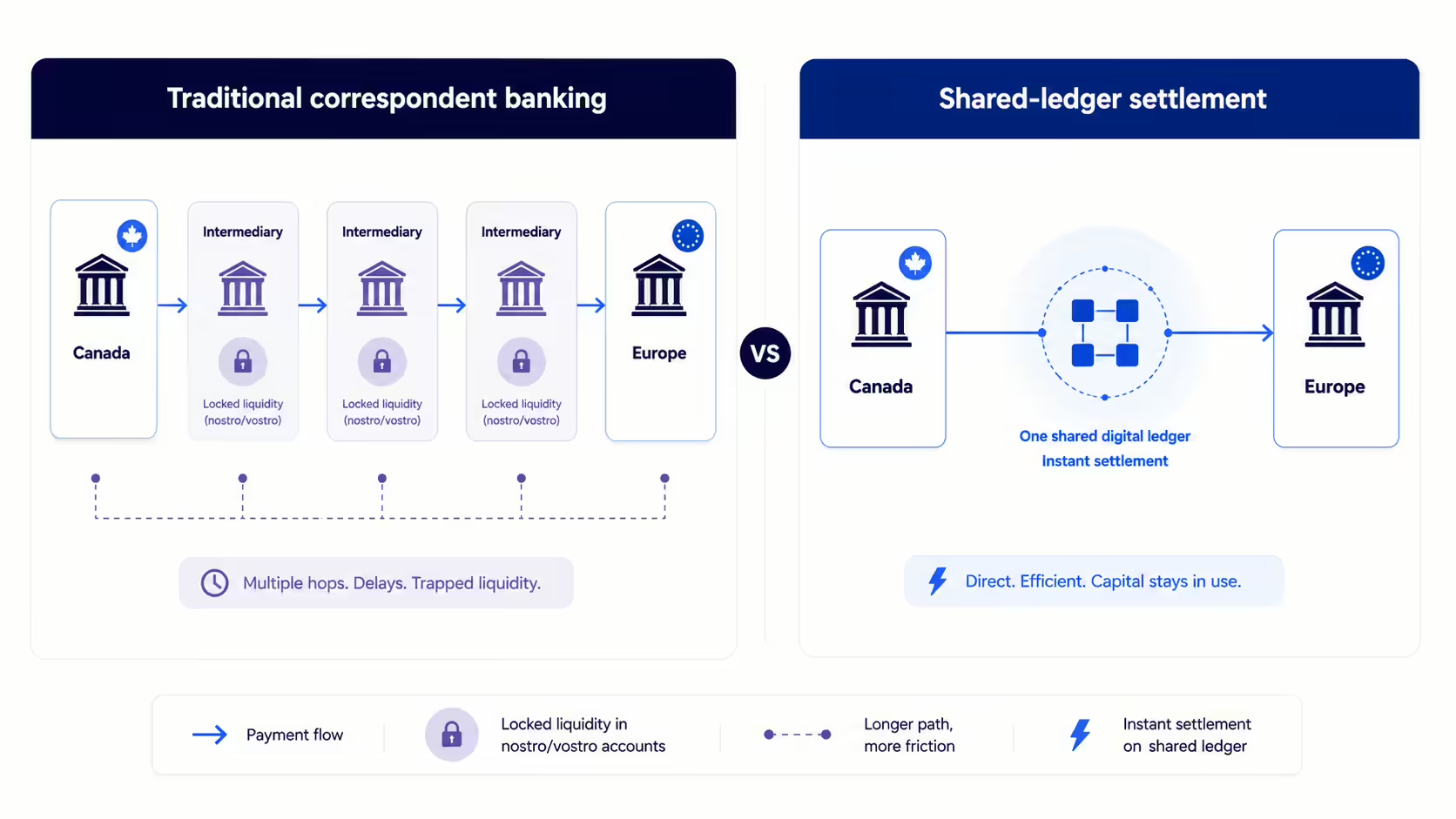
The words come from Latin. "Nostro" means "ours," and "vostro" means "yours." When a Canadian bank holds a balance of US dollars at a bank in New York, the Canadian bank calls that its nostro account, meaning our money at your bank. The American bank sees the exact same account as a vostro account, meaning your money at our bank. These paired accounts are the reservoirs that keep international trade flowing.
The core issue is that this model immobilizes capital. Industry estimates of how much sits idle vary widely, from hundreds of billions to, by some measures, trillions of dollars, but the direction is clear: a large pool of money is locked away rather than lent or invested. For a small or mid-sized institution, this is a heavy burden. It must hold reserves at home while also funding accounts overseas to keep payments running.
Nostro accounts also require constant reconciliation. Every bank runs its own private ledger, and those ledgers do not talk to each other in real time. After each transaction, each side updates its own records, and the two must be checked against one another to confirm they match. Time zones, banking holidays, and limited operating hours all slow this down, which is a big reason international wires commonly take one to five business days.
For the end user, the result is expensive. The Bank of England notes that a cross-border transfer can cost up to ten times more than a comparable domestic payment [Source]. Rising compliance and operational costs have also led some large banks to reduce the number of correspondent relationships they keep, a trend the industry calls de-risking. That leaves payments in some regions routing through longer, costlier chains of intermediaries.
The True Cost of the Pre-Funding Problem for Canadian Businesses
The pre-funding requirement hits Canadian businesses and individuals directly, through intermediary fees, wide currency spreads, slow settlement, and tied-up working capital.
When capital is trapped in nostro accounts, the cost of holding it does not disappear. Banks pass it along to customers. These friction costs affect everything from large corporate treasury transfers to a single family remittance, and they add up quickly across a year of international activity.
First, payments collect fees at every stop. If the sender's bank and the receiver's bank have no direct relationship, the instruction has to hop through a chain of correspondent banks until a shared connection is found. Each bank in that chain takes a cut, so the final amount that lands is hard to predict. For a business paying invoices in several countries, that unpredictability makes budgeting difficult.
Second, currency conversion adds a hidden markup. Because banks must hold balances in many currencies, they carry exchange-rate risk. To protect themselves, they widen the spread they apply to the mid-market rate, and that markup lands on the customer. A CAD to USD or CAD to EUR transfer often costs more than the headline "fee" suggests.
Third, slow settlement drains working capital. For an Ontario manufacturer paying for parts from Asia, a payment stuck in transit for four days is cash that cannot go toward inventory, payroll, or growth. Multiply that across many transfers a month and the delay becomes a real drag on the business.
For individuals, the cost is clearest in remittances. Sending money abroad still runs through the same heavy correspondent network built for large institutional transfers. The World Bank reports that the global average cost of sending a remittance was 6.36 percent in the third quarter of 2025, with banks the most expensive channel at nearly 15 percent, well above the United Nations target of 3 percent [Source]. Canadians funding an account often start with Interac e-Transfer, and many first learn the ropes through the basics of how to buy Bitcoin in Canada.
How Blockchain and Digital Assets May Reduce Pre-Funding Requirements
Blockchain-based settlement may reduce reliance on pre-funded correspondent accounts in certain payment models, by using a shared ledger where the payment record and the settlement can happen within the same network.
The key change is that distributed ledger technology can combine two steps that traditional finance keeps separate. In the SWIFT model, sending the instruction to move money is one action, and settling the money is a different, slower one. On a blockchain network, on-chain transfer and settlement can occur within the same network, although fiat funding, conversion, and payout may still rely on external providers and banking rails. If you want the fundamentals, see our explainer on what a blockchain is.
When a digital asset moves, the transaction is broadcast to a network of independent computers that validate it and record it on a shared, public ledger. Because everyone references that same ledger as a single record, this can reduce certain inter-institution reconciliation requirements for the on-chain portion of the transaction. Many blockchain networks are also designed so that a transfer reaches settlement finality quickly once it is confirmed, rather than sitting in the multi-day limbo common to correspondent banking.
Here is how the two settlement models compare:
- Settlement method: Traditional correspondent banking relies on pre-funded nostro and vostro accounts. Blockchain settlement uses a shared ledger where value can reach finality on the network once a transfer is confirmed.
- Speed: Correspondent transfers commonly take one to five business days. Blockchain transfers can settle in seconds or minutes, at any hour.
- Capital efficiency: The legacy model traps capital in foreign accounts. Digital settlement lets capital be used on a just-in-time basis.
- Reconciliation: Correspondent banking needs manual, multi-party reconciliation. A shared ledger gives every party one matching record.
- Main cost drivers: Traditional rails carry intermediary fees and wide currency spreads. Digital rails carry network fees and local conversion costs.
This shift changes how a firm manages liquidity. Instead of funding accounts in fifty countries, an institution can keep one pool of capital at home, convert to a digital asset when a payment is needed, send it across the network, and convert it into local currency for the recipient. Blockchain networks also run 24 hours a day, every day of the year, so payments no longer wait for banking cut-off times or weekends. It is worth noting the technology is still early: the Financial Stability Board estimates that stablecoin transfers made up less than 0.2 percent of cross-border payments in 2025 [Source]. You can also read how crypto payments and fiat on-ramps work in Canada.
Bridge Assets: XRP and On-Demand Liquidity
A bridge asset is a neutral currency used to connect two different fiat currencies in a cross-border payment, so neither side has to hold a pre-funded account in the other's country.
The problem bridge assets address is common. Trading Canadian dollars directly for a less common currency often means routing through the US dollar first, which adds another layer of conversion cost and delay. A bridge asset removes that middle step by acting as a shared medium of exchange between the two sides.
XRP is one asset used for this purpose. It runs on the XRP Ledger, which is designed to settle transactions in roughly three to five seconds at low network cost [Source]. Ripple, a financial technology company, uses XRP inside a product called On-Demand Liquidity, or ODL, to source liquidity at the moment a payment is made rather than in advance. It is important to note that network settlement speed and cost are not the same as the total end-to-end speed and cost of a payment. You can learn more about the asset on our how to buy XRP page.
The process generally works as follows, and it can reduce reliance on pre-funded nostro and vostro arrangements for the settlement leg:
- A sender starts a payment in their local currency, for example CAD.
- The provider uses that CAD to buy XRP on a domestic exchange.
- The XRP moves across the network to a partner exchange in the destination country.
- The XRP is sold there for the local currency, for example the Mexican peso or the euro.
- The local currency is paid out to the recipient over domestic rails.
Because settlement on the network is fast, the time the money spends exposed to price movement can be short. This model may reduce or eliminate the need for certain destination-currency pre-funded accounts, depending on the corridor and the providers involved, which can free capital that would otherwise sit idle. Whether an XRP-based payment is faster or less expensive on an end-to-end basis depends on liquidity in the relevant currency pair, exchange and provider fees, spreads, blockchain conditions, fiat on and off-ramp availability, and local payment rails. XRP is a volatile crypto asset, and its market value may change significantly during periods of market stress.
Stablecoins and Faster Settlement
Stablecoins may help address the pre-funding problem by turning fiat currency into a digital token on a blockchain, so institutions can move value on-chain at any hour with settlement that can be faster than traditional rails.

A stablecoin is a digital token designed to track the value of a traditional currency, most often the US dollar, and typically backed by reserves such as cash and short-term government treasury bills. The aim is to hold a steady value. It is important to be clear, though, that a stablecoin is not the same as fiat currency and its value is not guaranteed. Tokens can and sometimes do trade away from their intended peg.
Programmable blockchain platforms, most notably Ethereum, made it possible to create standardized tokens such as USD Coin (USDC). For a corporate treasury, a token that aims to stay close to a dollar can be easier to work with than a volatile asset. That convenience depends on the issuer staying solvent and fully backed, which introduces reserve and counterparty risk that cash in a bank account does not carry in the same way. To see how this compares with other major networks, read our beginner guide to Bitcoin versus Ethereum.
In a stablecoin transfer, a business can settle account to account. The sender funds a fiat account, a provider converts it into stablecoins, the tokens move across the blockchain to the receiving institution, and that institution redeems them for local currency. Because a stablecoin aims to track the currency it references, it can reduce exposure to price swings during transit, though redemption and liquidity risk remain if an issuer or market comes under stress.
It helps to be clear about the trade-offs. Stablecoins carry risks that a traditional deposit does not. These include the risk that reserves fall short (reserve risk), that a token cannot be redeemed at its intended value (redemption risk), that a market becomes hard to trade in (liquidity risk), that an issuer or provider fails (counterparty risk), and that the rules governing these assets change (regulatory risk). Value-referenced crypto assets can lose value.
This matters most for business-to-business payments. Some businesses and payment providers use stablecoins to shift from forecasting cash needs days ahead toward managing liquidity closer to real time, moving funds to a regional office late at night or on a weekend without waiting for banks to open. This can avoid some of the unpredictable intermediary fees of traditional wires, though it introduces different costs of its own, including exchange, blockchain network, custody, redemption, liquidity, and service-provider fees. For Canadians sending money abroad, the same idea applies to stablecoin remittances.
Security stays central to all of this. Whether the asset is volatile or a stablecoin, safe storage matters. Netcoins uses established custody providers such as Fireblocks and BitGo and holds crypto assets in cold storage. No storage method removes all risk, so it helps to understand how Canadian stablecoin custody works.
ISO 20022 and the Upgrade of Traditional Banking
The traditional banking system is adopting the ISO 20022 messaging standard to improve data quality and interoperability, though it does not remove the liquidity drain caused by pre-funding.
While digital assets build parallel rails, the banking industry is modernizing its own. A central part of that effort is the global move to ISO 20022, a shared standard for how payment messages are formatted. In Canada, Payments Canada has integrated this standard into the Lynx high-value payment system [Source].
Historically, cross-border payments have struggled because different countries used different message formats. An instruction leaving one country might lack a field the destination requires, so the payment gets flagged, delayed, or rejected. ISO 20022 introduces a richer, more structured format. It standardizes how remittance details, party identification, and payment purpose are communicated, which cuts down on manual fixes and repeated data entry.
That is a meaningful upgrade, but it has a clear limit. ISO 20022 is a messaging standard. It improves the quality of the conversation between banks. It does not change how the underlying money settles. Even with perfect, instant messaging, banks in the correspondent network still rely on pre-funded nostro and vostro accounts to actually move value.
In other words, better messages do not free the trapped capital. The funds are still sitting in foreign accounts. So while ISO 20022 is an important modernization of the banking sector's communication layer, solving the pre-funding problem itself requires a change in how settlement assets clear across borders, not just how instructions are written. This is why many observers see messaging upgrades and blockchain settlement as complementary rather than competing.
The Future of Global Payments and Capital Efficiency
The future of global payments points toward a mix of distributed ledgers, tokenized bank money, and regulated digital assets working together to make settlement faster and more capital-efficient.
Global financial bodies continue to study payment frictions, and much of the discussion centers on unified ledgers and tokenization. The shared goal is to close the gap between sending a payment message and settling the money behind it, which would make pre-funding far less necessary over time.
Several ideas are converging. Tokenized deposits, where commercial banks issue digital versions of customer deposits on a blockchain, could let traditional institutions use programmable money while staying inside the banking system. At the same time, central banks are exploring digital currencies. The Bank of Canada, for example, has researched the case for a digital Canadian dollar and the broader modernization of money and payments [Source].
No single winner is guaranteed. The dominant rail could end up being a regulated stablecoin, a bridge asset such as XRP, a tokenized deposit, or a central bank digital currency. It may well be several of these at once, chosen corridor by corridor based on cost and speed.
Whatever the mix, the direction of travel is the same: less capital sitting idle, and faster movement of money through the economy. Releasing funds that currently sit dormant in correspondent accounts would put more capital to productive use, lower the cost of international trade, and widen access to global payments for smaller businesses and individuals alike. For Canadians, that shift is worth understanding now, well before it becomes the default.
People Also Ask About the Pre-Funding Problem
Why do banks need nostro and vostro accounts? Banks use nostro and vostro accounts to make international transfers possible across different currencies and countries. Because there is no single global clearing system, a bank must keep its own money at a partner bank abroad so funds are physically available when a customer requests a cross-border payment. This web of paired accounts is the foundation of correspondent banking, and it is what makes pre-funding necessary in the first place.
How much money is trapped in correspondent banking? Estimates vary widely, from hundreds of billions to, by some measures, trillions of dollars, because different studies count different things. What is not in dispute is that a large amount of capital sits idle in foreign accounts as a liquidity buffer. That money cannot be lent or invested while it waits, which is why analysts describe it as a major opportunity cost for the financial system.
How does XRP help solve the pre-funding problem? XRP can act as a fast, liquid bridge between two currencies. Instead of holding a pre-funded account abroad, a provider converts local currency into XRP, sends it across the network in seconds, and converts it into the destination currency on arrival. This sources liquidity at the moment of payment rather than in advance, which is the core idea behind on-demand liquidity.
Are stablecoins faster than SWIFT for cross-border payments? Certain stablecoin transfers may achieve faster on-chain settlement than traditional rails, since they move value directly on a blockchain around the clock, although funding, redemption, and local payout can add time. SWIFT is a messaging network, not a settlement rail, and it still depends on pre-funded accounts behind the scenes. That said, SWIFT retains broad institutional reach, and stablecoins remain a very small share of total cross-border volume today.
What is on-demand liquidity (ODL)? On-demand liquidity is an approach that uses a digital asset to source the funds for a cross-border payment in real time. Rather than tying up money in pre-funded foreign accounts, an institution buys the liquidity it needs at the exact moment a transfer is requested. This improves capital efficiency and reduces the operational overhead of maintaining balances in many currencies.
Frequently Asked Questions
What does capital velocity mean in cross-border payments? Capital velocity is the speed at which money moves through the economy. In traditional cross-border payments, velocity is low because funds take days to settle and require large idle buffers. Faster settlement lets the same capital be used more than once in a short period, which raises its velocity and its usefulness.
How is ISO 20022 different from blockchain settlement? ISO 20022 is a standard for how payment messages are formatted between institutions. It improves clarity and reduces errors, but it does not move money on its own. Blockchain settlement can combine the message and the movement of value within one network, and may reduce certain reconciliation requirements for the on-chain portion of a transaction.
Why are remittances sent from Canada still expensive? Retail remittances are pushed through the same heavy infrastructure built for large institutional transfers. Funds may pass through several correspondent banks, each taking a fee, while the provider also covers currency risk and the cost of keeping pre-funded balances abroad. Those layered costs are why the global average remittance fee still sits above the international target.
Can Canadian businesses use stablecoins instead of wire transfers? Some businesses and payment providers use stablecoins for supplier payments and treasury management, mainly for their speed and the fact that a stablecoin aims to track a fiat currency. Settling account to account can avoid some of the unpredictable intermediary fees and multi-day delays of traditional wires, though it introduces other costs such as exchange, network, custody, and redemption fees. A stablecoin is not the same as fiat, its value is not guaranteed, and reserve, redemption, liquidity, counterparty, and regulatory risks apply.
What is atomic settlement? Atomic settlement means a transaction either completes fully or not at all, with no in-between state. On a blockchain, the sender's balance decreases at the same instant the receiver's balance increases. This removes the settlement gap that exists in correspondent banking, where the message and the actual movement of funds happen at different times.
What is the difference between a hot wallet and cold storage? A hot wallet is connected to the internet, which makes it convenient for frequent transactions but gives it a larger attack surface. Cold storage keeps the private keys entirely offline, for example on a hardware device, which offers stronger protection against online threats. Many platforms hold the bulk of assets in cold storage for security.
Quick Glossary
Bridge Asset: A digital asset used as an intermediary to connect two different or less-liquid fiat currencies during a transfer.
Capital Velocity: The rate at which money is exchanged or circulated in an economy over a set period of time.
Correspondent Banking: An arrangement where one bank provides services, such as payments or currency exchange, on behalf of another bank in a foreign country.
Atomic Settlement: A transfer that either completes in full or not at all, with the sender's and receiver's balances updating at the same instant.
ISO 20022: An international standard for how financial institutions format electronic payment messages, designed to create a common language.
Nostro Account: An account a bank holds at a foreign bank, in that foreign country's currency. From the holder's view, it is "our money at your bank."
On-Demand Liquidity: A model where the funds needed for a transaction are sourced in real time, removing the need for pre-funded accounts.
Stablecoin: A digital token designed to hold a steady value by tracking a reserve asset, most commonly a fiat currency such as the US dollar.
Key Takeaways
- The traditional payment system forces banks to keep large amounts of idle capital in foreign accounts so cross-border transfers can clear, a design known as the pre-funding problem.
- Nostro and vostro accounts create real friction, leading to slow settlement, wide currency spreads, and layered intermediary fees that reach the end user.
- Blockchain networks can combine the payment record and settlement within one network, which may reduce certain reconciliation requirements for the on-chain portion of a transaction.
- Bridge assets such as XRP and fiat-backed stablecoins enable on-demand liquidity, so institutions can source funds when a payment is made rather than holding them in advance.
- The banking system's upgrade to ISO 20022 improves messaging, but resolving the trapped-liquidity issue requires a change in how value actually settles.
Closing
Understanding the pre-funding problem makes it easier to see why so many institutions are exploring blockchain-based settlement. By reducing idle capital and shortening the correspondent banking chain, digital-asset settlement models may offer faster or more capital-efficient settlement in certain circumstances, while introducing different operational, market, custody, and regulatory risks. As the system evolves toward on-demand liquidity and tokenized settlement, a solid grasp of the fundamentals goes a long way. If you want to keep learning, see how crypto payments and fiat on-ramps work in Canada, or brush up with our step-by-step guide to buying Bitcoin in Canada.

About Netcoins
Established in 2014 in Vancouver, British Columbia, Netcoins is a registered Restricted Dealer with the provincial securities commissions and a registered Money Services Business (MSB) with FINTRAC. Netcoins is owned by Surge Digital Inc. (formerly BIGG Digital Assets Inc.), a publicly traded company listed on the TSX Venture Exchange (TSXV: SRGE), and complies with applicable public company regulatory.
The information provided in the blog posts on this platform is for educational purposes only. It is not intended to be financial advice or a recommendation to buy, sell, or hold any cryptocurrency. Always do your own research and consult with a professional financial advisor before making any investment decisions. Cryptocurrency investments carry a high degree of risk, including the risk of total loss. The blog posts on this platform are not investment advice and do not guarantee any returns. Any action you take based on the information on our platform is strictly at your own risk. The content of our blog posts reflects the authors’ opinions based on their personal experiences and research. However, the rapidly changing and volatile nature of the cryptocurrency market means that the information and opinions presented may quickly become outdated or irrelevant. Always verify the current state of the market before making any decisions.

.png)


