TL;DR
CAKE is the token behind PancakeSwap, a decentralized exchange that lets people trade crypto directly against liquidity pools rather than through a company that holds their funds. CAKE has a maximum supply of 400 million tokens and its supply is being reduced through ongoing token burns, though this does not guarantee any particular price outcome. Some Canadian crypto trading platforms offer CAKE directly in Canadian dollars; using PancakeSwap itself requires moving assets to a self-custody wallet, which shifts full responsibility for security to the user and introduces DeFi-specific risks.
Decentralized finance lets people trade and provide liquidity without a company holding their funds, and PancakeSwap is one of the largest platforms built this way. Understanding CAKE means understanding two separate things: the mechanics of an automated trading system with no order book, and the practical reality that moving funds off a Canadian crypto trading platform into a decentralized protocol changes who is responsible for custody, verification, and support. This guide covers both.
The History of PancakeSwap and CAKE
PancakeSwap launched in September 2020 as a low-cost alternative to trading on Ethereum, at a time when Ethereum network fees had become expensive for smaller trades.
The platform was built by an anonymous group of developers and deployed on what was then called Binance Smart Chain, now the BNB Smart Chain, which offered much lower transaction costs than Ethereum at the time. That cost advantage helped the platform grow quickly during a period commonly called "DeFi summer," and by early 2021 it had become one of the largest decentralized applications on that network by trading volume [Source].
The protocol has gone through several major upgrades since launch. Early versions used a standard automated market maker design. A later version introduced "concentrated liquidity," letting liquidity providers place their capital within a specific price range rather than spreading it across all possible prices, which can improve capital efficiency for some strategies while changing the risk profile for the person providing that liquidity. In 2024, the protocol introduced a modular, more flexible version of its trading infrastructure, later rebranded as PancakeSwap Infinity in 2025 [Source].
PancakeSwap has expanded from a single-chain platform to one supporting several blockchain networks beyond BNB Chain, including Ethereum and a number of Layer 2 networks. Exactly how many networks are supported changes as the platform grows, so current details are best confirmed directly through the project's own documentation rather than any fixed figure. Our explainer on what a blockchain is covers the underlying technology, and for the fundamentals of acquiring a digital asset in Canada in the first place, our complete guide to buying Bitcoin in Canada is a useful starting point.
How PancakeSwap's Automated Market Maker Works
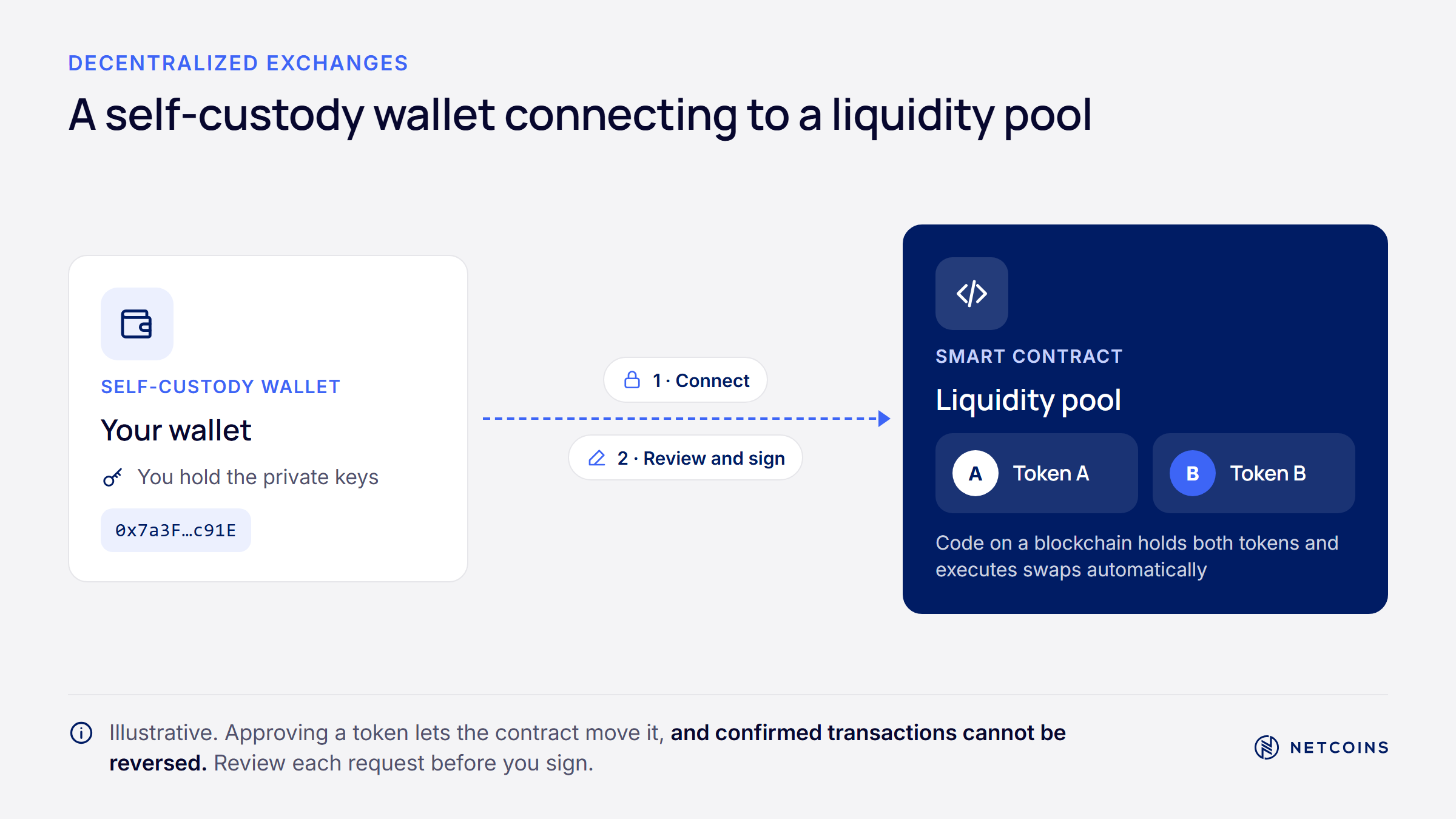
PancakeSwap uses an automated market maker model, meaning trades execute against a pool of pooled funds governed by a smart contract, rather than being matched against another person's order.
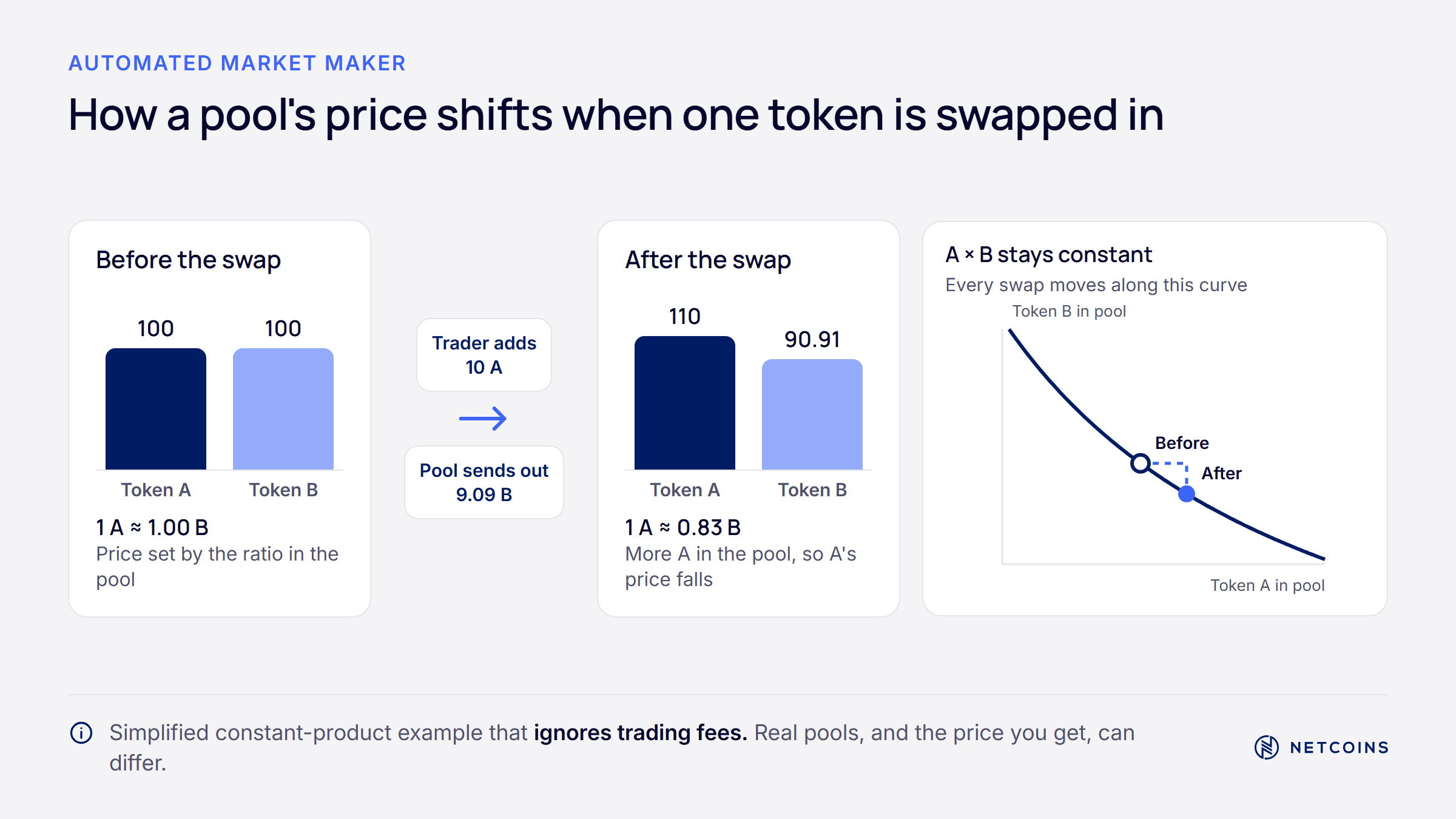
A traditional exchange matches a buy order against a sell order using an order book. PancakeSwap works differently. People called liquidity providers deposit pairs of tokens, such as CAKE and BNB, into a shared smart contract called a liquidity pool. When someone wants to trade one token for another, they transact directly against that pool rather than against another trader.
The price within a standard pool is set by a mathematical relationship between the quantities of each token in it: as one token is removed, its price rises relative to the other, and the reverse happens as it's added. This keeps a price available at any size of trade without needing someone on the other side at that exact moment. Traders pay a small fee on each swap, and a portion of that fee is distributed to the liquidity providers as compensation for supplying the pool, since providing liquidity carries its own risk, most notably a risk called impermanent loss, covered later in this guide [Source].
Because the whole process runs through smart contracts rather than a company holding funds, PancakeSwap does not custody user assets. A person connects a personal wallet directly to the protocol and retains their own private keys throughout. This is a structural difference from using a Canadian crypto trading platform, where the platform typically holds assets on a customer's behalf, and it means there is no company to contact if something goes wrong with a transaction.
CAKE Tokenomics: The Shift to a Deflationary Model
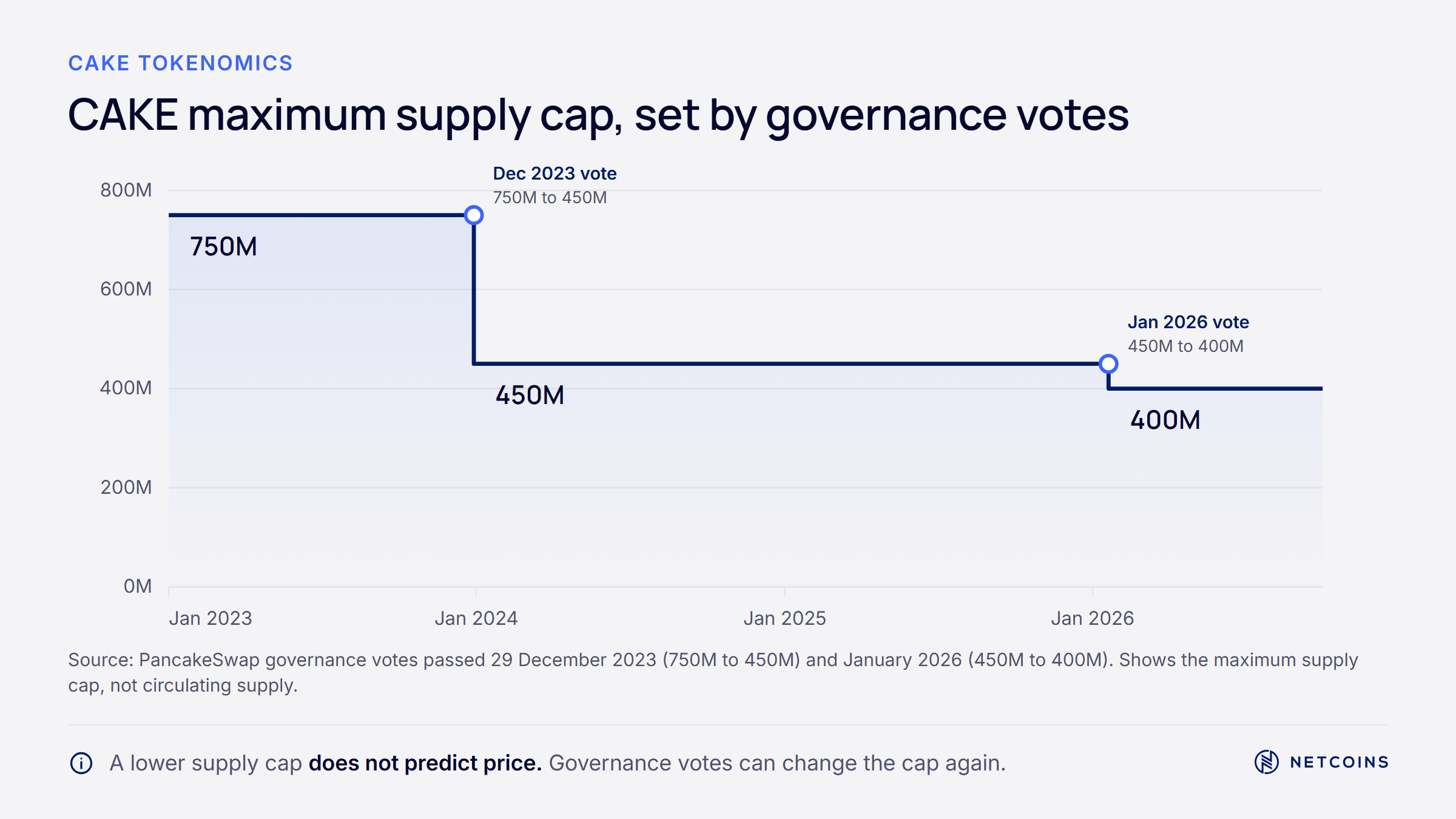
CAKE's supply structure has changed significantly since 2023, moving from an inflationary token used to attract liquidity toward a lower hard cap and a deflationary model.
In its early years, CAKE was issued in large quantities to reward people for providing liquidity and using the platform, a common approach new DeFi protocols use to attract users quickly. That approach increases supply over time, which can dilute the value of tokens already in circulation if demand does not keep pace.
CAKE's hard cap predates the protocol's most recent tokenomics overhaul. In December 2023, a governance vote lowered the maximum supply from 750 million to 450 million tokens [Source]. CAKE currently has a maximum supply of 400 million tokens, following a governance-approved reduction from 450 million in January 2026 [Source].
Separately, starting in April 2025, the protocol implemented what it calls Tokenomics 3.0, a set of changes aimed at reducing the rate of new supply and increasing the rate tokens are removed from circulation, according to the project's own documentation [Source]. The changes included retiring a complex staking and voting system, redirecting revenue that had gone to that system toward token burns instead, and reducing daily token emissions in stages [Source]. The project has stated a target of reducing total supply through ongoing burns, with a portion of platform trading fees used to buy CAKE on the open market and send it to a burn address, a wallet with no accessible private key, permanently removing those tokens from circulation.
Supply figures change regularly as burns and emissions take place, and governance can adjust parameters again. For current CAKE prices and market data in Canadian dollars, see our CAKE price and buying page, and check PancakeSwap's official documentation for the latest tokenomics.
It is important to be direct about what this framework does and does not do. A capped, shrinking supply is a mechanical property of the token. It does not create demand for CAKE, and demand, not supply reduction alone, is what determines price. An asset's supply can shrink while its price still falls if fewer people want to hold or use it. Token burns should be understood as a design choice with real mechanics behind it, not as a guarantee of future value.
The BNB Chain Infrastructure Behind PancakeSwap
Because CAKE runs primarily on the BNB Smart Chain, its transaction costs and speed depend on how that underlying network operates.
The BNB Smart Chain uses a consensus model called Proof of Staked Authority, which elects a fixed set of 45 validators each day based on how much BNB is staked to them, rather than relying on open computational mining or a much larger, broadly distributed validator pool [Source]. This smaller, coordinated validator set is what allows the network to produce blocks quickly and keep fees low, commonly a fraction of a cent per transaction [Source]. BSC currently has a block time of approximately 0.45 seconds, following the Fermi upgrade that activated on mainnet in January 2026 [Source]. Block times can change with future upgrades, so the BNB Chain documentation is the best place to confirm the current figure. That same design trade-off means network security is concentrated among fewer participants than on more broadly distributed blockchains, which is worth understanding rather than treating purely as a benefit.
The network also runs an ongoing burn mechanism of its own for BNB, the asset used to pay gas fees on the chain. A set percentage of gas fees collected in each block is automatically sent to a burn address, a mechanism called BEP-95, introduced in 2021 with an initial burn rate of 10 percent, adjustable through validator governance [Source]. Since PancakeSwap activity generates gas fees paid in BNB, higher usage of the platform indirectly contributes to this separate burn process, though this is a mechanical link rather than something that determines either asset's price.
opBNB and BNB Greenfield: The Wider Ecosystem
The BNB Chain ecosystem includes two additional networks relevant to understanding where PancakeSwap fits: opBNB for faster, cheaper transactions, and BNB Greenfield for decentralized storage.
opBNB is a Layer 2 network, meaning it processes transactions off the main BNB Smart Chain and later posts a summarized record back to it, which allows lower fees [Source] and faster block times than the main chain. At the time of writing, opBNB's block time is approximately 0.25 seconds, following a January 2026 upgrade, compared with approximately 0.45 seconds on BSC [Source]. These figures have changed several times through network upgrades, so check the BNB Chain documentation for current numbers. PancakeSwap has expanded onto opBNB, since very low fees suit high-frequency or small-value trades that would otherwise be impractical.
BNB Greenfield is a separate network built for decentralized data storage rather than trading. It distributes encrypted data across independent storage providers rather than a single centralized server, and links stored data to ownership records on the BNB Smart Chain through a token that functions as an access key [Source]. Greenfield is not directly part of how PancakeSwap functions today, but it is part of the same broader ecosystem and reflects how project infrastructure can expand well beyond a single initial use case.
What DeFi Actually Means for a Canadian User
Using a decentralized exchange like PancakeSwap means interacting directly with a smart contract rather than a registered company, and that distinction has real, practical consequences.
On a Canadian crypto trading platform, a company holds custody of assets on a customer's behalf, follows identity verification requirements, and provides a point of contact if a transaction goes wrong. On a decentralized exchange, none of that applies in the same way. Trades execute automatically according to code, there is no company holding your funds, and there is no customer service line to call if you send funds to the wrong address or interact with a fraudulent token contract, since blockchain transactions generally cannot be reversed. Using a platform does not remove risk either: custodial platforms carry their own operational, custody, and counterparty risks.
This distinction matters most in the practical mechanics of high fees on some networks during busy periods. Ethereum's mainnet has, at points of significant network congestion, seen fees rise well above typical levels, though current fees vary substantially depending on network conditions and are generally much lower than during the busiest historical periods. This is one reason platforms like PancakeSwap built on lower-fee networks such as the BNB Smart Chain gained early traction, since fees there are typically a small fraction of a cent [Source].
None of this makes decentralized exchanges inherently unsafe to research or understand. It does mean that anyone considering using one should recognize they are taking on a different set of responsibilities than they would using a custodial platform.
Funding a Digital Asset Purchase in Canada
PancakeSwap itself cannot receive Canadian dollars directly. Canadians can either buy CAKE on a Canadian crypto trading platform that offers it, or buy a base asset such as BNB with Canadian dollars and move it to a personal wallet to use PancakeSwap.
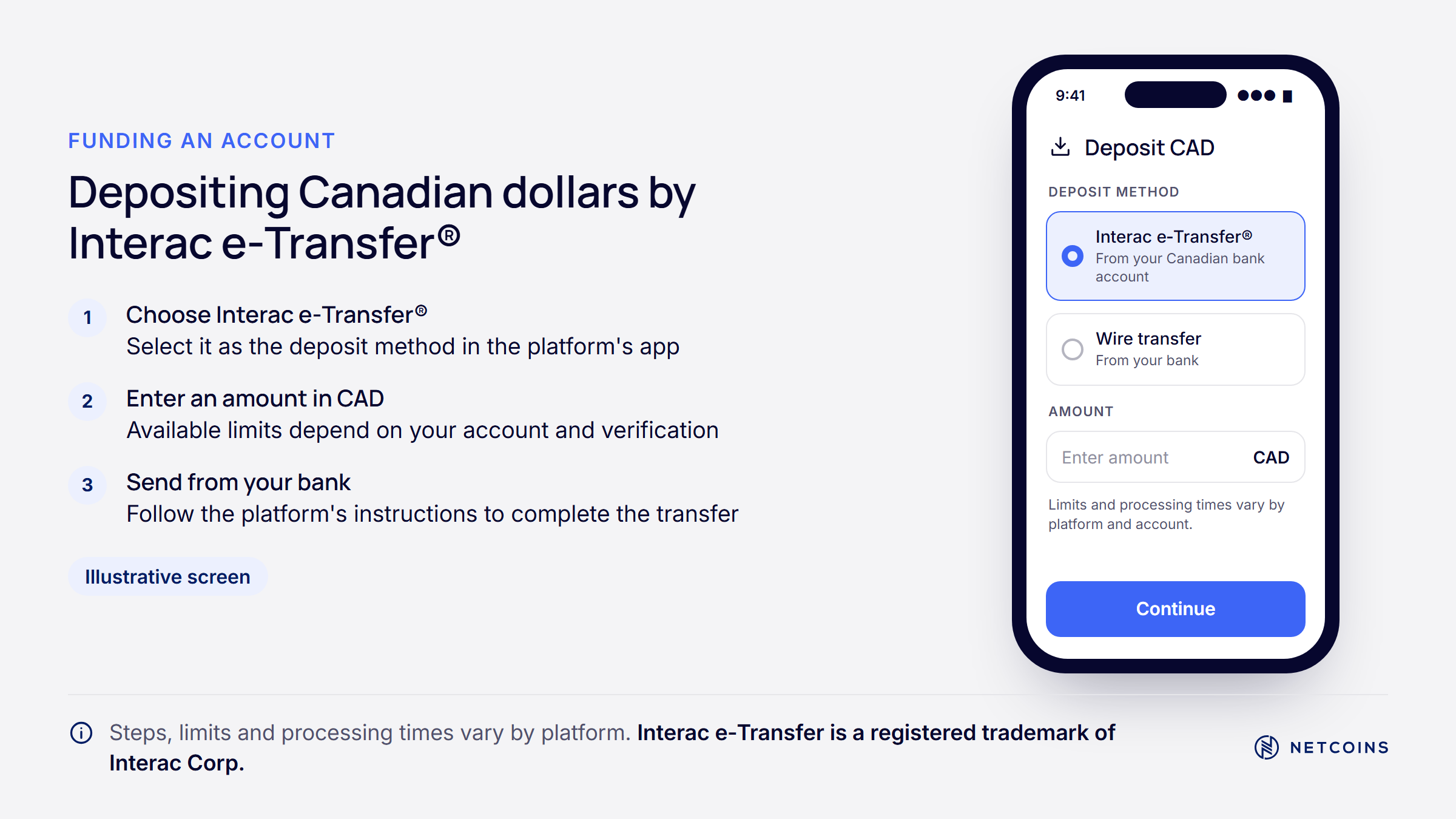
Before using any platform, check whether it is registered with the applicable Canadian securities regulators, and review its custody, fee, and risk disclosures. Common funding methods on Canadian platforms include Interac e-Transfer, which many Canadians are already familiar with, and wire transfers for larger amounts. Bank of Canada survey work found that roughly half of Canadians had used Interac e-Transfer [Source]. Processing times, limits, and fees vary by platform and by financial institution, and change over time, so confirming current details directly is more reliable than relying on a fixed figure.
Some Canadian financial institutions apply their own policies to transfers destined for crypto platforms specifically, and these policies differ between institutions and are subject to change without much notice. Rather than relying on a summary of any specific bank's current policy, which can become outdated quickly, checking directly with your own financial institution is the most reliable approach. Our guide to how Interac e-Transfer works for crypto in Canada covers the general mechanics, and our step-by-step guide to buying Bitcoin in Canada covers the broader process of acquiring a digital asset for the first time.
Once an asset is acquired, a decision remains between leaving it on the platform or moving it to a personal wallet to interact with something like PancakeSwap. Platforms use different custody arrangements, which may include third-party custody providers and keeping some keys offline in cold storage. These arrangements differ between platforms and change over time, and no custody model removes all risk. Moving assets to a personal wallet to use with a decentralized application shifts that responsibility entirely to the individual. Our overview of crypto custody in Canada covers this trade-off, and our guide to common Bitcoin scams in Canada covers scams that specifically target people moving funds into self-custody.
DeFi Risks Worth Understanding Before Using PancakeSwap
Beyond the general volatility of holding crypto, providing liquidity or trading on a decentralized exchange introduces risks that are specific to that activity and worth understanding on their own terms. These risks are not rare edge cases: Bank of Canada research on Bitcoin owners, whose experiences broadly reflect risks common across crypto activity, found that about half had experienced price crashes, loss of access to funds, scams, or data breaches [Source].
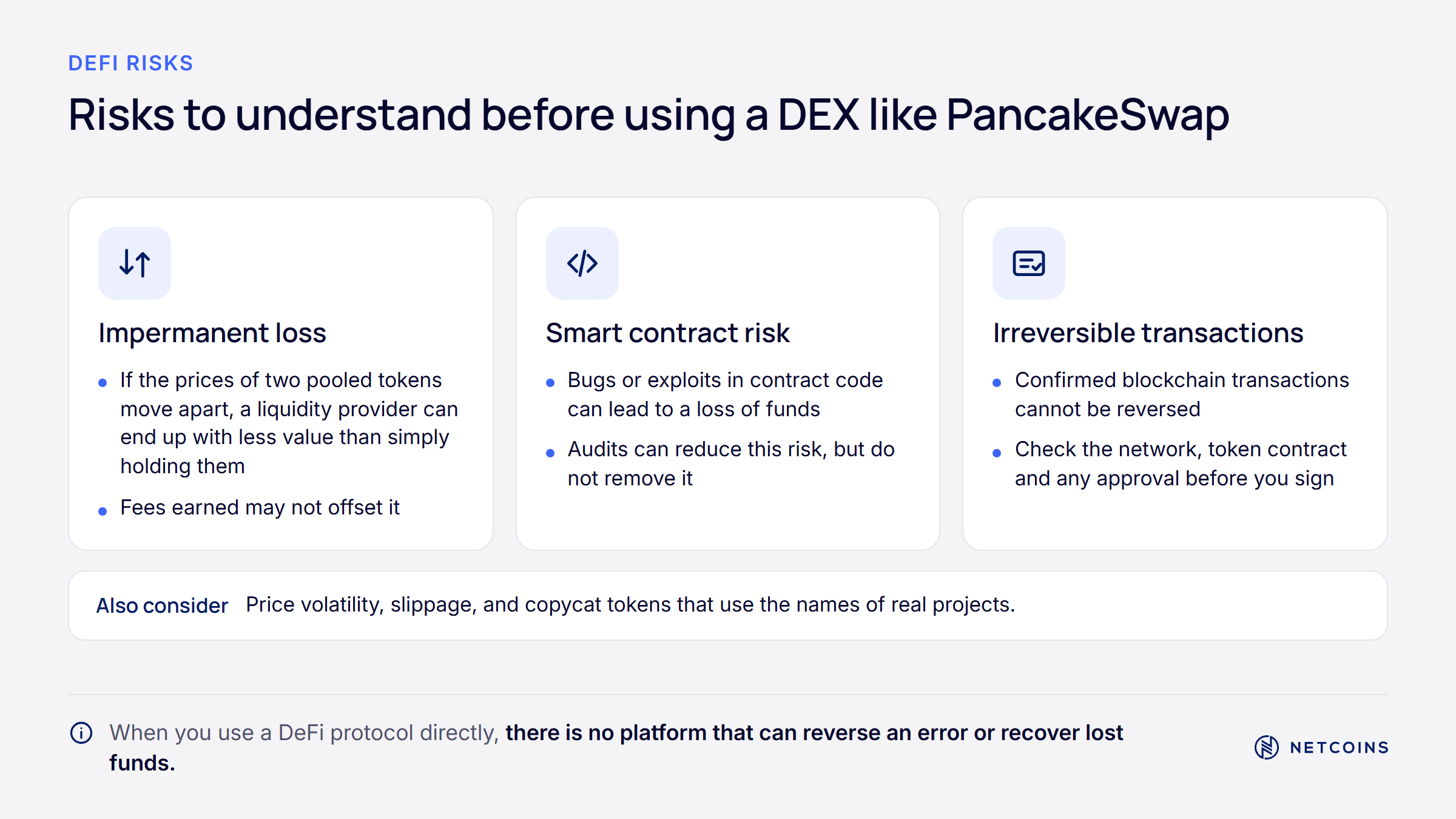
Impermanent loss is the risk most specific to liquidity provision. When the prices of the two tokens in a pool move differently from each other, the value of a liquidity provider's share can end up lower than if they had simply held the two tokens separately, even though they earned trading fees along the way. This is a real and well-documented risk, not an edge case, and it applies to a meaningful share of liquidity positions depending on how volatile the paired assets are relative to each other.
Smart contract risk applies broadly. PancakeSwap's contracts have undergone security audits from third-party firms, but audits reduce risk rather than eliminate it, and no audited protocol is guaranteed to be free of exploitable flaws. A vulnerability discovered after deployment, or in a newer feature not yet as thoroughly reviewed, can result in loss of funds with no company or insurance to make users whole.
Scam and fraudulent token risk is significant on any open, permissionless exchange. Because anyone can create a liquidity pool and list a token, decentralized exchanges are commonly used to launch fraudulent tokens designed to be bought but never sellable, or to disappear along with pooled funds shortly after launch, a pattern sometimes called a rug pull. Verifying a token's contract address against an official source before trading it is a meaningful precaution, though not a complete safeguard.
Irreversibility applies to every transaction. Sending funds to an incorrect address, connecting a wallet to a fraudulent site, or approving a malicious smart contract can all result in permanent loss with no recourse. None of these risks are unique to PancakeSwap specifically, but they are inherent to decentralized finance generally, and anyone moving funds off a custodial platform to explore this space should understand them clearly before doing so rather than after.
People Also Ask About CAKE Coin
What is the maximum supply of CAKE coin?
CAKE currently has a maximum supply of 400 million tokens, following a governance-approved reduction from 450 million in January 2026 [Source]. The cap had already been lowered once before, from 750 million to 450 million in December 2023. The project also reduces supply through ongoing token burns. Because governance can adjust these parameters again, check PancakeSwap's official documentation for the latest figures, or see our CAKE page for current market data in Canadian dollars. A capped supply does not by itself determine price, which depends on demand.
Is PancakeSwap a secure decentralized exchange?
PancakeSwap has undergone third-party security audits, which is a meaningful signal but not a guarantee against all risk. Decentralized exchanges place full responsibility for private key security, wallet safety, and careful transaction verification on the user, since there is no company holding funds or reversing transactions on a user's behalf. Security in this context means something different than it does for a custodial platform, and both carry risks worth understanding on their own terms.
Can someone buy CAKE directly with Canadian dollars?
Yes, on some Canadian crypto trading platforms that list CAKE, but not on PancakeSwap itself. Canadian banks cannot send funds directly to a decentralized protocol. A Canadian can either buy CAKE with Canadian dollars on a platform that offers it, or buy a base asset such as BNB, move it to a personal wallet, and swap it for CAKE on a decentralized exchange. Each route involves separate considerations around fees, custody, and security, and the second adds the risks specific to self-custody and DeFi.
Which blockchain networks does CAKE operate on?
CAKE originated on the BNB Smart Chain and has since expanded to additional networks, including Ethereum and various Layer 2 networks. The exact list and count of supported networks changes as the platform develops, so current details are best confirmed through PancakeSwap's own documentation rather than any fixed figure that may go out of date.
How does the CAKE burn mechanism work?
A portion of trading fees generated across PancakeSwap's products is used to buy CAKE on the open market, and those tokens are sent to a burn address with no accessible private key, permanently removing them from circulation. This is intended to reduce supply over time. It is a mechanical process tied to platform activity and trading fee revenue, and it does not by itself guarantee that CAKE's price will rise.
Frequently Asked Questions
What is the difference between a centralized and a decentralized exchange?
A centralized exchange is a company that holds custody of user funds, verifies identity, and matches trades using an internal order book. A decentralized exchange uses smart contracts to let people trade directly against pooled funds without a company holding assets on their behalf. The trade-off is that decentralized exchanges offer more autonomy but remove the customer support, account recovery, and custody services a centralized platform provides, while centralized platforms carry their own custody and counterparty risks.
Why do PancakeSwap trades require a network fee?
Every transaction on a blockchain requires validators to process and permanently record it, and network fees, commonly called gas, compensate them for that work. On the BNB Smart Chain, fees are typically a small fraction of a cent, which is one reason PancakeSwap became popular relative to platforms built on networks with historically higher fees. Fee levels vary by network and by how congested it is at the time of the transaction.
What is an automated market maker?
An automated market maker is the underlying system that lets decentralized exchanges set prices and execute trades without a traditional order book. It uses a mathematical relationship between the quantities of tokens held in a liquidity pool to determine price automatically as trades occur, rather than relying on individual buyers and sellers being matched directly.
Is CAKE compatible with hardware wallets?
CAKE follows the BEP-20 token standard used on the BNB Smart Chain, which is broadly supported by hardware wallets designed for that network. Using a hardware wallet keeps private keys on a dedicated offline device rather than an internet-connected one, which reduces certain risks, though it does not eliminate risks specific to interacting with smart contracts, such as approving a malicious contract or sending funds to an incorrect address.
What are PancakeSwap's Syrup Pools?
Syrup Pools are a feature that lets users lock CAKE into a smart contract to earn rewards, sometimes paid in additional CAKE and sometimes in tokens from other projects that partner with the platform. Like other yield-generating DeFi mechanisms, Syrup Pools carry smart contract risk and depend on the sustainability of the rewards being offered, which can change or be discontinued.
Quick Glossary
- Automated Market Maker (AMM): A system that prices assets and executes trades using a mathematical formula and pooled funds, rather than an order book matching buyers and sellers.
- Liquidity Pool: A smart contract holding paired tokens that traders swap against directly on a decentralized exchange.
- Impermanent Loss: A risk specific to liquidity providers, where the changing price ratio between two pooled tokens can leave a provider with less value than simply holding the tokens separately.
- Burn Address: A wallet address with no accessible private key, used to permanently remove tokens from circulation.
- BEP-20: The technical standard used to create tokens on the BNB Smart Chain, closely modeled on Ethereum's ERC-20 standard.
- Decentralized Exchange (DEX): A trading platform that uses smart contracts to let people trade directly with each other's pooled funds, without a company holding custody of assets.
- Rug Pull: A type of scam where the creators of a token or liquidity pool withdraw funds and abandon the project, often shortly after attracting deposits.
- Self-Custody: Holding your own private keys rather than relying on a platform to hold assets on your behalf, which shifts full responsibility for security to the individual.
Key Takeaways
- CAKE powers PancakeSwap, a decentralized exchange: it uses an automated market maker model, where trades execute against pooled funds rather than an order book, and the platform does not custody user assets.
- CAKE's supply cap has been cut twice: from 750 million to 450 million in December 2023, and to 400 million in January 2026, alongside ongoing burns. A shrinking supply does not guarantee price appreciation.
- The BNB Smart Chain's design trades some decentralization for speed: a fixed set of 45 validators enables fast, cheap transactions but concentrates network security among fewer participants.
- Using PancakeSwap means taking on DeFi-specific risks: impermanent loss, smart contract risk, and fraudulent token risk are real and specific to decentralized exchanges, not just general crypto volatility.
- There are two ways to get CAKE in Canada: buy it with Canadian dollars on a platform that lists it, or buy a base asset and move it into self-custody to use PancakeSwap directly, which adds DeFi-specific risks.
Closing
CAKE and PancakeSwap illustrate both what decentralized finance can offer and what it asks of the people who use it. The technology genuinely removes the need for a custodial intermediary in a trade, and its low fees and multi-network reach are real advantages of the underlying design. Those advantages come paired with responsibilities that a custodial platform normally handles on a customer's behalf, including security, verification, and support if something goes wrong. Understanding both sides clearly, rather than only the appealing parts, is the more useful starting point for anyone researching this space. For further background, see our overview of cryptocurrency for beginners or our explainer on decentralized finance.

About Netcoins
Established in 2014 in Vancouver, British Columbia, Netcoins is a registered Restricted Dealer with the provincial securities commissions and a registered Money Services Business (MSB) with FINTRAC. Netcoins is owned by Surge Digital Inc. (formerly BIGG Digital Assets Inc.), a publicly traded company listed on the TSX Venture Exchange (TSXV: SRGE), and complies with applicable public company regulatory.
The information provided in the blog posts on this platform is for educational purposes only. It is not intended to be financial advice or a recommendation to buy, sell, or hold any cryptocurrency. Always do your own research and consult with a professional financial advisor before making any investment decisions. Cryptocurrency investments carry a high degree of risk, including the risk of total loss. The blog posts on this platform are not investment advice and do not guarantee any returns. Any action you take based on the information on our platform is strictly at your own risk. The content of our blog posts reflects the authors’ opinions based on their personal experiences and research. However, the rapidly changing and volatile nature of the cryptocurrency market means that the information and opinions presented may quickly become outdated or irrelevant. Always verify the current state of the market before making any decisions.