

TL;DR
Crypto ownership is rising steadily in Canada, and more financial advisors now discuss digital assets with clients as a result. Before relying on anyone's guidance, verify their registration status, confirm whether they're bound by a fiduciary standard or only a suitability standard, and check their compensation model for potential conflicts of interest. Verifying credentials through CSA, CIRO, and FP Canada is the essential first step.
Navigating the digital asset ecosystem requires a comprehensive understanding of market volatility, platform security, and who's actually qualified to talk you through it. As cryptocurrencies move from niche technological experiments toward mainstream financial assets, more Canadians are running into advisors, self-styled experts, and outright scammers all using similar language. Knowing how to tell the difference starts with knowing exactly what to check.
What a Crypto-Literate Financial Advisor Actually Does
A crypto financial advisor is a credentialed professional who provides strategic guidance on integrating digital assets, such as Bitcoin and Ethereum, into a comprehensive, long-term wealth management plan.

In Canada, "financial advisor" is a broad title, but professionals who work with digital assets and holistic wealth integration typically hold advanced designations, most notably the Certified Financial Planner (CFP) or Chartered Investment Manager (CIM) credentials. [Source] These professionals don't recommend which specific coins to buy on a given day; rather, they look at an individual's entire financial picture, risk tolerance, time horizon, and long-term objectives to figure out how, if at all, digital assets fit into a diversified portfolio.
Historically, traditional Canadian financial institutions were hesitant to even discuss cryptocurrency with clients. Recent data from the Ontario Securities Commission (OSC) shows that's shifting: crypto asset ownership in Canada reached 25 percent by the end of 2025, and a growing share of investors working with an advisor say crypto has come up in that relationship. [Source]
A qualified advisor provides education on market mechanics, helps establish secure storage practices, and integrates digital assets with broader retirement and estate planning. The role is less about picking winning assets and more about building a financial approach that can withstand crypto's volatility.
Fee-Only vs. Commission-Based: Why Compensation Structure Matters
How an advisor gets paid directly shapes the incentives behind their recommendations, which is worth understanding before you weigh anything they tell you.
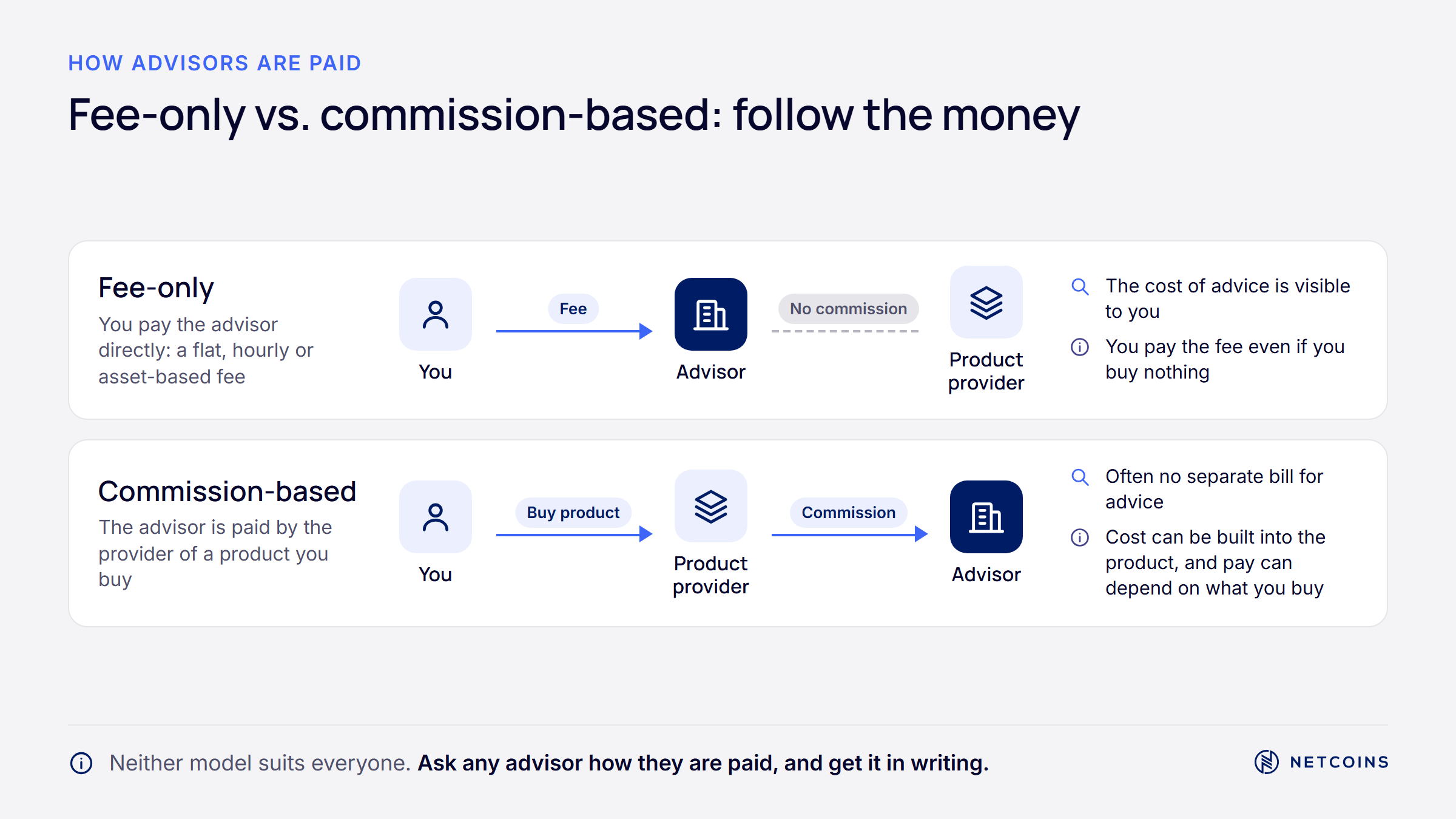
- Fee-Only (Advice-Only): Paid a flat project fee, hourly rate, or monthly retainer directly by the client. No product sales, no trailing commissions — the advisor's income doesn't depend on which assets you hold. [Source]
- Fee-Based (AUM): Paid a percentage of Assets Under Management, typically 1–2 percent annually. Common among portfolio managers; their income scales with the assets they can directly custody, which tends to be traditional holdings rather than self-custodied crypto.
- Commission-Based: Paid a percentage from the sale of mutual funds, insurance, or other institutional products. Income depends on selling specific products, which can create a structural incentive against recommending anything they don't sell — including crypto. [Source]
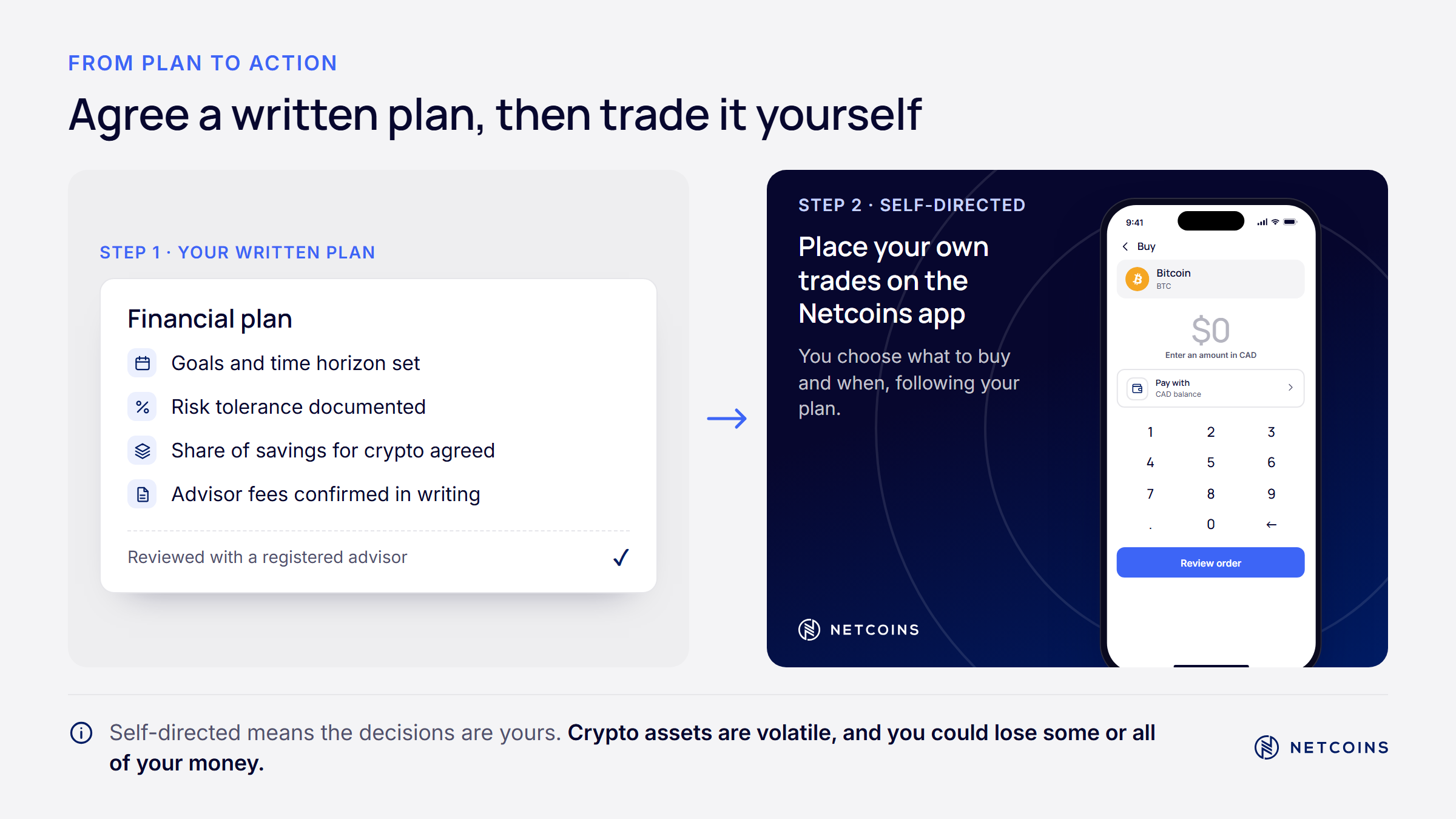
Because fee-only planners don't earn commissions, they have no financial incentive to push proprietary products or steer a client away from digital assets. They typically provide a written strategy and let the client execute the purchase independently on a registered platform. [Source]
Fiduciary Duty vs. the Suitability Standard
Fiduciary duty is a strict legal and ethical obligation requiring an advisor to act entirely in the client's best interest, placing the client's financial well-being above the advisor's own potential profit.
Many Canadians assume anyone with the title "financial advisor" is legally required to give the best possible advice. In reality, the industry runs on two different standards of care. [Source]
The suitability standard only requires that a recommended investment is generally appropriate for a client's broad risk profile, age, and stated goals. [Source] It doesn't require the product to be the most cost-effective option available — an advisor under this standard could legally recommend a high-fee product that pays them a commission, as long as it fits the client's general risk tolerance.
The fiduciary standard is the highest level of care in the industry. Advisors bound by it must actively seek the most efficient solution for the client, fully disclose conflicts of interest, and stay transparent about all compensation. In Canada, registered Portfolio Managers with discretionary trading authority operate under a common law fiduciary duty, and CFP holders are bound by the FP Canada Standards of Professional Responsibility, which includes a Duty of Loyalty requiring they place the client's interests first. [Source]
Knowing which standard your advisor operates under changes how much scrutiny their recommendations deserve.
How to Verify Registration and Credentials
Verifying a financial advisor means checking their legal registration status with provincial securities regulators and confirming their professional designations through accredited national bodies.
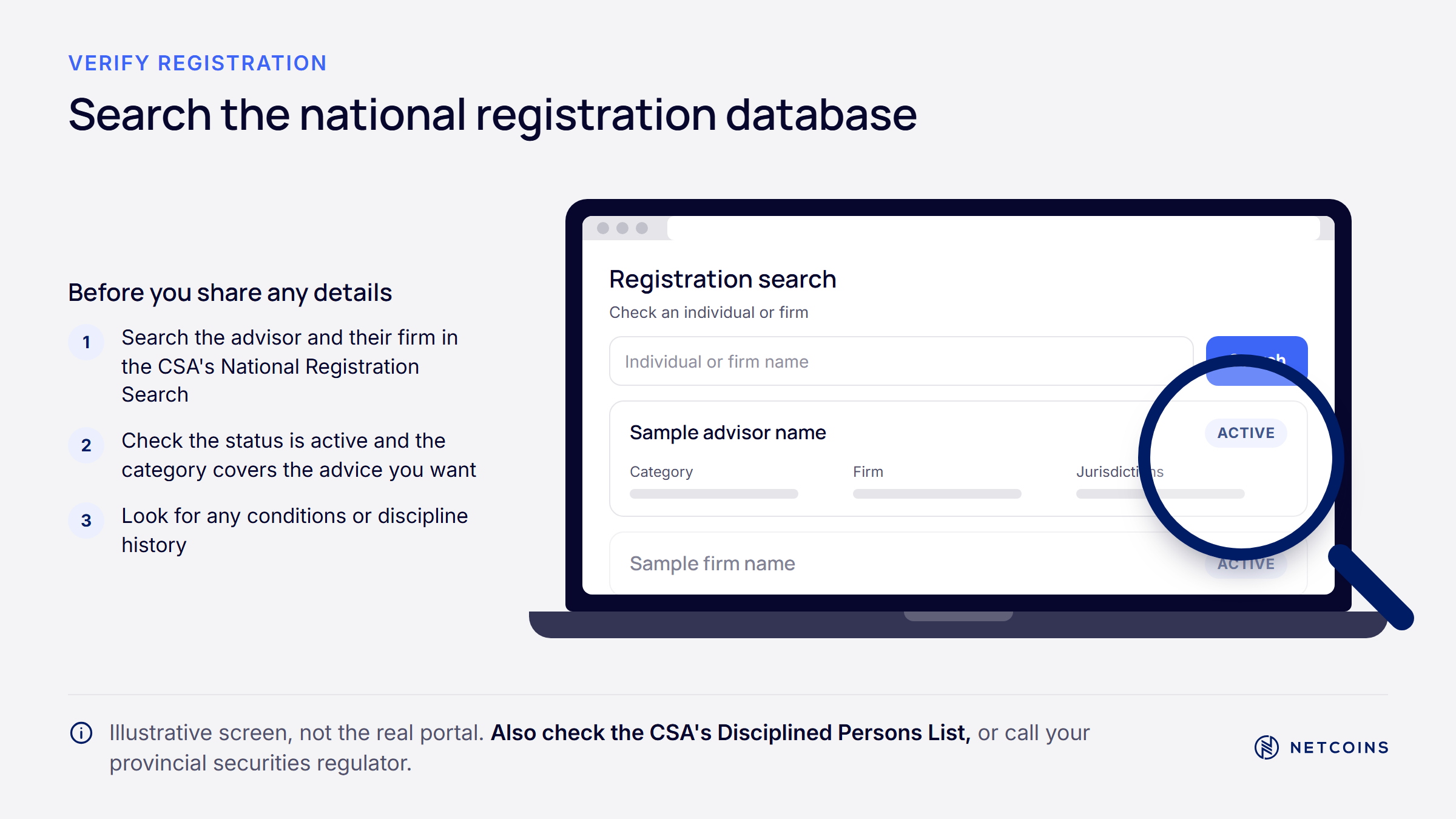
Canadian securities law requires individuals and firms selling securities or offering investment advice to be registered with the appropriate provincial or territorial regulator. [Source] This is the fundamental first line of defense for any investor.
To verify an advisor, use the Canadian Securities Administrators (CSA) National Registration Search. It confirms whether someone is legally permitted to operate in a specific province and shows any history of disciplinary action. [Source] The Canadian Investment Regulatory Organization (CIRO) offers a separate Advisor Report database that lets you check the background, education, and qualifications of advisors employed by CIRO-regulated firms. [Source]
Beyond legal registration, check the credential itself. The CFP designation is widely regarded as the standard for comprehensive financial planning in Canada; you can verify a planner's standing and disciplinary history directly through the official FP Canada website. [Source]
Red Flags: Finfluencers, Fraud, and Custody Requests
Significant red flags in the digital asset advising space include promises of guaranteed returns, high-pressure tactics to invest immediately, and any request for a professional to take personal custody of an investor's digital assets.
Legitimate advisors understand that cryptocurrency is a volatile asset class, so they won't promise risk-free profits or specific monthly returns. Anyone guaranteeing a fixed return is very likely running a fraudulent scheme. [Source]
Another critical red flag: a request for control over your private keys or direct custody of your funds. A foundational principle of digital asset security is that the owner keeps control of their own access credentials. A legitimate advisor will guide strategy and asset allocation, but will never ask a client to send cryptocurrency directly to their personal or corporate wallet. [Source]
Exercise extra caution with advice sourced purely from social media. OSC research on financial influencers ("finfluencers") found that people exposed to social media financial content were significantly more likely to purchase promoted, highly volatile assets — often to their financial detriment. [Source] Relying on unverifiable online personalities instead of credentialed, registered professionals carries real risk.
Questions to Ask Before Working With Any Advisor
A short set of direct questions can tell you more about an advisor than their website ever will:
- Are you currently registered with a provincial securities regulator or CIRO?
- Do you operate under a fiduciary standard or a suitability standard?
- How exactly are you compensated — fee-only, AUM, or commission-based?
- What's your professional experience and philosophy on digital assets and blockchain technology?
- Have you ever faced disciplinary action, and if so, what happened?
If an advisor is evasive about any of these, that's information in itself.
Executing Safely Once You've Vetted an Advisor
Security is the paramount concern once you're ready to execute a strategy independently. Reputable Canadian platforms use institutional-grade custody to protect client assets — Netcoins, for instance, secures client holdings through partnerships with Fireblocks and BitGo, using cold storage protocols to keep the majority of assets offline. [Source]
Understanding the mechanics behind an approach like Dollar-Cost Averaging (DCA) — buying a fixed dollar amount at regular intervals to smooth out short-term volatility — is worth doing regardless of whether an advisor suggested it. Netcoins' DCA guide walks through the mechanics and the psychology behind it.
It also helps to understand the basic differences between major assets before allocating anything. Comparing Bitcoin and Ethereum is a useful starting point — Bitcoin generally functions as a digital store of value, while Ethereum functions as a decentralized computing platform.
Funding an account should be simple and secure. Canadian platforms widely support Interac e-Transfer, which moves capital from a bank account to the exchange, typically clearing within minutes. [Source] For a full walkthrough of the purchase process itself, see how to buy Bitcoin in Canada.
People Also Ask About Verifying a Crypto Financial Advisor in Canada
Can a financial advisor buy crypto for clients in Canada? Generally, traditional financial advisors don't directly purchase or hold cryptocurrency on behalf of clients, due to complex regulatory and custody requirements. Fee-only planners typically provide strategic advice, while the investor executes trades themselves on a registered Canadian platform.
How much does a fee-only financial planner cost in Canada? A fee-only financial planner typically charges a flat project fee, an hourly rate, or a monthly retainer. Hourly rates often range from $150 to $400, while comprehensive, multi-stage plans can run from $1,500 to over $5,000 depending on complexity.
Are robo-advisors effective for digital asset investing? Robo-advisors offer a hands-off, automated approach with lower overall fees, but they generally lack personalized, holistic financial planning capabilities. Some offer broad exposure to digital asset ETFs, but they don't provide the tailored strategy a dedicated human advisor can.
What is the difference between a CFP and a general financial advisor? A Certified Financial Planner (CFP) holds a rigorously tested, internationally recognized designation and is bound by a strict code of ethics through FP Canada. "Financial advisor" is a much broader term that can include individuals who primarily sell commission-based products under the lower suitability standard.
Do major Canadian banks offer direct cryptocurrency advice? Most major Canadian banks remain conservative about cryptocurrency and don't typically offer bespoke advice on self-custodied digital assets. Investors seeking specialized guidance usually turn to independent, advice-only planners or specialized registered portfolio managers.
Frequently Asked Questions
What does fiduciary duty mean in the Canadian financial sector? Fiduciary duty is a strict legal and ethical obligation requiring a professional to act solely in the client's best interest — prioritizing their financial well-being, disclosing conflicts of interest, and staying transparent about fees and compensation.
How can an investor check if an advisor is officially registered? Use the National Registration Search tool provided by the Canadian Securities Administrators (CSA). CIRO also offers an Advisor Report database to check the credentials, education, and disciplinary history of advisors at CIRO-regulated firms.
Is it safe to use Interac e-Transfer to fund digital asset platforms? Interac e-Transfer is a widely used, bank-level payment rail for funding registered digital asset platforms in Canada. It clears funds quickly without requiring you to share banking login details with the receiving exchange.
What exactly is the suitability standard? The suitability standard is a baseline requirement that a financial professional only recommend products that align with a client's general risk tolerance, timeline, and goals. Unlike the fiduciary standard, it doesn't require the advisor to find the lowest-cost or most optimal product available.
What should I do if I suspect my advisor isn't properly registered? Cross-check their name against the CSA National Registration Search and CIRO's Advisor Report immediately. If they aren't listed, or their registration doesn't cover the advice they're giving, stop engaging and consider reporting them to the relevant provincial securities regulator.
Quick Glossary
Assets Under Management (AUM): A compensation model where an advisor charges an ongoing percentage fee based on the total value of investments they manage for a client.
Canadian Investment Regulatory Organization (CIRO): The national self-regulatory organization overseeing investment dealers, mutual fund dealers, and trading activity on Canada's debt and equity markets.
Certified Financial Planner (CFP): An internationally recognized professional designation requiring extensive financial education, a comprehensive exam, and adherence to strict ethical standards.
Cold Storage: A security method where digital assets are stored completely offline, reducing the risk of unauthorized access or cyber theft.
Fee-Only Planner: A financial professional compensated solely by direct client payments — hourly rates or flat project fees — with no trailing commissions from product sales.
Fiduciary Duty: The highest standard of care in financial law and ethics, requiring a professional to act entirely in the best interest of the person they represent.
Suitability Standard: A regulatory requirement that investment recommendations be generally appropriate for a client's risk profile, though not necessarily the most optimal or conflict-free choice available.
Key Takeaways
- Crypto ownership is rising in Canada, and more advisors now discuss digital assets with clients — verify before relying on anyone's guidance.
- Fiduciary duty legally requires an advisor to act in your best interest; the suitability standard doesn't go that far.
- Fee-only compensation removes the product-sale conflicts of interest built into commission-based models.
- Always verify registration through the CSA National Registration Search and check CIRO's Advisor Report before working with anyone.
- Red flags include guaranteed-return promises, pressure tactics, and any request to send crypto directly to an advisor's own wallet.
Closing
Knowing how to vet a financial advisor matters more in the digital asset space than almost anywhere else in finance, precisely because the terminology sounds authoritative even when the person using it isn't registered to give the advice. Checking registration through CSA and CIRO, understanding the difference between fiduciary and suitability standards, and watching for custody-related red flags puts the decision back in your hands. For a full walkthrough of executing a purchase safely once you've done that homework, see how to buy Bitcoin in Canada.

About Netcoins
Established in 2014 in Vancouver, British Columbia, Netcoins is a registered Restricted Dealer with the provincial securities commissions and a registered Money Services Business (MSB) with FINTRAC. Netcoins is owned by Surge Digital Inc. (formerly BIGG Digital Assets Inc.), a publicly traded company listed on the TSX Venture Exchange (TSXV: SRGE), and complies with applicable public company regulatory.
The information provided in the blog posts on this platform is for educational purposes only. It is not intended to be financial advice or a recommendation to buy, sell, or hold any cryptocurrency. Always do your own research and consult with a professional financial advisor before making any investment decisions. Cryptocurrency investments carry a high degree of risk, including the risk of total loss. The blog posts on this platform are not investment advice and do not guarantee any returns. Any action you take based on the information on our platform is strictly at your own risk. The content of our blog posts reflects the authors’ opinions based on their personal experiences and research. However, the rapidly changing and volatile nature of the cryptocurrency market means that the information and opinions presented may quickly become outdated or irrelevant. Always verify the current state of the market before making any decisions.
.png)


