

TL;DR
Crypto trading platforms protect client assets and accounts with layered controls, including offline cold storage, multi-signature approval, two-factor login, encryption, and monitoring. These controls reduce some risks but cannot remove them, and they do not protect you from price drops, scams you are tricked into, or platform failure. Your own habits, such as using 2FA and spotting phishing, matter as much as the platform's tools.
Whether you are in Vancouver, Winnipeg, or Halifax, the questions are the same when you hold crypto on a platform: who holds the keys, how accounts are protected, and what happens if something goes wrong. This guide explains the main security measures crypto trading platforms use, in plain language. It also covers the limits of those measures and the steps you can take yourself.
Why Is Security a Top Concern for Crypto Trading Platforms?
Security is a top concern because crypto is a large and frequent target for theft, and stolen crypto is often hard or impossible to recover. Crypto transactions generally cannot be reversed once they are confirmed on a blockchain, so a mistake or a theft can be permanent.
The numbers are large. More than $3.4 billion USD in crypto was stolen in 2025, according to Chainalysis data reported by The Block [Source]. A single breach at one large overseas crypto trading platform accounted for about $1.5 billion USD, or around 44% of that total [Source].
Individuals are targeted too. The same data counted 158,000 personal wallet compromises in 2025, involving at least 80,000 unique victims [Source]. Attackers went after private keys, passwords, and devices, not only large platforms.
In Canada, fraud is a broad problem that often involves crypto. The Canadian Anti-Fraud Centre received over 112,000 fraud reports in 2025, involving more than $704 million in reported losses [Source]. Investment fraud led reported dollar losses at $351 million [Source]. The CAFC also says only 5% to 10% of frauds are reported, so real losses are likely higher [Source].
That is why security has two sides. One side is what a platform does to protect the assets it holds and the accounts it runs. The other side is what you do to protect your login, your devices, and any wallet you control. Both are covered below. If you are new to buying crypto, our step-by-step guide to buying Bitcoin in Canada explains account setup and verification first.
Cold Storage and Hot Wallets: How Platforms Hold Crypto
Most crypto trading platforms split client crypto between hot wallets and cold storage. A hot wallet is connected to the internet and handles day-to-day movements such as deposits and withdrawals. Cold storage keeps private keys offline, away from internet-connected systems.
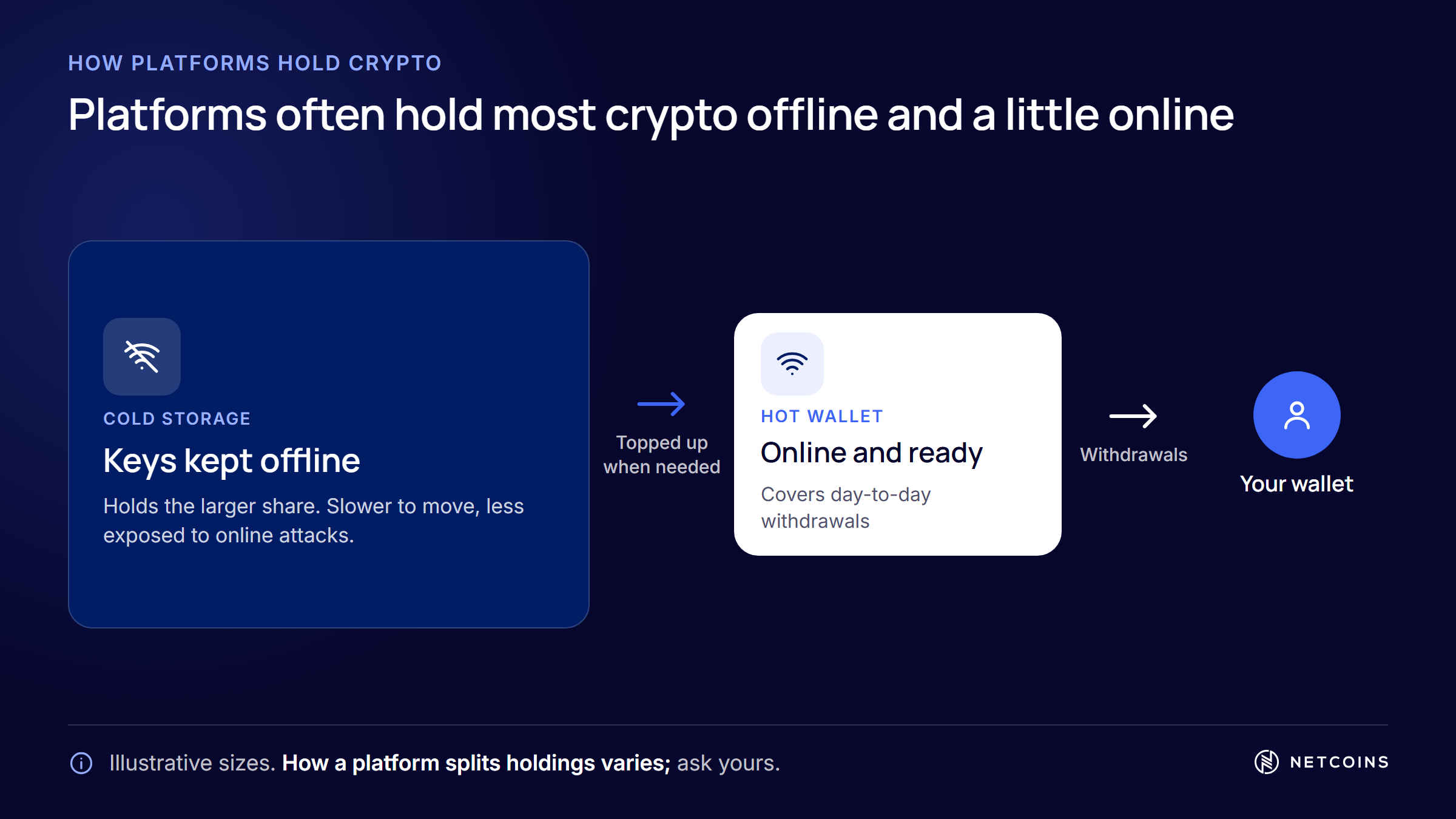
The private key is what controls crypto on a blockchain. Anyone who has the key can move the funds. Keeping keys offline makes it harder for an attacker on the internet to reach them, which is why platforms often hold most client crypto in cold storage and keep only what they need for daily activity in hot wallets.
The trade-off is speed. Moving crypto out of cold storage takes extra steps and approvals, so it is slower. Hot wallets are faster but more exposed. Platforms balance the two based on how much crypto clients move each day.
At Netcoins, Fireblocks provides the hot wallet infrastructure, and BitGo cold storage holds the bulk of client assets, with private keys kept offline [Source]. You can read the details on the Netcoins custody page.
Cold storage reduces some online risks. It does not remove risk. Keys can still be mishandled, backups can fail, and the people and processes around cold storage can make mistakes. A platform or custodian can also face operational problems, cyberattacks on its other systems, or financial failure. Any description of cold storage should be read as one layer of protection, not a guarantee.
A reader in Calgary comparing platforms can ask a simple question: does the platform publish who holds client crypto, and how much is kept offline? A clear, specific answer is more useful than general words like "secure".
Multi-Signature Wallets and Two-Factor Authentication
Multi-signature wallets and two-factor authentication are often confused, but they protect different things. Multi-signature protects the wallet that holds crypto. Two-factor authentication protects the account you log in to.
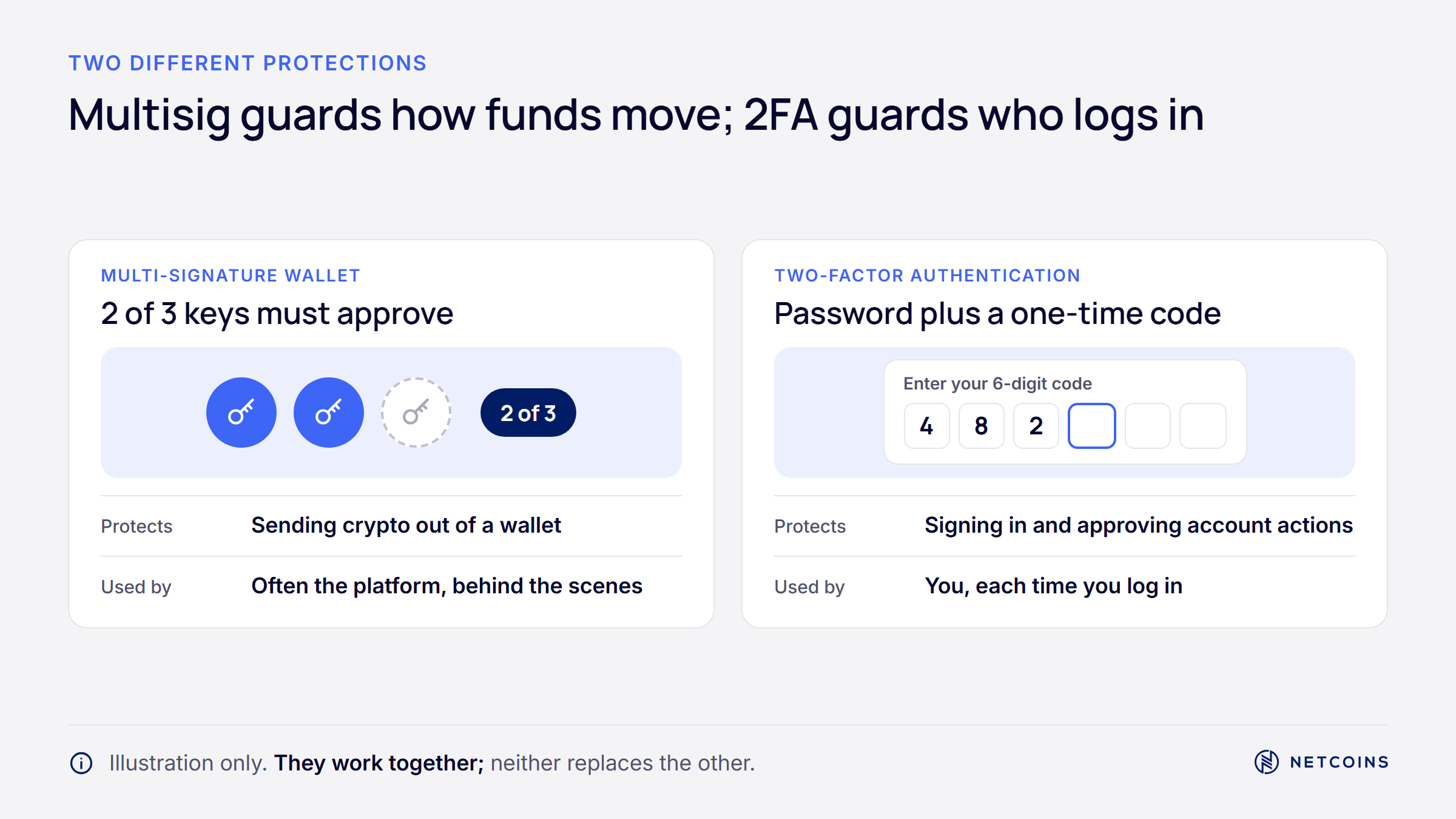
A multi-signature wallet, often called multisig, needs more than one key to approve a transaction. For example, a wallet might need two of three keys. If one key is stolen or lost, an attacker still cannot move funds alone. This reduces the risk of a single point of failure inside the platform. Netcoins describes using multi-signature wallets, which need multiple private keys to authorize transactions [Source].
Two-factor authentication, or 2FA, protects your login. After you enter your password, you also enter a second code, usually from an authenticator app or a text message. If someone steals your password, they still need that second factor. Netcoins offers 2FA on client accounts [Source].
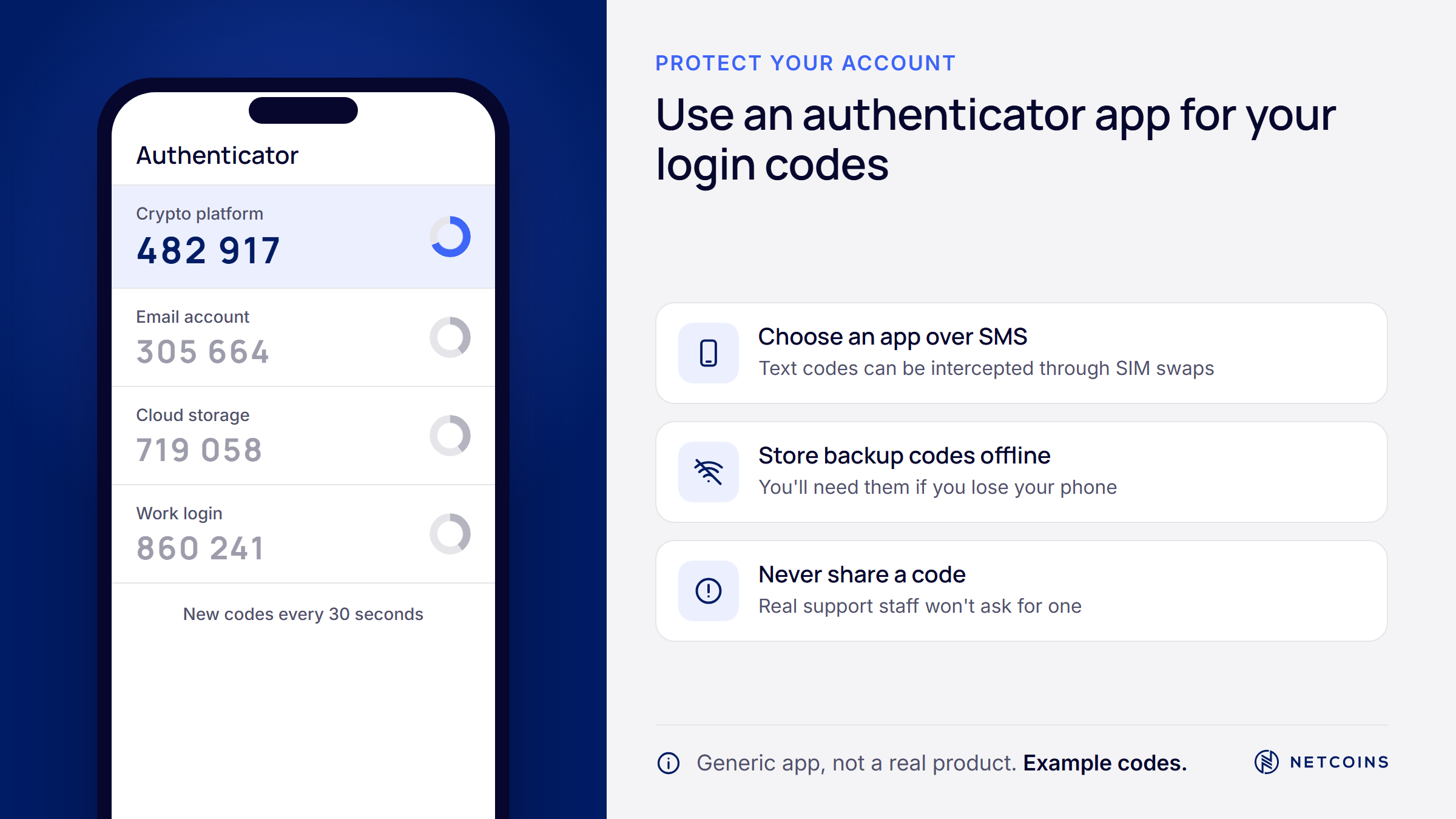
Not all 2FA is equal. Codes sent by text message can be intercepted if a scammer takes over your phone number, a trick often called a SIM swap. Authenticator apps or hardware security keys are generally harder to intercept, where a platform supports them.
Platforms in Canada also verify your identity when you open an account. This confirms who owns the account. It does not stop someone who has stolen your password and 2FA code from logging in, which is why login security still matters.
Neither tool is perfect on its own. Multisig does not help if you send crypto to a scammer yourself. 2FA does not help if you type your code into a fake website. They work best as part of several layers.
Encryption and Data Protection
Encryption turns readable data into coded text that only someone with the right key can read. Crypto trading platforms use it to help protect personal information, passwords, and the connection between your device and the platform.
You see one form of it every time you log in. The padlock in your browser's address bar means the connection to the site is encrypted, so data sent between you and the platform is harder to intercept on public Wi-Fi in a Toronto coffee shop or a Montréal airport.
Platforms also protect stored data. Passwords are usually not stored as plain text. Instead, they are run through a one-way function called a hash, so the original password is not kept in readable form. Sensitive documents, such as ID uploaded during sign-up, are typically encrypted when stored.
Crypto networks themselves rely on cryptography too. Public and private key pairs let you receive funds to a public address while only the private key can authorize spending. Hash functions link blocks of transactions together so that changes are easy to detect.
Encryption helps, but it has limits. It does not stop a phishing site from collecting the password you type into it. It does not help if malware on your device records your keystrokes. And it does not make any system breach-proof. Platforms can still face data incidents, which is why it is worth reading a platform's privacy policy to understand what it collects and how it handles a breach.
A simple habit helps here: type the platform's address yourself or use its official app, rather than clicking links in emails or text messages. That way, the encrypted connection you rely on is with the real platform.
Monitoring, Testing, and Incident Response
Good security is not a one-time setup. Platforms generally monitor activity, test their own systems, and plan for what happens when something goes wrong.
Monitoring looks for unusual patterns, such as a login from a new country followed by a large withdrawal request. When something looks wrong, a platform may pause a transaction, ask for extra confirmation, or contact the account holder. These steps can feel inconvenient, but they exist to catch account takeovers early.
Testing includes security audits and penetration testing, where specialists try to break into systems in a controlled way to find weak spots before attackers do. Some platforms and custodians also obtain independent reports on their controls. These reports describe how controls were designed and tested over a period. They are not a guarantee that a breach will never happen.
Incident response is the plan for a breach or outage: who investigates, how systems are isolated, and how clients are informed. A platform that explains how it communicates during incidents gives you a better idea of what to expect.
No amount of monitoring or testing makes a platform immune to attack. Large, well-resourced organizations have been breached. The most useful mindset is to treat these measures as ways to reduce risk and detect problems sooner, not as proof that losses cannot happen.
For Canadians in smaller communities, such as a reader in Moncton or Prince George, the same applies: the quality of a platform's controls matters more than its marketing language. Look for specific, published information rather than general promises.
What Platform Security Cannot Protect You From
Platform security protects against some risks, such as outside attackers reaching keys or accounts. It does not protect against every way you can lose money with crypto.
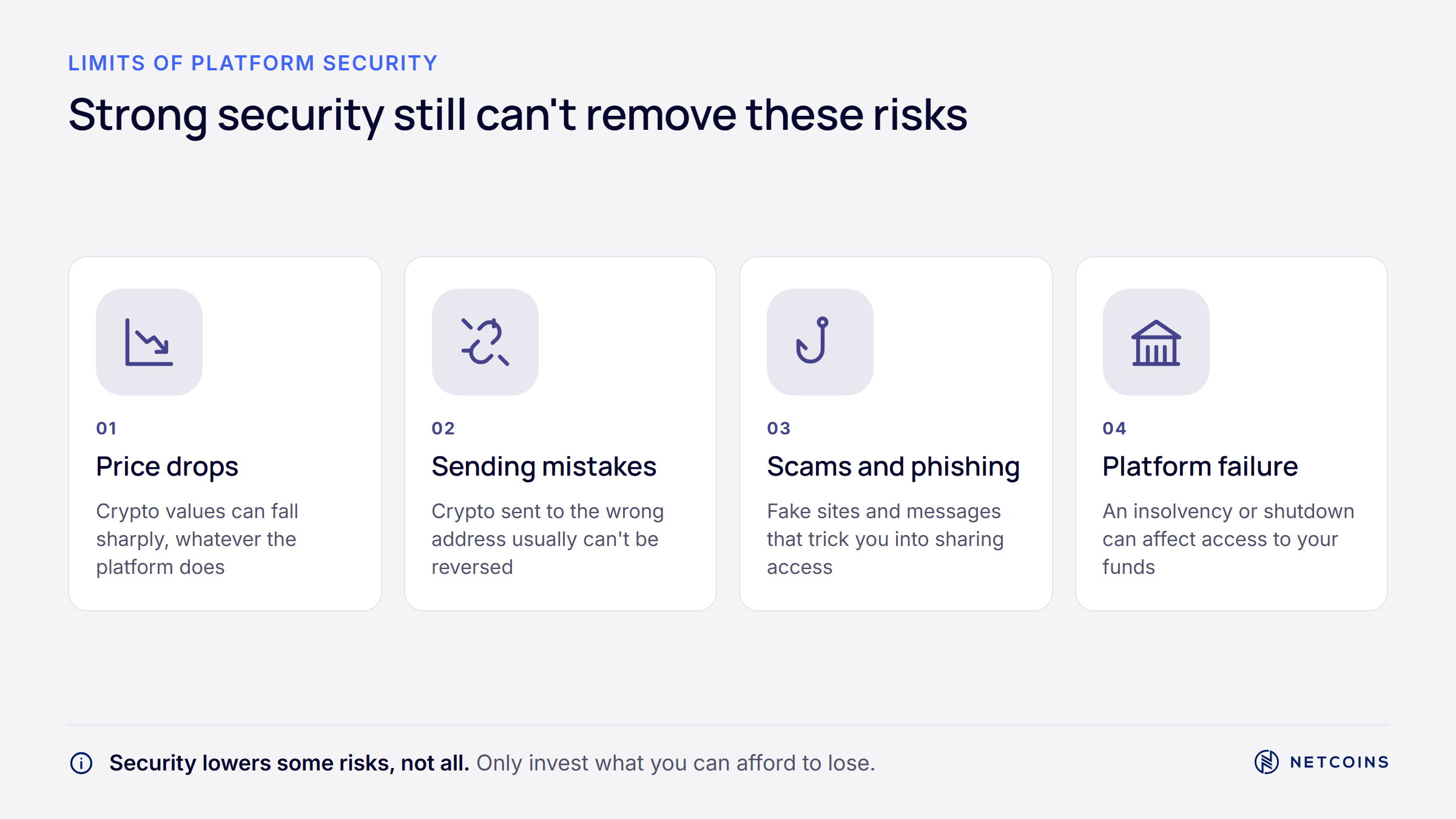
Price risk. Crypto prices can fall sharply in short periods. No security measure changes that. You could lose some or all of the money you put in.
No investor protection or deposit insurance. The Canadian Investor Protection Fund does not cover crypto assets [Source], and Canada Deposit Insurance Corporation deposit insurance does not cover cryptocurrencies [Source]. Money and crypto held on a crypto trading platform are not bank deposits.
Platform and custodian failure. If a platform or a custodian it uses becomes insolvent, has a custody failure, or suffers a cyberattack or other security incident, you could lose some or all of your assets, and there may be no compensation fund to cover the loss.
Scams you are tricked into. If a scammer convinces you to send crypto to their wallet, or to log in on a fake site, platform security usually cannot reverse it. Crypto sent on a blockchain generally cannot be pulled back.
Registration limits. A platform's registration with Canadian securities regulators is not an endorsement. It does not protect you from losses caused by price changes, insolvency, custody failures, or fraud.
The practical takeaway is to read a platform's custody, fee, and risk disclosures before you deposit, and to only put in money you can afford to lose. Our guide to common Bitcoin scams in Canada covers the scams Canadians report most often.
How to Protect Your Own Account and Crypto
Many losses start with the account holder, not the platform. Phishing emails, fake support agents, and reused passwords are common entry points. These steps are within your control.
- Turn on 2FA. Use an authenticator app or security key where the platform supports it, rather than text messages alone.
- Use a unique password. A password manager can create and store a long, unique password for each account.
- Watch for phishing. Real platform staff will not ask for your password, 2FA codes, or recovery phrase. Do not share them with anyone.
- Use official channels. Open the platform's app or type its web address yourself. Do not follow links in unexpected messages.
- Keep devices updated. Install operating system and app updates, and avoid installing unknown software.
- Be wary of pressure. Anyone urging you to move money fast, keep it secret, or buy crypto to pay a bill is a red flag.
If you move crypto to a wallet you control, you take on more responsibility. Self-custody gives you more direct control, but if you lose your private keys or recovery phrase, you may lose access permanently. Bitcoin.org recommends backing up your entire wallet, using several secure locations for backups, encrypting your wallet, and keeping software up to date [Source].
If you think you have been targeted or scammed, contact your platform's official support right away, then your bank if money left your account. You can also report fraud to the Canadian Anti-Fraud Centre, which collects reports from across Canada, whether you are in Regina or St. John's.
How to Evaluate a Crypto Trading Platform's Security
Before you open an account or move crypto onto a platform, look for specific, published facts rather than general claims like "secure" or "safe".
- Registration: Check whether the platform is registered with the applicable Canadian securities regulators. Remember that registration is not an endorsement and does not protect against losses.
- Custody: Does the platform say who holds client crypto, which custodians it uses, and how much is kept offline?
- Account security: Does it offer 2FA, and which methods? Can you add withdrawal confirmations or address allow-lists?
- Disclosures: Read the risk statement and terms. Look for what happens if the platform or a custodian fails.
- Fees: Check deposit, withdrawal, and network fees so there are no surprises when you move funds.
- Support: Find the official support channels now, so you know where to go if something looks wrong.
No checklist can tell you a platform is risk-free. The goal is to understand how a platform holds and protects assets, and what risks remain with you. For Netcoins, custody details are on the Netcoins custody page, and current fees are on the Netcoins fees page.
People Also Ask About Crypto Platform Security
What security measures do crypto trading platforms use? Common measures include cold storage, hot wallets with limits, multi-signature wallets, two-factor authentication, encryption, and activity monitoring. Cold storage keeps private keys offline. Multi-signature requires more than one key to approve a transaction. Two-factor authentication adds a second step to your login. Encryption helps protect data in transit and at rest. Monitoring looks for unusual activity. Each measure reduces some risks, but none of them remove risk entirely, so it helps to know what each one does and does not cover.
Why is crypto security important in Canada? Crypto is a frequent target for theft and fraud, and crypto transactions generally cannot be reversed. The Canadian Anti-Fraud Centre received reports of more than $704 million in fraud losses in 2025, and it estimates only 5% to 10% of frauds are reported. That makes both platform security and your own habits important. Using 2FA, avoiding phishing links, and knowing where to report fraud can reduce your exposure.
What is the difference between a hot wallet and cold storage? A hot wallet is connected to the internet and is used for everyday deposits and withdrawals. Cold storage keeps private keys offline, away from internet-connected systems. Hot wallets are faster but more exposed to online attacks. Cold storage is slower to access but harder to reach remotely. Many platforms keep most client crypto in cold storage and a smaller amount in hot wallets for daily activity.
How can I tell if a crypto platform is legitimate? Check whether it is registered with the applicable Canadian securities regulators, and read its custody, fee, and risk disclosures. Look for specific, published facts about who holds client crypto. Be cautious of platforms you found through unsolicited messages, social media ads promising returns, or people pressuring you to act fast. Registration is not an endorsement and does not protect you from losses, so it is one check among several.
What is a recovery phrase? A recovery phrase, sometimes called a seed phrase, is a list of words that can restore a self-custody wallet. Anyone who has it can take control of the crypto in that wallet. Store it offline in a safe place and never share it, type it into a website, or give it to someone claiming to be support. If you lose it and your device fails, you may lose access to your crypto permanently.
Frequently Asked Questions
Is it safe to keep crypto on a crypto trading platform? It carries risk. Platforms use measures such as cold storage, multi-signature wallets, and 2FA to reduce some risks, but no platform is risk-free. Crypto held on a platform is not covered by CIPF or CDIC, and you could lose some or all of your assets if the platform or a custodian fails or is hacked. Read the platform's custody and risk disclosures before you deposit.
What is the difference between multi-signature and 2FA? Multi-signature protects a wallet by requiring more than one key to approve a transaction. Two-factor authentication protects your account login by asking for a second code after your password. They guard different things, so a platform may use both. Neither protects you if you send crypto to a scammer yourself.
Does cold storage mean my crypto cannot be stolen? No. Cold storage keeps private keys offline, which makes them harder to reach from the internet. It reduces some online risks, but it does not remove operational, custody, insider, or counterparty risk. Platforms usually keep some crypto in hot wallets for daily withdrawals, and those are more exposed.
Can a crypto trading platform reverse a transaction if I get scammed? Usually not. Crypto sent on a blockchain generally cannot be reversed once confirmed. If you were tricked into sending crypto, contact your platform's official support right away and report it to the Canadian Anti-Fraud Centre. Acting fast may help, but recovery is not guaranteed.
What should I do if I think my account was hacked? Contact your platform's official support through its app or website right away, change your password, and check your 2FA settings. If money left your bank account, call your bank using the number on your card. You can also report fraud to the Canadian Anti-Fraud Centre. Be careful of anyone who contacts you offering to recover funds for a fee.
Is text message 2FA enough? Text message codes are better than no 2FA, but they can be intercepted if a scammer takes over your phone number, often called a SIM swap. Authenticator apps or hardware security keys are generally harder to intercept, where a platform supports them. Whichever you use, never share your codes with anyone.
Quick Glossary
- Private key: A secret code that controls crypto at a blockchain address. Anyone with the key can move the funds.
- Hot wallet: A crypto wallet connected to the internet, used for day-to-day deposits and withdrawals.
- Cold storage: Keeping private keys offline. It reduces some online risks but does not remove all risk.
- Multi-signature (multisig): A wallet setup that needs more than one key to approve a transaction.
- Two-factor authentication (2FA): A login step that asks for a second code or device after your password.
- Phishing: A fake email, text, or website designed to trick you into sharing passwords, codes, or recovery phrases.
- SIM swap: A scam where someone takes over your phone number to receive your text message codes.
- Custodian: A company that holds crypto on behalf of a platform or its clients.
Key Takeaways
- Crypto trading platforms use layers such as cold storage, multi-signature wallets, 2FA, encryption, and monitoring to reduce risk.
- These measures lower some risks but do not make crypto risk-free, and none of them protect against price drops.
- Crypto assets are not covered by CIPF or CDIC. Platform insolvency, custody failures, and cyberattacks could lead to losses.
- Your own habits matter: use 2FA, unique passwords, and official channels, and never share codes or recovery phrases.
- Before depositing, check a platform's registration, custody details, risk disclosures, and fees.
Security on a crypto trading platform is a shared job. The platform protects the keys and systems it controls, and you protect your login, your devices, and any wallet you hold yourself. Knowing what each measure does, and what it cannot do, helps you make informed decisions. To learn how account setup, funding, and your first order work, read our guide on how to buy Bitcoin in Canada step by step.

About Netcoins
Established in 2014 in Vancouver, British Columbia, Netcoins is a registered Restricted Dealer with the provincial securities commissions and a registered Money Services Business (MSB) with FINTRAC. Netcoins is owned by Surge Digital Inc. (formerly BIGG Digital Assets Inc.), a publicly traded company listed on the TSX Venture Exchange (TSXV: SRGE), and complies with applicable public company regulatory.
The information provided in the blog posts on this platform is for educational purposes only. It is not intended to be financial advice or a recommendation to buy, sell, or hold any cryptocurrency. Always do your own research and consult with a professional financial advisor before making any investment decisions. Cryptocurrency investments carry a high degree of risk, including the risk of total loss. The blog posts on this platform are not investment advice and do not guarantee any returns. Any action you take based on the information on our platform is strictly at your own risk. The content of our blog posts reflects the authors’ opinions based on their personal experiences and research. However, the rapidly changing and volatile nature of the cryptocurrency market means that the information and opinions presented may quickly become outdated or irrelevant. Always verify the current state of the market before making any decisions.