
TL;DR Canadian merchants have three practical routes: direct wallet transfers, a third-party payment gateway, or a native option such as USDC on Shopify Payments. Gateways automate checkout and can convert to fiat, at a processing fee. Direct wallets avoid processor fees but require manual reconciliation. All three carry limitations, and crypto payments remain a small share of commerce.
Canadian business owners face real payment costs, and crypto is increasingly discussed as an alternative. The practical picture is more mixed than most guides suggest. This article covers how each method actually works, what Shopify's own documentation says you can and cannot do, how to evaluate a gateway, and the limitations worth knowing before you enable anything at checkout.
Why Canadian Businesses Are Looking at Crypto Payments

Interest is driven mainly by cross-border payment costs and settlement delays, which affect Canadian exporters more than domestic sales.
The traditional cross-border picture is genuinely expensive. The Bank of England notes that a cross-border transfer can cost up to ten times more than a comparable domestic payment [Source]. Costs sit in flat wire fees, in the spread applied to currency conversion, and in the working capital tied up while a payment clears over one to five business days.
Canadian trade patterns make this increasingly relevant. Statistics Canada reported that in 2025 the United States share of Canadian goods exports fell to 71.7 percent, the lowest since the early 1980s, while goods exports to non-US markets rose 17.2 percent to an all-time high and total goods trade with overseas markets grew 14.3 percent [Source]. More trade outside the US corridor means more currency pairs, more intermediary banks, and more friction for a Vancouver or Mississauga exporter.
There is also a domestic customer-facing argument, though it should be kept in proportion. The Bank of Canada found Bitcoin ownership at around 10 percent of Canadians in 2023, with a median holding worth about Can$500 [Source]. That is a real group of people, but a median holding of Can$500 suggests most owners treat crypto as an investment rather than spending money.
The honest framing is that crypto payments are a small and growing option rather than a mainstream one. The Financial Stability Board estimates stablecoin transfers made up less than 0.2 percent of cross-border payments in 2025 [Source]. For most Canadian businesses this is worth understanding as a supplementary channel. For background on the rails involved, see our explainer on how crypto payments and fiat on-ramps work in Canada.
Direct Wallet Transfers Versus Payment Gateways
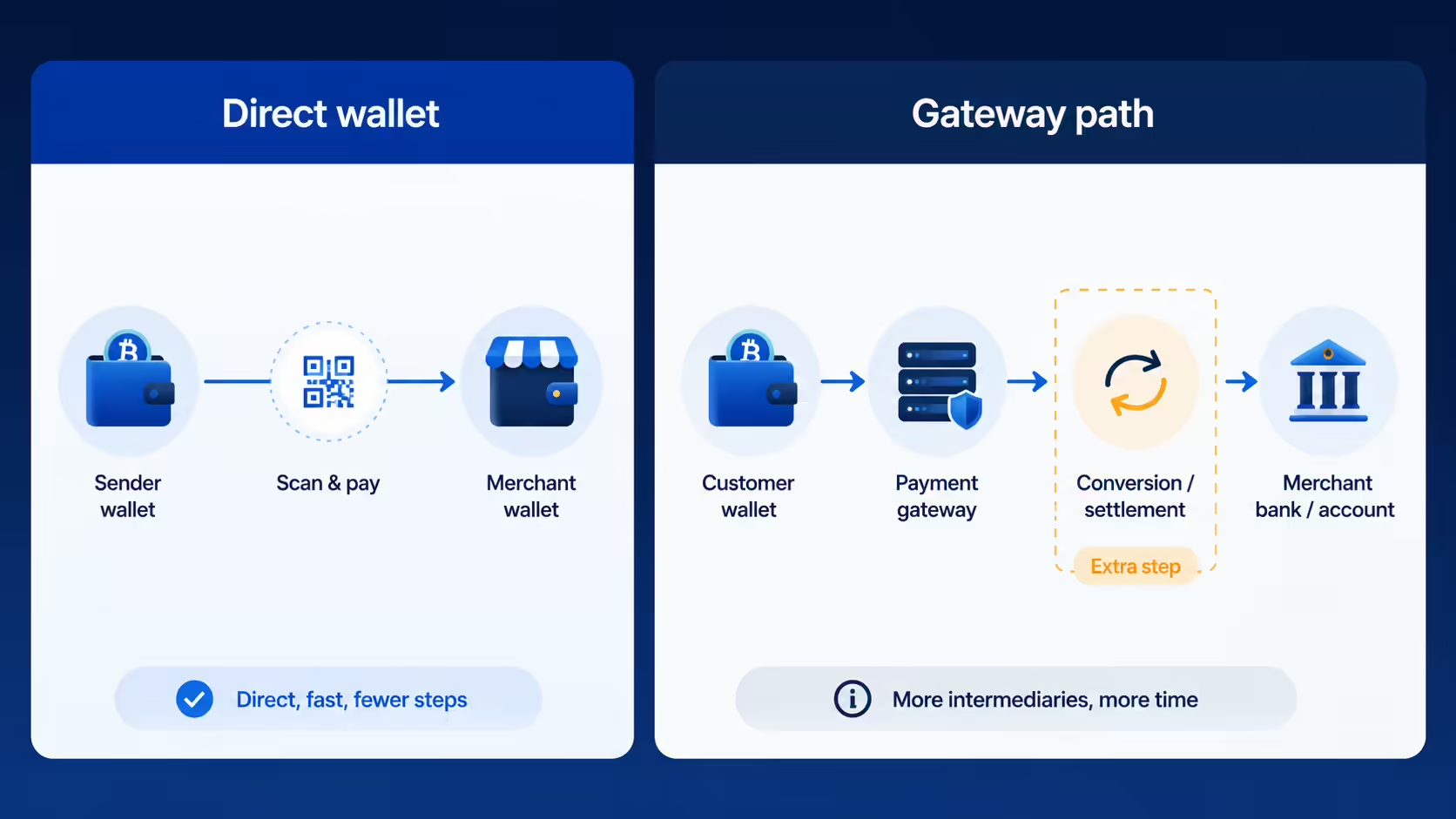
The choice is between manual control with no processor fee, and automation with a processing fee attached.
A direct wallet transfer means displaying a public wallet address or QR code and having the customer send funds from their own wallet. No third-party processor is involved, so no processing fee applies, though the sender pays a network fee. The merchant receives the asset directly.
The trade-offs are operational rather than financial. There is no automatic link to a point-of-sale or e-commerce system, so the merchant verifies each payment manually, matches it to an invoice, and records it for bookkeeping. Exchange rates must be calculated at the time of sale. For a Calgary cafe processing dozens of transactions an hour, this is impractical. For a consultant in Halifax invoicing a handful of clients monthly, it can work. Anyone taking this route holds their own keys, so our overview of crypto custody in Canada is relevant reading.
A payment gateway works more like a card processor. It integrates with a website or terminal, calculates the rate at checkout, generates a unique payment address per invoice, monitors the network for confirmation, and updates the order automatically. Many gateways also offer conversion, exchanging the received asset for a stablecoin or fiat currency shortly after receipt, which reduces the merchant's exposure to price movement between sale and settlement.
Gateways charge for this. Fee structures vary by provider, volume, and settlement currency, and published rates change, so compare current disclosed pricing rather than relying on figures quoted in any article. The practical question is whether the automation and reconciliation savings justify the fee for your transaction volume. Bank of Canada survey work found roughly half of Canadians had used Interac e-Transfer [Source], which remains a far more familiar payment method for most Canadian customers.
How to Accept USDC on Shopify in Canada
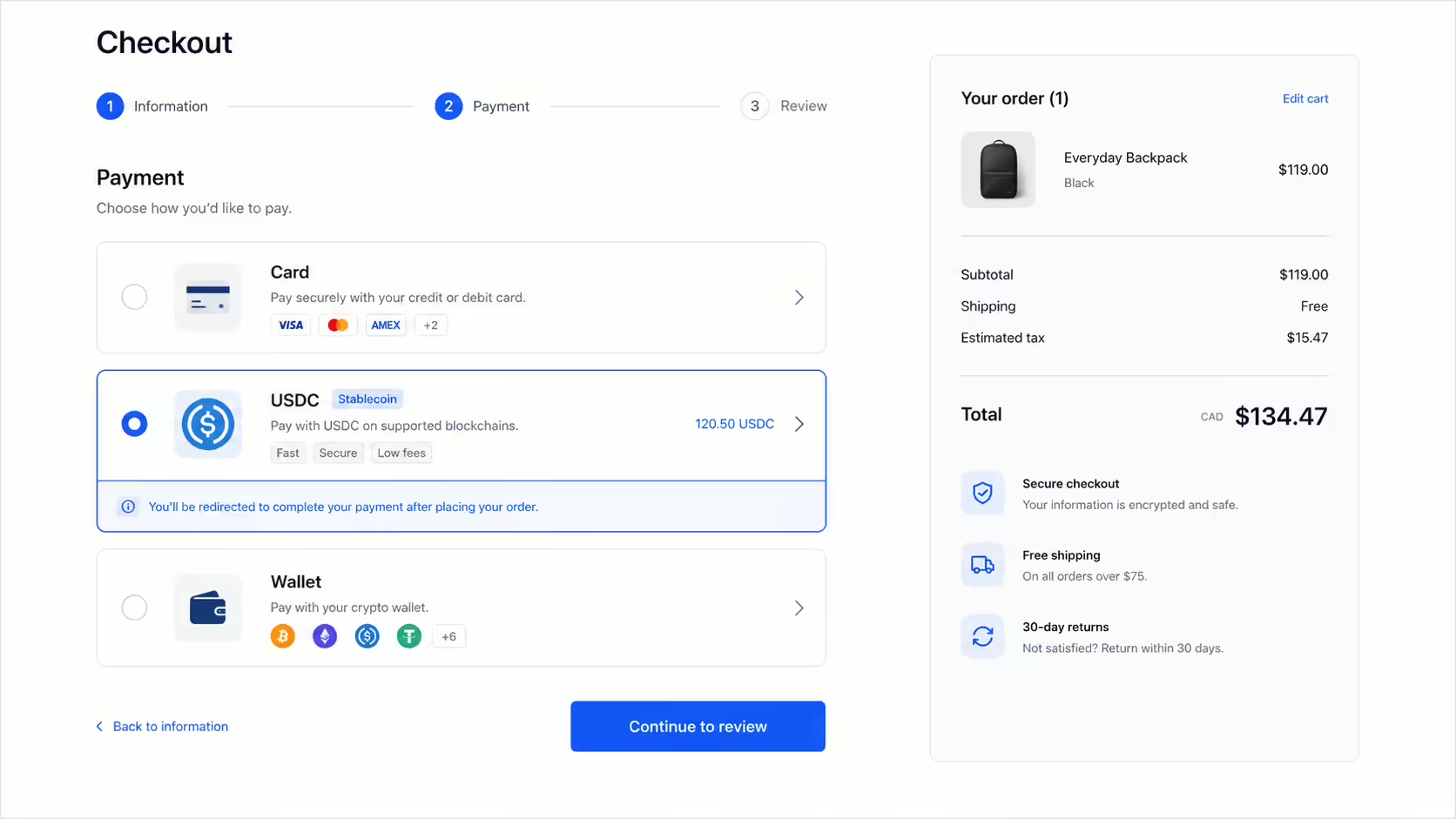
Shopify Payments supports USDC on the Base network as a checkout option for eligible merchants, without a separate plugin or gateway.
Shopify announced the feature in June 2025, rolling out to Shopify Payments merchants in eligible markets. Shopify states that payouts default to the merchant's local currency with no foreign exchange or multi-currency fees on that conversion [Source]. Standard Shopify Payments processing fees still apply, so this is not a fee-free payment method. Merchants can alternatively claim USDC directly by connecting a wallet supporting Base.
Two eligibility conditions apply. Shopify Payments must be active on the store, and the store must be located in a supported Shopify Payments region in North America, Europe, or Asia-Pacific [Source]. Canadian merchants should confirm current eligibility in their own Payments settings rather than assuming availability, since supported regions have expanded over time.
The limitations matter and are easy to miss. According to Shopify's documentation, funds on USDC orders cannot be partially captured, customers cannot pay for subscription products with USDC, post-purchase upsells are unavailable, and customers cannot open disputes on USDC orders. Where a customer received USDC cashback, refunds cannot exceed the original order amount minus that cashback [Source].
Those constraints shape who this suits. A Toronto store selling one-off physical products loses little. A business running subscriptions or relying on upsells would find meaningful functionality unavailable. Customers also need USDC on a supported network already, which narrows the addressable group considerably. Many merchants test the checkout flow before enabling it publicly, and current Shopify documentation is a more reliable reference than any third-party summary, including this one.
How to Evaluate a Crypto Payment Gateway
Rather than picking from a ranked list, it is more useful to assess providers against criteria that match your operation, since features and pricing change frequently.
This article does not rank or recommend specific gateways. Provider fees, supported assets, supported countries, and settlement options change regularly, and published comparisons date quickly. Any ranking you read, here or elsewhere, should be checked against the provider's current disclosed terms.
Seven criteria are worth checking directly with each provider:
- Canadian availability and CAD settlement: whether the provider serves Canadian businesses and can settle to a Canadian dollar bank account, or only to USD.
- Total cost: the processing fee, any conversion spread applied when converting to fiat, and any payout or withdrawal fee. The spread is the most commonly overlooked component.
- Custodial or non-custodial: whether funds pass through the provider's custody before reaching you, which introduces counterparty risk, or settle directly to a wallet you control, which shifts key management onto you.
- Integration fit: whether a supported plugin exists for your platform, or whether development work is required.
- Refund handling: what tooling exists for returns, given that blockchain transactions cannot be reversed by the network.
- Conversion timing: how quickly a received asset is converted, since price can move between confirmation and conversion.
- Reporting: whether transaction exports suit your bookkeeping process.
For a Winnipeg retailer taking occasional online orders, a simple plugin with CAD settlement matters most. For a business handling larger volumes, total cost and reporting quality dominate. Either way, the questions above are the ones to put to a provider before committing.
Size the evaluation effort to expected volume. With Canadian Bitcoin ownership at around 10 percent and a median holding near Can$500 [Source], most Canadian merchants should not expect crypto to become a primary checkout method. For a broader look at how Canadian platforms differ on fees and features, see our comparison of Canadian crypto trading platforms, and for the underlying mechanics of acquiring and holding assets, our complete guide to buying crypto in Canada.
Stablecoins for Cross-Border B2B Payments
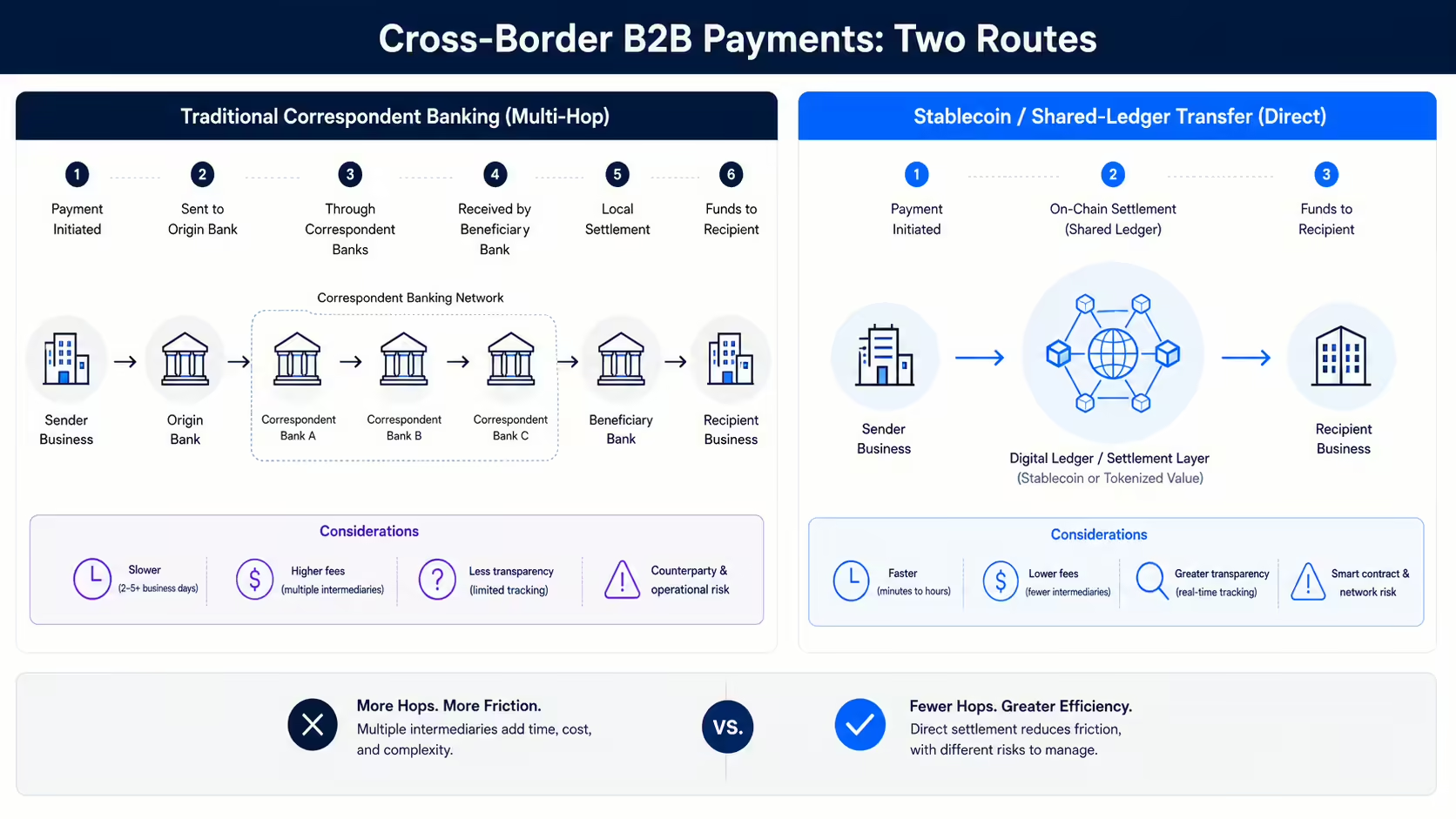
Stablecoins are used by some businesses to settle international invoices faster than conventional bank transfers, with different risks attached.
A stablecoin is a digital token designed to track the value of a reference currency, most often the US dollar. The aim is to reduce the price movement that makes other crypto assets impractical for invoicing. It is important to be clear that a stablecoin is not the same as fiat currency, its value is not guaranteed, and tokens can trade away from their intended peg.
The friction stablecoins address is real. Conventional cross-border payments route through correspondent banking relationships, where banks hold balances in accounts abroad so funds are available when needed. That structure contributes to multi-day settlement and layered fees, and messaging networks such as SWIFT transmit instructions rather than moving money themselves. The World Bank reported the global average cost of sending a remittance at 6.36 percent in the third quarter of 2025, with banks the most expensive channel at close to 15 percent [Source].
Settling on a blockchain can compress that timeline, because the transfer of value and its record occur in the same operation on a shared ledger, and networks operate continuously rather than on banking hours. Whether an end-to-end payment is genuinely faster or cheaper depends on liquidity in the currency pair, the fees charged converting CAD in and the destination currency out, and network conditions at the time.
The risks belong in the same paragraph as the benefits. Stablecoins carry reserve risk if backing falls short, redemption risk if tokens cannot be exchanged at the intended value, liquidity risk in stressed markets, counterparty risk if an issuer or provider fails, and regulatory risk as rules develop. Value-referenced crypto assets can lose value. Adoption also remains early: the Financial Stability Board put stablecoin transfers at under 0.2 percent of cross-border payments in 2025 [Source]. Our guide to stablecoin remittances in Canada covers the consumer side.
Volatility, Refunds, and Disputes
Blockchain transactions cannot be reversed by the network, which changes how refunds and disputes work but does not remove commercial risk.
Once a transaction is confirmed on a blockchain, the network provides no mechanism to reverse it. Neither the sender, the merchant, nor a bank can undo the transfer. This is a genuine operational difference from card payments, and it is often described as eliminating chargebacks. That description overstates the position.
Several qualifications apply. A merchant using a gateway is subject to that provider's terms, which may include their own dispute or reversal processes. Where a customer funded their crypto purchase with a credit card at some earlier point, a dispute can still occur upstream at the card level, outside the merchant's transaction. Customers who are dissatisfied still request refunds, and declining them carries reputational and customer-service consequences even when no chargeback mechanism exists. Platform-specific rules also vary: Shopify's documentation states customers cannot open disputes on USDC orders, which is a product behaviour rather than a universal property of crypto [Source].
Refunds require a deliberate process. Because the network will not reverse a payment, a refund means sending a new transaction to the customer, or using whatever refund tooling a gateway provides. The amount to return is a real question when the asset's price has moved between purchase and refund, and businesses should decide their policy in advance rather than case by case.
Volatility is the other operational issue. A Canadian business pricing in CAD but receiving a volatile asset carries price exposure between sale and conversion. Automatic conversion at checkout reduces but does not remove this, since conversion is not instantaneous. Accepting a stablecoin reduces price movement but introduces the reserve and redemption risks described above.
Converting Crypto Revenue Into Canadian Dollars
Most Canadian businesses accepting crypto convert some or all of it to Canadian dollars to meet payroll, rent, and supplier obligations.
The mechanics are straightforward. Assets are transferred to a Canadian trading platform, sold for Canadian dollars, and withdrawn to a business bank account. Netcoins, founded in 2014 and headquartered in Vancouver, is one Canadian platform supporting this. Business withdrawal and settlement options, along with supported assets, limits, and fees, vary by platform and change over time, so confirm current details directly with the platform before relying on any timeline.
Treasury decisions follow. A business can convert everything immediately, which removes price exposure but forgoes any subsequent price movement in either direction. It can hold a portion, which retains exposure to a volatile asset. Or it can convert into a stablecoin, which reduces price movement while carrying the reserve, redemption, and counterparty risks described earlier. These are decisions with real consequences, and a business weighing them may wish to consult a qualified financial professional rather than relying on general guidance.
Custody is a related choice. Leaving assets with a platform means relying on that company to remain solvent, secure, and operational. Netcoins' current published disclosures describe its custody approach, including how client assets are secured. [CUSTODY WORDING NEEDED: insert Netcoins' exact, currently approved custody disclosure language here; do not describe cold storage coverage without confirmed wording]. Custody arrangements differ between platforms and change over time, so review a platform's current published security information rather than relying on a summary, and no custody approach removes all risk. Self-custody removes reliance on a company but transfers full responsibility for keys, where a lost recovery phrase generally means permanent loss.
Businesses should also expect their bank to have views. Interac e-Transfer is the most familiar rail for most Canadian businesses, with Bank of Canada survey work finding roughly half of Canadians had used it [Source]. That said, some Canadian financial institutions apply restrictions to transfers involving crypto platforms, and policies differ between institutions and change. If a transfer is declined, contacting your financial institution is usually the fastest way to understand what applies. For the mechanics of moving funds, see our guide to how Interac e-Transfer works for crypto in Canada, and for the fundamentals of acquiring assets, our step-by-step guide to buying Bitcoin in Canada.
Risks and Practical Limitations
.png)
Accepting crypto payments introduces operational, security, and demand-side limitations that deserve weighing against the potential cost savings.
The most immediate limitation is customer demand. A payment method only helps if customers use it. With Canadian Bitcoin ownership around 10 percent and a median holding near Can$500 [Source], and stablecoin transfers under 0.2 percent of cross-border flows [Source], transaction volumes are likely to be modest. Setup effort should be sized accordingly.
Security and error risk are real. Crypto transactions are irreversible, so funds sent to a wrong address are generally unrecoverable. Businesses holding their own keys face the possibility of permanent loss, and merchants are targets for payment-related fraud. Bank of Canada research found roughly half of Bitcoin adopters had experienced price crashes, loss of access to funds, scams, or data breaches [Source]. Our guide to common Bitcoin scams in Canada covers current tactics.
Administrative overhead should not be underestimated. Accepting a second form of payment adds reconciliation work, and conversion timing affects the Canadian dollar amounts recorded. How crypto revenue should be recorded and reported is outside the scope of this article, and it is a question for your accountant before accepting payments rather than after.
Finally, availability is not stable. Gateway providers change fees, add and drop supported assets and countries, and occasionally discontinue products. Platform integrations change too. A setup that works today may need revisiting, so this is better understood as a channel requiring periodic review than as a one-time configuration. Businesses wanting to learn more can review Netcoins' payments page for current service details. [VERIFY NEEDED: confirm the services described on that page are within Netcoins' currently approved and registered business activities before linking; nothing here should be read as regulatory approval of the payment service itself.]
People Also Ask About Accepting Crypto Payments
Can a business accept crypto in a physical retail store? Yes, typically using a point-of-sale tool from a crypto payment gateway, which displays a QR code on a tablet or terminal for the customer to scan with a mobile wallet. Availability of these tools in Canada varies by provider, so confirm Canadian support and CAD settlement before committing. In practice, in-person crypto payment volumes are low for most Canadian retailers, so the setup effort is worth weighing against expected use.
How does a business convert crypto into Canadian dollars? By transferring the assets to a Canadian trading platform, selling for Canadian dollars, and withdrawing to a business bank account. Canadian platforms typically support Interac e-Transfer, wire, or bank draft for withdrawals, though limits, fees, and processing times vary and change. Some Canadian banks apply restrictions to crypto-related transfers, so it is worth confirming with your financial institution before setting up a regular conversion process.
What is the lowest-cost way to accept crypto payments? A direct wallet transfer avoids third-party processing fees, since the customer sends funds straight to a wallet you control and pays the network fee themselves. The cost is operational: manual verification, invoice matching, and bookkeeping, plus full responsibility for securing your own keys. Whether that trade-off is worthwhile depends on your transaction volume and whether the administrative time costs more than a gateway fee would.
Do Canadian banks support crypto business accounts? Canadian banks generally do not offer business accounts designed to hold digital assets directly. Businesses typically maintain a conventional corporate account and move funds between it and a Canadian crypto trading platform. Policies on crypto-related transfers differ between institutions and can change without much notice, so confirming your own bank's current position before building a process around it avoids disruption later.
Which crypto is most practical for business payments? Stablecoins are commonly used because they aim to track a reference currency, which reduces price movement between sale and settlement compared with volatile assets. A stablecoin is not fiat currency, its value is not guaranteed, and reserve, redemption, liquidity, counterparty, and regulatory risks apply. Businesses accepting volatile assets often convert promptly instead, which achieves a similar outcome through a different route.
Is it worth accepting crypto for a small Canadian business? It depends on your customer base and cross-border activity. A business with international suppliers or customers may see more benefit than one selling domestically, where Interac e-Transfer and cards dominate. Given that stablecoins remain under 0.2 percent of cross-border payments, most businesses should treat this as a supplementary channel rather than a replacement, and size the setup effort to realistic expected volumes.
Frequently Asked Questions
What happens if a customer wants a refund on a crypto payment? The blockchain will not reverse the original transaction, so a refund requires sending a new transaction to the customer or using refund tooling provided by your gateway. Price movement between purchase and refund raises the question of what amount to return, in the original asset or in equivalent CAD value. Deciding this policy in advance and stating it clearly at checkout avoids disputes later.
How long do crypto payments take to settle? It varies by network. Some networks confirm in seconds, while Bitcoin transactions typically require several confirmations and can take from around ten minutes to an hour depending on network conditions and the confirmation threshold your gateway requires. Network congestion affects both timing and fees, so settlement speed is not fixed. Gateways usually specify how many confirmations they wait for before marking an order paid.
Can a Canadian merchant accept USDC on Shopify? Shopify Payments supports USDC on the Base network for eligible merchants in supported regions across North America, Europe, and Asia-Pacific. Shopify Payments must be active on the store. Because supported regions have changed over time, checking your own Shopify Payments settings is more reliable than any published list. Several functional limitations apply, including no subscription purchases and no customer-opened disputes on USDC orders.
What is a crypto payment gateway? A software service that handles crypto payments on a merchant's behalf. It calculates the exchange rate at checkout, generates a payment address for each invoice, monitors the network for confirmation, updates the order, and often converts the received asset to a stablecoin or fiat currency. It functions similarly to a card processor and charges a fee, and introduces the provider as an additional party to your transaction.
Are crypto payments really immune to chargebacks? Not entirely. The network cannot reverse a confirmed transaction, which does remove the card-style chargeback mechanism. But a gateway's own terms may include dispute processes, upstream card disputes can occur where a customer funded their crypto with a card, and dissatisfied customers still request refunds regardless of what mechanisms exist. Treating irreversibility as a complete protection against commercial disputes would be a mistake.
What are the main risks for a merchant accepting crypto? Price movement between sale and conversion, irreversible transactions where an address error means permanent loss, custody risk whether relying on a platform or holding your own keys, counterparty risk with gateways and issuers, and low customer demand relative to setup effort. Administrative recording and reporting in Canadian dollars also adds ongoing work worth discussing with an accountant beforehand.
Do customers pay network fees on Shopify USDC orders? According to Shopify's documentation, customers paying with USDC on a supported network do not incur their own foreign exchange or gas fees. Gas fees are the transaction fees blockchain networks charge to process transfers. This is specific to that integration rather than typical of crypto payments generally, where the sender usually pays the network fee. Terms can change, so verify current documentation.
Quick Glossary
Payment Gateway: A software service that processes payments on a merchant's behalf, handling rate calculation, confirmation monitoring, and often conversion to fiat.
Stablecoin: A digital token designed to track the value of a reference currency, most often the US dollar. It is not fiat currency and its value is not guaranteed.
USDC: USD Coin, a stablecoin referencing the US dollar, supported as a checkout option on some commerce platforms.
Base: An Ethereum layer-2 network, used by Shopify Payments for its USDC checkout option.
Network Fee: The fee a blockchain charges to process a transaction, sometimes called a gas fee. It varies with network demand.
Spread: The difference between the rate quoted and the underlying market rate. It is a real cost even when not itemised as a fee.
Custodial vs Non-Custodial: Whether a provider holds funds before passing them to you, or funds settle directly to a wallet you control.
Interac e-Transfer: A Canadian service for moving funds between accounts at participating financial institutions, commonly used for platform deposits and withdrawals.
Key Takeaways
- Three routes exist: direct wallet transfers avoid processor fees but require manual reconciliation, gateways automate checkout for a fee, and some platforms offer native options such as USDC on Shopify Payments.
- Shopify's USDC option has real limitations: no subscription purchases, no partial capture, no post-purchase upsells, no customer-opened disputes, and regional eligibility conditions.
- Irreversibility is not complete chargeback protection: gateway terms, upstream card disputes, and ordinary refund requests all still apply.
- Stablecoins reduce price movement but add other risks: reserve, redemption, liquidity, counterparty, and regulatory risks apply, and value-referenced crypto assets can lose value.
- Demand is modest: with stablecoins under 0.2 percent of cross-border payments, this is best treated as a supplementary channel sized to realistic volumes.
Closing
Accepting crypto payments is more accessible for Canadian businesses than it was a few years ago, particularly with native options now built into major commerce platforms. It is also less transformative than much of the available guidance suggests. The cost advantages are most visible on cross-border payments, the customer demand for crypto at domestic checkout remains limited, and each method carries operational limitations that are easier to plan for than to discover afterwards. Reading a provider's current documentation, testing before going live, and speaking with your accountant about recording are the practical steps that matter most. For related background, see our explainer on how crypto payments and fiat on-ramps work in Canada or our overview of cryptocurrency for beginners.

About Netcoins
Established in 2014 in Vancouver, British Columbia, Netcoins is a registered Restricted Dealer with the provincial securities commissions and a registered Money Services Business (MSB) with FINTRAC. Netcoins is owned by Surge Digital Inc. (formerly BIGG Digital Assets Inc.), a publicly traded company listed on the TSX Venture Exchange (TSXV: SRGE), and complies with applicable public company regulatory.
The information provided in the blog posts on this platform is for educational purposes only. It is not intended to be financial advice or a recommendation to buy, sell, or hold any cryptocurrency. Always do your own research and consult with a professional financial advisor before making any investment decisions. Cryptocurrency investments carry a high degree of risk, including the risk of total loss. The blog posts on this platform are not investment advice and do not guarantee any returns. Any action you take based on the information on our platform is strictly at your own risk. The content of our blog posts reflects the authors’ opinions based on their personal experiences and research. However, the rapidly changing and volatile nature of the cryptocurrency market means that the information and opinions presented may quickly become outdated or irrelevant. Always verify the current state of the market before making any decisions.