

TL;DR
In January 2021, Bitcoin dropped about 10% in one day, and the total crypto market lost about $100 billion USD in value over two days. A sell-off happens when selling pressure outweighs buying pressure, often after a strong run-up or a news headline. "Billions wiped out" describes a drop in market value, not cash leaving the market. Large drops have happened many times, and past drops do not tell you what prices will do next.
Headlines about billions of dollars disappearing from crypto can be alarming, especially if you are new. This guide uses the January 2021 sell-off as a real example to explain what a sell-off is, why crypto prices can fall quickly, and what a big drop means for you. Whether you are in Toronto, Calgary, or Halifax, understanding volatility before you buy helps you make more informed decisions.
What Happened in the January 2021 Crypto Sell-Off?
In the week of January 18, 2021, crypto prices fell sharply after a strong rally. Bitcoin dropped about 10% on January 21, 2021, falling to a 10-day low, according to Reuters [Source]. By then, Bitcoin had lost nearly a quarter of its value since reaching a record of about $42,000 USD on January 8 [Source].
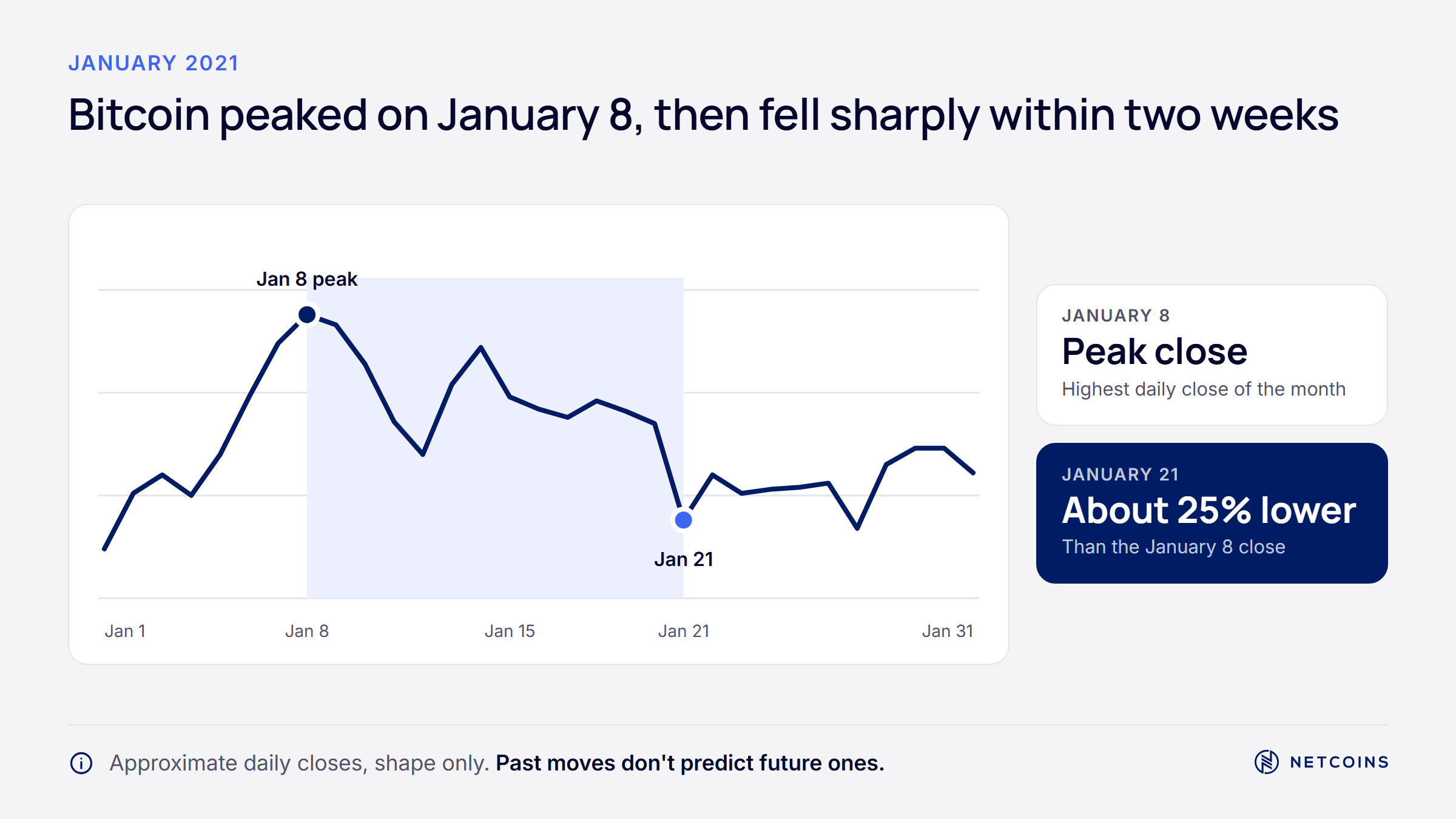
The wider market fell too. CNBC reported that the total value of all cryptocurrencies dropped by about $100 billion USD over 48 hours [Source]. Ethereum and many other cryptocurrencies also declined.
Market reports at the time pointed to a few possible reasons. One was profit-taking after Bitcoin's large run-up in late 2020 and early January 2021. Another was a news headline: during a US Senate hearing, the nominee for US Treasury Secretary said cryptocurrencies could be used to finance illegal activity, and some traders linked the drop to those comments [Source].
It is rarely possible to say exactly why a market moved. Prices reflect millions of decisions by buyers and sellers. Explanations offered after a drop are informed guesses, not proof.
The main lesson from this event is not about one headline. It is that crypto prices can fall by double-digit percentages in days, even after a strong run. If you are new to crypto, our guide on what Bitcoin is explains the basics before you look at price history.
What Is a Crypto Sell-Off?
A sell-off is a period when many holders sell an asset at the same time, pushing its price down quickly. In crypto, sell-offs often spread across many coins at once, because many cryptocurrencies tend to move in the same direction as Bitcoin.
Prices on a market move when buyers and sellers agree on trades. If more people want to sell than buy at the current price, sellers have to accept lower prices to find buyers. When that happens quickly and across the market, it is called a sell-off.
You may also hear related terms. A correction usually describes a drop of around 10% or more from a recent high. A crash usually describes a sudden, very large drop. A bear market usually describes a long period of falling prices. These labels are informal and do not have exact definitions in crypto.
Crypto markets trade 24 hours a day, 7 days a week. That means a sell-off can start late at night or on a weekend, when someone in Winnipeg or Vancouver might not be watching. Prices can change a lot between the time you check your app and the next morning.
Sell-offs are not unique to crypto. Stock markets have them too. But crypto prices have historically moved much more sharply than many traditional assets, which is why sell-offs in crypto can feel sudden and large.
What Does "Billions Wiped Out" Actually Mean?
When a headline says billions were "wiped out", it usually refers to a drop in total market capitalization, not cash that left the market.
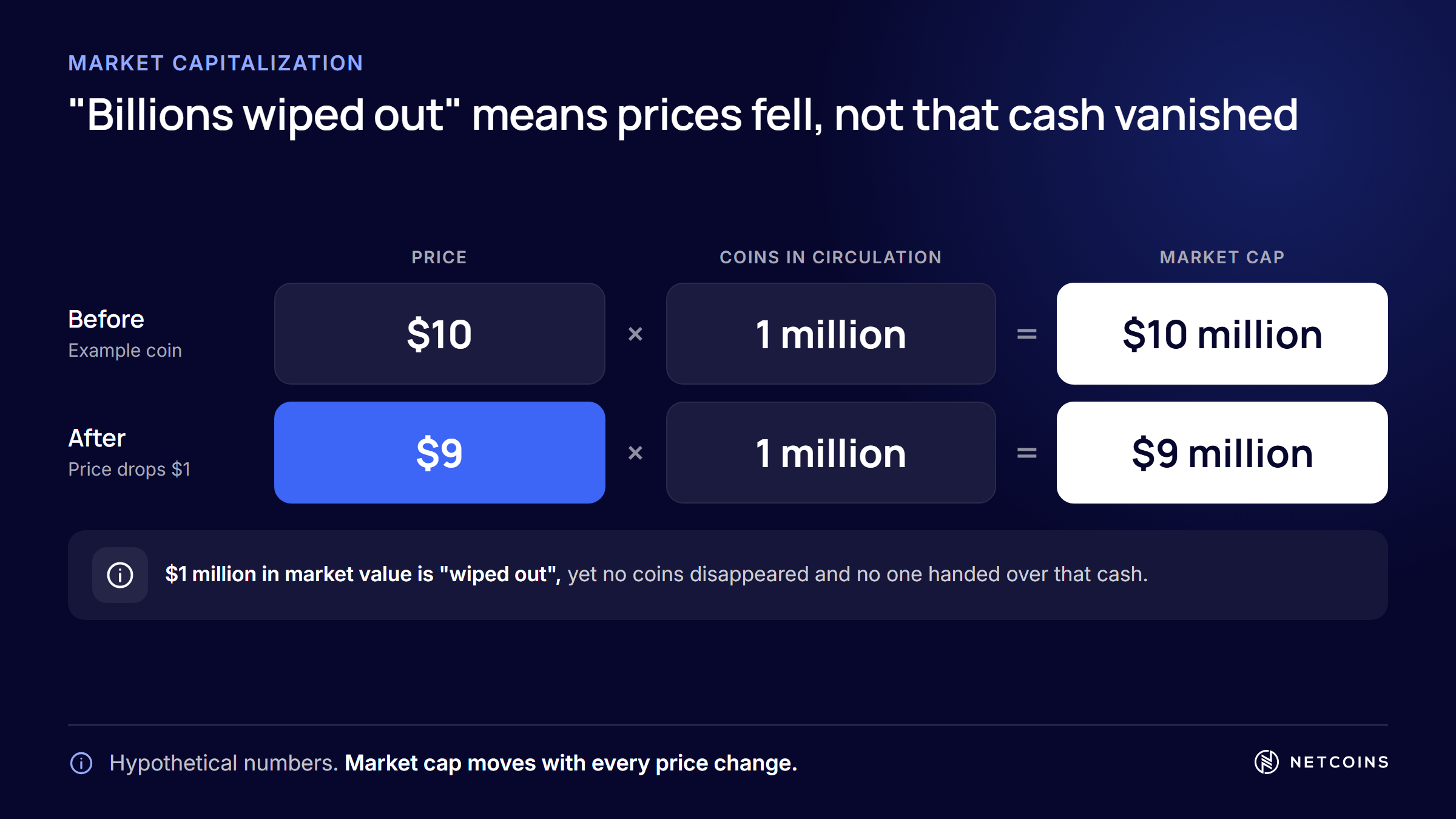
Market capitalization, or market cap, is the current price of a cryptocurrency multiplied by the number of coins in circulation. Total crypto market cap adds up this number for all cryptocurrencies. When prices fall, market cap falls, even if very few coins actually change hands.
Here is a simple example with made-up numbers. Imagine a coin with 1 million units in circulation at $10 each. Its market cap is $10 million. If a few trades happen at $9, the market cap drops to $9 million. The headline might say $1 million was "wiped out", but nobody withdrew $1 million in cash. The value of every holder's coins simply fell on paper.
This matters in two ways. First, it means market cap can rise and fall quickly on relatively small trading volume. Second, the loss is real for holders on paper, and it becomes a realized loss if they sell at the lower price. Anyone who sells at a lower price than they paid locks in that loss.
You can see current prices for many cryptocurrencies on the Netcoins live coin prices page. Prices on any page change constantly, so the number you see can be out of date minutes later.
Why Crypto Prices Can Fall So Quickly
Crypto prices can drop fast for several reasons, and often more than one is at work at the same time.

Profit-taking after a run-up. When prices have risen a lot in a short time, some holders sell to lock in gains. If many do this at once, prices can fall quickly. Reports linked part of the January 2021 drop to this kind of selling after Bitcoin's strong rally [Source].
News and headlines. Comments from public officials, reports of hacks, or news about a large company can change how buyers and sellers feel within minutes. Crypto markets often react strongly to headlines, even before the details are clear.
Borrowed money and forced selling. Some traders use borrowed money, called leverage, on platforms that offer it. When prices fall, those positions can be closed automatically, which is called a liquidation. Each forced sale adds more selling pressure, which can push prices down further.
Thin trading at certain hours. Crypto trades around the clock. At quieter times, such as overnight or on holidays, fewer buyers may be active, so large sell orders can move prices more.
Many coins move together. Many cryptocurrencies have tended to move in the same direction as Bitcoin. When Bitcoin falls, the rest of the market often follows, which turns one coin's drop into a market-wide sell-off.
Emotion. Fear spreads quickly. When people see prices falling and headlines about losses, some sell to avoid further losses, which can push prices lower still.
None of these factors can be predicted reliably. Understanding them will not tell you when the next drop will happen, but it can help you understand why crypto is considered a high-risk asset.
Past Bitcoin Drawdowns: Big Drops Are Part of the History
A drawdown is the drop from a high point to a later low point. Bitcoin's history includes many large drawdowns, some much bigger than the January 2021 sell-off.
The January 2021 drop was one example. Bitcoin lost nearly a quarter of its value in about two weeks after its January 8 record [Source].
A much larger drop came in 2022. Reuters reported that by December 1, 2022, the price of Bitcoin had fallen 65% since the start of that year, during a period that also included the collapse of a major cryptocurrency and the bankruptcy of a large crypto trading platform [Source].
These events show two things. First, large drops in crypto are not rare. Second, the size and length of a drop vary a lot. Some drops last days. Others last months or years.
After past drops, prices have sometimes risen again and sometimes stayed lower for long periods. Some coins never returned to their earlier highs, and some projects failed completely. Past drawdowns do not tell you what will happen next, and there is no guarantee that any price will recover.
For someone in Edmonton or Montréal looking at a long-term price chart, it is easy to focus on the high points. It is just as important to look at the drops and ask whether you could hold through a similar fall without needing the money.
How to Think About Volatility Before You Buy
Volatility is how much and how quickly a price moves. Crypto has historically been very volatile. The best time to think about volatility is before you buy, not in the middle of a sell-off.
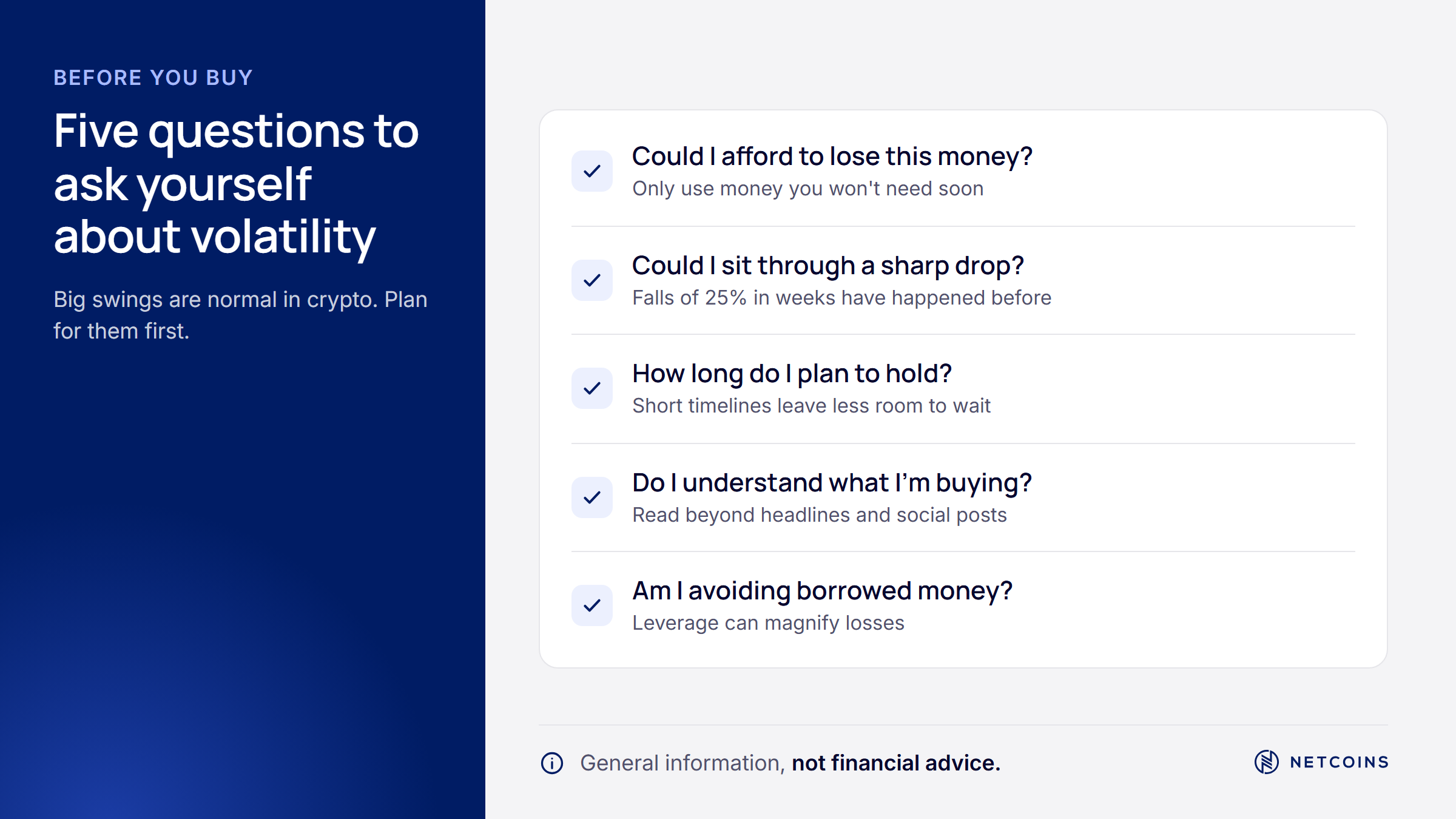
Here are some general points many people consider. This is not advice for your situation.
- Only use money you can afford to lose. Crypto can lose most or all of its value. Money you need for rent, bills, or an emergency fund is not suited to a high-risk asset.
- Know your time frame. If you might need the money soon, a sharp drop could force you to sell at a loss.
- Understand what you are buying. Read about the specific cryptocurrency, how it works, and its risks. Our guide on what Bitcoin is is a starting point.
- Know the costs. Fees and spreads affect what you pay and receive. Check the Netcoins fees page for current fees on Netcoins, since they can change.
- Know where your crypto is held. Holding crypto on a platform comes with custody and platform risks. Our guide on crypto platform security measures explains what security can and cannot protect.
- Think about taxes. Selling or trading crypto can have tax consequences in Canada. Speak with a qualified tax professional about your situation.
Crypto assets are not protected by the Canadian Investor Protection Fund (CIPF) or by Canada Deposit Insurance Corporation (CDIC) deposit insurance. A drop in price is a loss you bear yourself.
If you are unsure whether crypto fits your situation, a qualified financial professional can help you think it through.
Common Mistakes During a Sell-Off
Sell-offs can lead to rushed decisions. These are common mistakes people describe after a sharp drop. Avoiding them does not prevent losses, but it can help you avoid making a bad situation worse.
- Making decisions in a panic. Selling or buying in a rush, based only on fear or excitement, often means not thinking through the risks.
- Assuming a drop means a bargain. A lower price is not automatically a good price. Prices can keep falling after any drop, and there is no guarantee they will recover.
- Using borrowed money. Borrowing to buy crypto, or using leverage, can turn a price drop into a loss larger than what you put in.
- Putting in money you need. A sell-off is especially hard if you need the money soon.
- Trusting "recovery" offers. Scammers often contact people after market drops, promising to recover losses or guarantee returns. Our guide to common Bitcoin scams in Canada explains how to spot them.
- Acting on social media hype. Posts telling you to "buy now" or "sell everything" are not advice for your situation, and some are designed to move prices for someone else's benefit.
Whether you live in Regina or St. John's, the same principle applies: understand the risks before a sell-off happens, so you are not forced to learn them during one.
People Also Ask About Crypto Sell-Offs
Why does crypto drop so often? Crypto prices can drop often because the market is young, trades 24/7, and reacts strongly to news, profit-taking, and emotion. Some traders use borrowed money, and when prices fall, their positions can be closed automatically, adding more selling. Many coins also tend to move with Bitcoin, so one drop can spread across the market. These factors make crypto a high-risk asset, and drops can happen at any time without warning.
How much has Bitcoin dropped in the past? Bitcoin has had many large drops. In January 2021, it lost nearly a quarter of its value in about two weeks after a record high. In 2022, Reuters reported that Bitcoin had fallen 65% from the start of the year by December 1. The size and length of drops vary widely. Past drops do not predict future prices, and there is no guarantee any price will recover.
What does market cap mean in crypto? Market capitalization is a cryptocurrency's current price multiplied by the number of coins in circulation. Total crypto market cap adds this up for all coins. When prices fall, market cap falls, even if few coins change hands. That is why a headline can say billions were "wiped out" without that much cash actually leaving the market. The drop is a fall in value on paper for every holder.
Is it a good time to buy crypto after a sell-off? No one can know whether prices will rise or keep falling after a sell-off. A lower price is not automatically a better price. Before buying at any time, consider whether you can afford to lose the money, how long you might hold it, and what fees apply. If you are new, our step-by-step guide to buying Bitcoin in Canada explains how buying works, along with the risks.
What is a liquidation in crypto? A liquidation happens when a trader who used borrowed money, or leverage, no longer has enough funds to cover a losing position. The platform closes the position automatically, often by selling. During a sell-off, many liquidations can happen at once, adding selling pressure and pushing prices lower. Using leverage can lead to losses larger than the money you put in.
Frequently Asked Questions
What caused the January 2021 crypto sell-off? Market reports pointed to profit-taking after a strong rally and to comments at a US Senate hearing about crypto being used for illegal activity. Bitcoin fell about 10% on January 21, 2021, after reaching a record in early January. It is rarely possible to know exactly why a market moved, so explanations after a drop are informed guesses rather than proof.
Did the crypto market really lose $130 billion? Reports from the time put the drop at about $100 billion USD over 48 hours, based on CNBC's reporting. Different outlets gave different numbers because they measured at different times. Either way, the figure describes a fall in total market value, not cash leaving the market. The loss was real on paper for holders and became a realized loss for anyone who sold.
Is a sell-off the same as a crash? Not exactly. A sell-off is a fast, broad drop as many holders sell at once. A crash usually means a sudden, very large drop. A correction usually means a fall of around 10% or more from a recent high. These terms are informal in crypto and do not have exact definitions, so headlines may use them differently.
Can a cryptocurrency lose all of its value? Yes. Any cryptocurrency can lose most or all of its value. Some projects have failed completely, and some coins never returned to earlier highs. Bitcoin's price has also fallen sharply many times. This is why many people only put in money they can afford to lose and learn about a specific coin before buying.
Does a crypto sell-off affect all coins equally? No. Many cryptocurrencies tend to move in the same direction as Bitcoin, so sell-offs often spread across the market. But the size of the drop can vary a lot from coin to coin. Smaller coins with less trading activity can fall further and faster than larger ones. Past behaviour during a sell-off does not predict how any coin will behave next time.
Are crypto losses covered by CIPF or CDIC? No. Crypto assets are not protected by the Canadian Investor Protection Fund or by Canada Deposit Insurance Corporation deposit insurance. If the price of your crypto falls, that loss is yours. These programs also do not cover losses if a crypto trading platform or custodian fails. Read a platform's risk and custody disclosures before you deposit.
Quick Glossary
- Sell-off: A fast, broad drop in prices as many holders sell at the same time.
- Correction: An informal term for a drop of around 10% or more from a recent high.
- Bear market: An informal term for a long period of falling prices.
- Market capitalization (market cap): A cryptocurrency's price multiplied by the number of coins in circulation.
- Drawdown: The drop from a high point to a later low point.
- Volatility: How much and how quickly a price moves up and down.
- Leverage: Using borrowed money to trade, which can increase both gains and losses.
- Liquidation: The automatic closing of a leveraged position when the trader no longer has enough funds to cover losses.
Key Takeaways
- In January 2021, Bitcoin fell about 10% in a day, and the total crypto market lost about $100 billion USD in value over two days.
- A sell-off happens when selling pressure outweighs buying. Profit-taking, news, leverage, and emotion can all play a part.
- "Billions wiped out" means a drop in market value, not cash leaving the market, but the loss is real for holders.
- Large drops are part of crypto's history. Past drops do not predict future prices, and recovery is never guaranteed.
- Crypto is not covered by CIPF or CDIC. Only use money you can afford to lose, and understand the risks before a sell-off happens.
Sell-offs are a normal feature of crypto markets, and they can be large and sudden. Knowing what a sell-off is, what headline numbers really mean, and which mistakes to avoid can help you make calmer, more informed decisions. To learn how account setup, funding, and placing an order work, read our guide on how to buy Bitcoin in Canada step by step.

About Netcoins
Established in 2014 in Vancouver, British Columbia, Netcoins is a registered Restricted Dealer with the provincial securities commissions and a registered Money Services Business (MSB) with FINTRAC. Netcoins is owned by Surge Digital Inc. (formerly BIGG Digital Assets Inc.), a publicly traded company listed on the TSX Venture Exchange (TSXV: SRGE), and complies with applicable public company regulatory.
The information provided in the blog posts on this platform is for educational purposes only. It is not intended to be financial advice or a recommendation to buy, sell, or hold any cryptocurrency. Always do your own research and consult with a professional financial advisor before making any investment decisions. Cryptocurrency investments carry a high degree of risk, including the risk of total loss. The blog posts on this platform are not investment advice and do not guarantee any returns. Any action you take based on the information on our platform is strictly at your own risk. The content of our blog posts reflects the authors’ opinions based on their personal experiences and research. However, the rapidly changing and volatile nature of the cryptocurrency market means that the information and opinions presented may quickly become outdated or irrelevant. Always verify the current state of the market before making any decisions.