

TL;DR
Most crypto cards available to Canadians are prepaid cards, not true credit cards, so you can only spend the balance you have loaded or the crypto you sell. Merchants are paid in Canadian dollars while the card provider handles any conversion. The real cost of a card often sits in foreign exchange fees, conversion spreads, and ATM or inactivity fees, and crypto rewards can lose value after you earn them.
Canadians already pay by tapping a card or phone for most in-person purchases, and crypto cards use the same networks. That makes them look simple, but the costs and risks are less obvious than with a regular bank card. This guide explains in plain language how crypto cards work, the difference between prepaid and credit cards, which fees to verify, how crypto rewards work, and who holds the money behind your card. It ends with a checklist for comparing cards before you apply.
How Crypto Cards Work in Canada
A crypto card is a payment card on a major network, such as Visa or Mastercard, that draws on a card balance or a linked account or wallet,, and the merchant is paid in Canadian dollars.
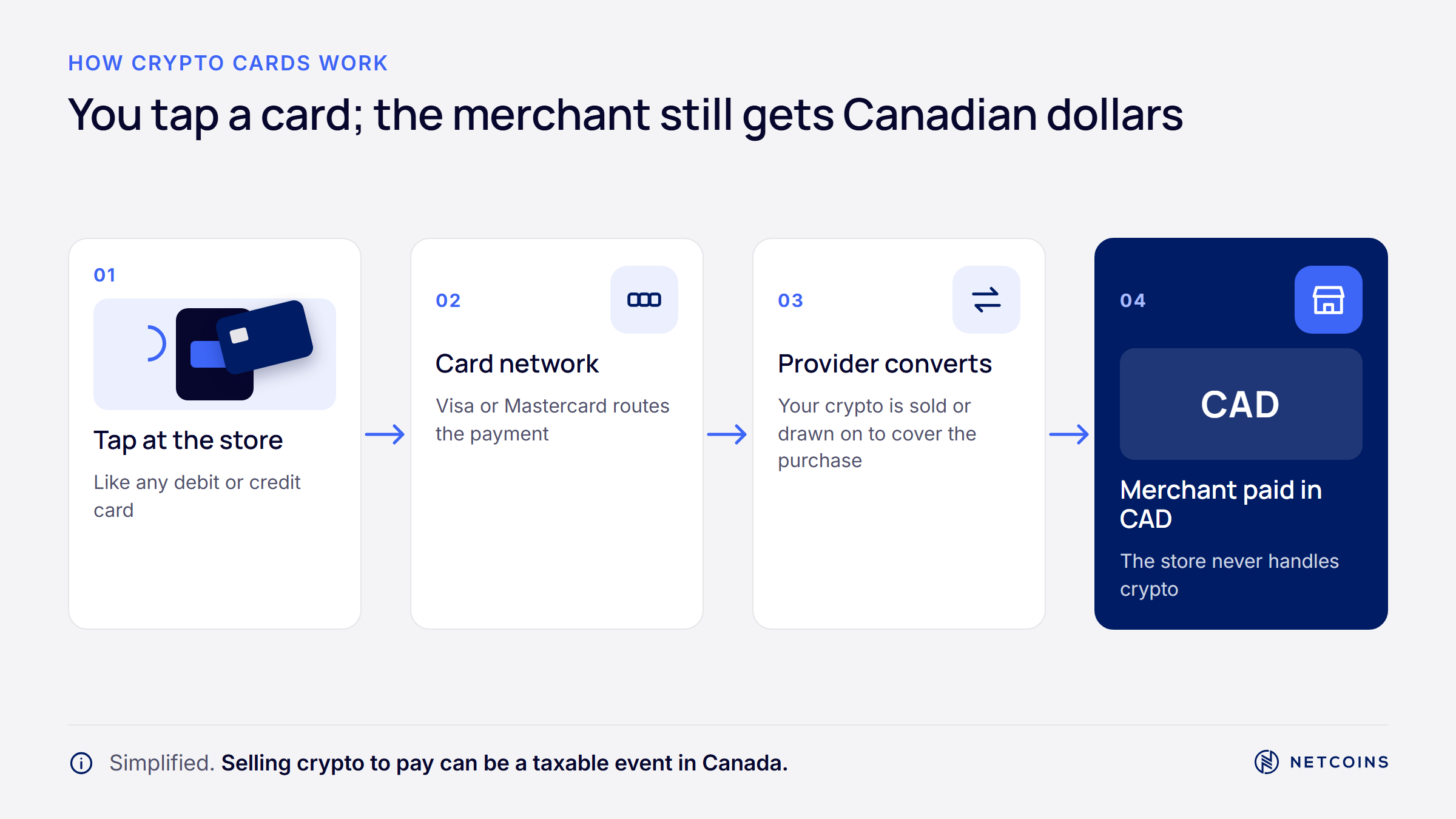
When you tap a crypto card at a store, the merchant's terminal asks for payment in CAD, the same as with any other card. The merchant never receives bitcoin or any other crypto. The request travels through the card network to the card issuer, which checks your available balance.
Cards usually work in one of two ways:
- CAD-funded cards: You load Canadian dollars first. The purchase is deducted from that CAD balance. Any crypto connection is through the rewards program.
- Crypto-funded cards: The provider sells some of your crypto at the time of purchase to cover the CAD amount. The sale price depends on the provider's rate, which may include a spread.
From the merchant's side, a crypto card looks like any other card payment. That means it can usually be used wherever the card network is accepted, in stores and online.
This fits how Canadians already pay. According to the Bank of Canada's 2025 Methods-of-Payment Survey, contactless card payments made up more than 60% of in-person payments in 2025, by both number and value [Source].
A crypto-funded card has one extra point to understand. Each time the provider sells crypto to pay for a purchase, you are selling an asset whose price changes. If a Halifax user pays for $80 of groceries with a crypto-funded card, the amount of crypto sold depends on the price at that moment. Selling or spending crypto may also have tax consequences, so speak with a qualified tax professional about your situation.
Our guide to where Canadians can spend Bitcoin covers other ways people use crypto for payments.
Prepaid Crypto Cards vs. Crypto Credit Cards
A prepaid crypto card lets you spend only the money you have loaded, while a true credit card lends you money up to a credit limit that you repay later.
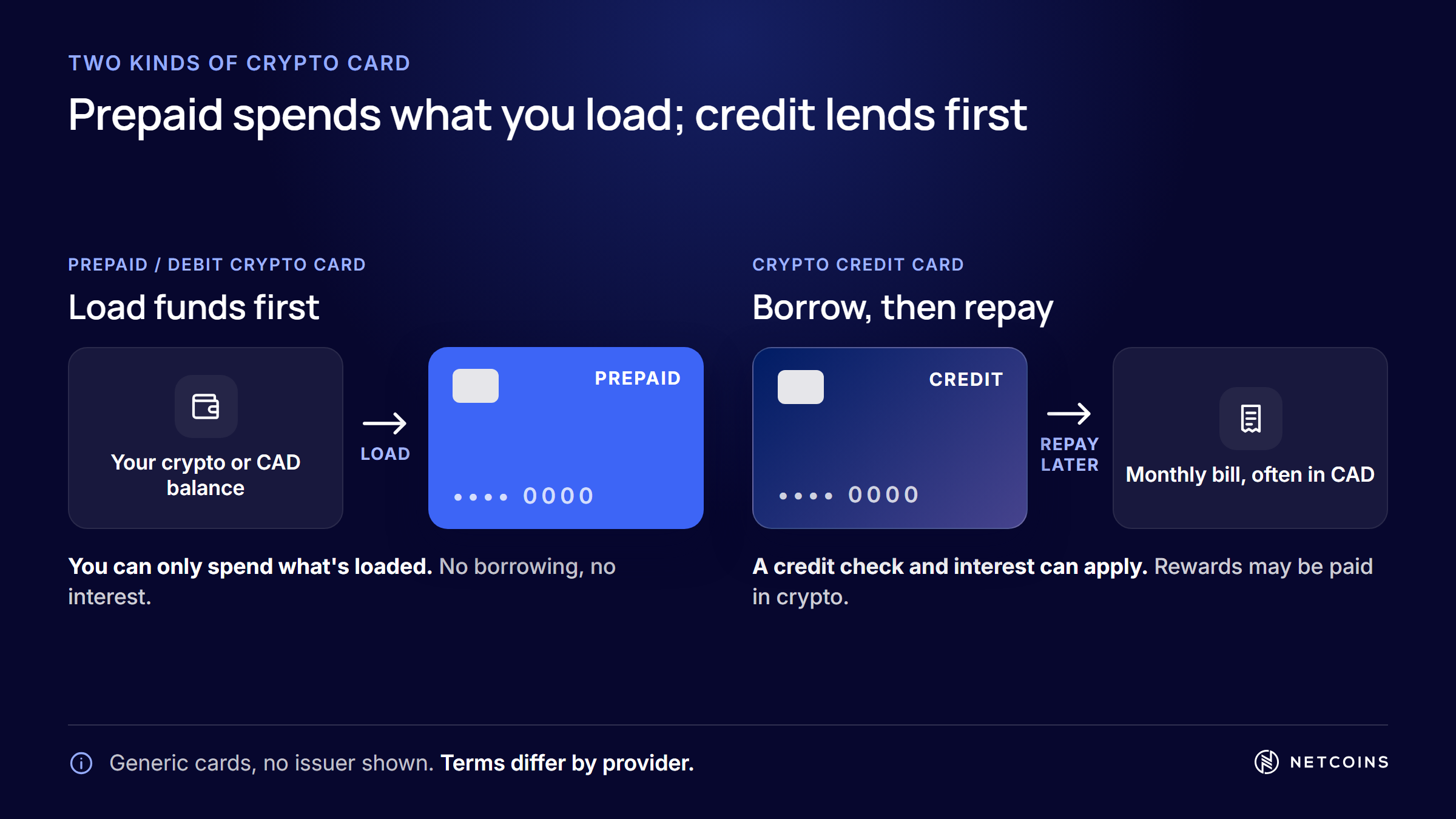
Most crypto cards offered to Canadians are open-loop prepaid cards. "Open-loop" means the card carries a Visa or Mastercard logo and can be used wherever that network is accepted. A closed-loop card, such as a store gift card, works at only one retailer.
Because a prepaid card does not lend you money:
- You cannot spend more than your available balance.
- Applying usually does not involve a hard credit check, but this depends on the issuer.
- Using the card usually does not build your credit history, because there is no credit to repay.
A true crypto credit card works like a regular credit card from a bank. The issuer sets a credit limit, you borrow against it, and you pay the statement balance later, with interest if you carry a balance. The "crypto" part is only the reward, which is paid in crypto instead of points or cash back.
True crypto credit cards are uncommon in Canada, and product availability changes over time. Some products marketed as "crypto credit cards" are actually prepaid. Read the cardholder agreement to see whether a card is prepaid, debit, or credit before you apply.
For a reader in Winnipeg comparing options, this difference matters more than the logo. A prepaid card limits spending to your balance, while a credit card can lead to interest charges if the balance is not paid in full.
Crypto Card Fees: What to Check
The most important crypto card costs to verify are foreign exchange fees, conversion spreads, ATM fees, and inactivity fees, because a card with "no annual fee" can still be expensive to use.
Use this list when you read a card's fee schedule:
- Foreign exchange (FX) fee: A percentage charged when you buy something priced in another currency, such as US dollars. This applies to many online subscriptions and to travel.
- Conversion spread: On crypto-funded cards, the difference between the market price of the crypto and the rate the provider uses when it sells your crypto. The spread is a cost even when a card advertises no conversion fee.
- Loading or top-up fees: Some providers charge to add money to the card, depending on the funding method.
- ATM fees: Many prepaid cards include a limited number of free withdrawals, then charge a fee per withdrawal or a percentage of the amount. The ATM owner may add its own fee.
- Inactivity fees: Some issuers charge a monthly fee if the card is not used for a set period.
- Monthly or subscription fees: Some reward tiers charge a monthly fee.
- Card issuance and replacement fees: Some providers charge for a physical card or for replacing a lost card.
- Crypto withdrawal fees: If you move your crypto rewards to another wallet, the platform may charge a withdrawal fee.
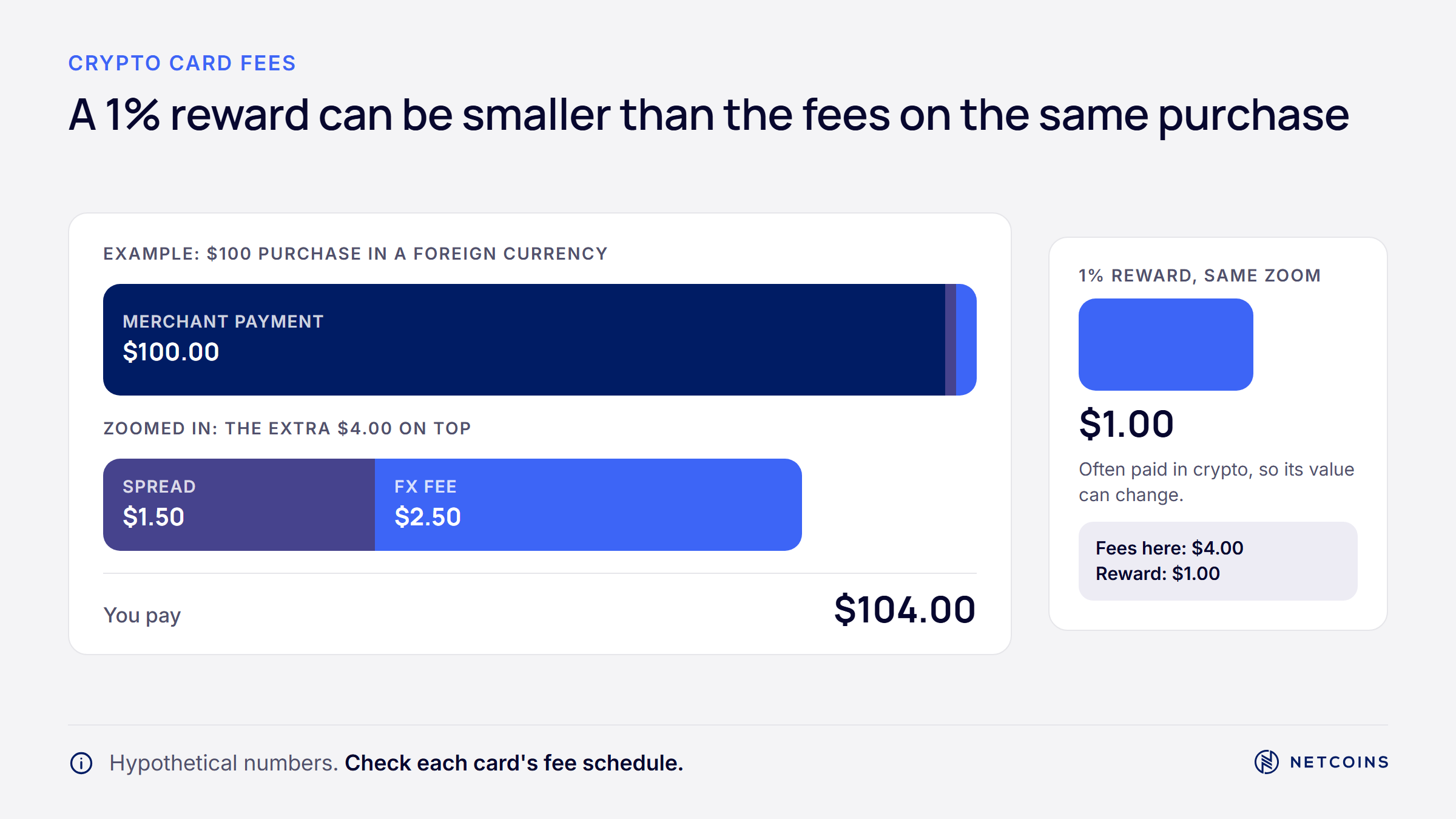
Here is a simple, hypothetical example of why fees matter. If a card charged a 2.5% FX fee on a $100 purchase priced in US dollars, the fee would be about $2.50, while a 1% reward on the same purchase would be worth about $1.00. In that case, the fee costs more than the reward earns. Actual fees and rewards vary by card.
Fee schedules change, so check the current version on the provider's website before you apply, and again from time to time.
How Crypto Cash Back Rewards Work
Crypto cash back rewards pay you a percentage of each purchase in crypto, such as bitcoin, instead of points or cash, and the value of that reward can rise or fall after you receive it.
Rewards are usually calculated on the CAD value of a purchase. The provider then converts that amount into crypto at its current rate, which may include a spread, and adds it to your account. Card programs generally fund rewards from interchange, the fee merchants pay to accept card payments.
Reward rates, eligible purchases, and conditions vary by card and can change. Some programs pay more to users who meet extra conditions, such as a minimum balance, a monthly subscription, or a lock-up of the platform's own token for a set period.
Lock-up conditions deserve extra care. If you must hold or lock a token to qualify for a higher reward rate, you are exposed to that token's price. If its value falls during the lock-up, the loss could be larger than the extra rewards. You may also be unable to sell it until the lock-up ends.
Other points to verify:
- Reward caps: Some programs limit how much you can earn each month.
- Reward timing: Rewards may be added after the transaction settles, not instantly.
- Refunds and returns: Rewards on refunded purchases may be reversed.
- Program changes: Providers can change reward rates or end a program.
For example, a Calgary user who earns $5 worth of bitcoin in rewards in a month could see that reward worth more or less the next month. Crypto rewards are not the same as fixed cash back.
Custody and Safety: Who Holds the Money Behind Your Card
The balance behind a crypto card is held by the card provider or its partners, so you rely on the provider's custody arrangements, security, and financial health.
With a prepaid crypto card, your CAD balance and any crypto are not in a wallet you control. A custodial platform or its custody providers manage the crypto, and the arrangement depends on the platform. Buying crypto through a platform may give you exposure to the underlying asset rather than direct ownership, depending on the platform's terms. Card programs often involve several companies, such as a card issuer, a program manager, and the crypto platform. Each one plays a role in holding and moving funds.
A balance held with a crypto platform is not the same as a deposit at a bank. Read the provider's terms to understand who holds your CAD and crypto, what happens if a partner stops operating, and what protections, if any, apply.
Practical steps that reduce, but do not remove, risk:
- Keep only what you plan to spend. A smaller balance limits what you could lose if something goes wrong.
- Turn on two-factor authentication (2FA) for the platform account.
- Use card controls such as freezing a lost card, if the app offers them.
- Watch for scams. No legitimate provider will ask for your password, 2FA code, or recovery phrase.
If you want to hold crypto rewards long term, you can usually withdraw them to a self-custody wallet. You then control the keys and are responsible for keeping them secure. Our guide to the best Bitcoin wallets for Canadian users compares wallet types.
How to Fund a Crypto Card Account
Most crypto card accounts in Canada can be funded with Interac e-Transfer, bank wire, or a crypto deposit, depending on the provider.
Interac e-Transfer is the most common way to move CAD from a Canadian bank account to a crypto platform. Check the provider's limits and any fees before you send. Our guide to how Interac e-Transfer works for crypto in Canada explains the process.
Bank wires are often used for larger amounts. Wires can take longer and may carry fees from your bank, the provider, or both.
Crypto deposits let you send crypto from another wallet or platform. Verify the exact address, the network, and any required destination tag or memo before you send, and check deposit minimums first.
Avoid funding a crypto platform with a credit card where it is treated as a cash advance. Many banks charge cash advance fees and start interest right away, and some block crypto purchases entirely. Check your credit card's terms before you try.
For a user in Regina funding a card for everyday spending, a simple approach is to load only what they expect to spend in the coming weeks, using a low-cost method such as Interac e-Transfer where available.
If you are new to crypto platforms in general, our step-by-step guide to buying Bitcoin in Canada walks through account setup, identity verification, and funding.
How to Compare Crypto Cards Before You Apply
Compare crypto cards on total cost, reward terms, custody, and availability, not just the headline reward rate.
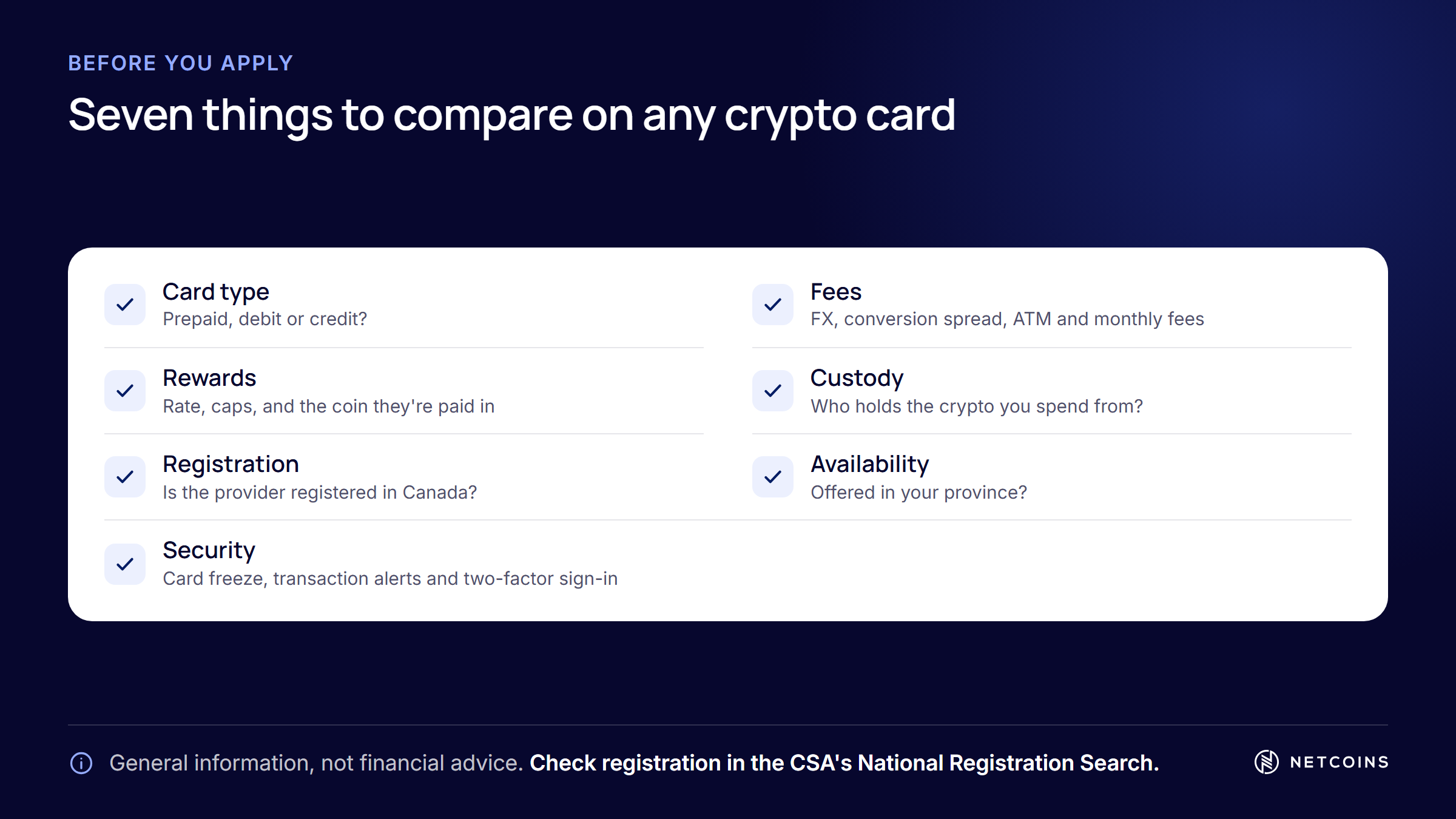
The crypto card market changes often. Cards launch, change terms, or close, and some international cards are not offered in Canada or in every province. Use this checklist when comparing:
- Card type: Is it prepaid, debit, or credit? Does it require a credit check?
- Funding: Is it CAD-funded or crypto-funded? Which funding methods are supported?
- Total fees: FX, spread, loading, ATM, inactivity, monthly, card, and withdrawal fees.
- Reward terms: Rate, eligible purchases, caps, timing, which asset rewards are paid in, and any lock-up or subscription conditions.
- Custody: Who holds the CAD and crypto, and what the terms say if a partner stops operating.
- Registration and terms: Whether the platform is registered with the applicable Canadian securities regulators, and what its cardholder agreement and risk disclosures say.
- Availability: Whether the card is offered in your province or territory.
- Support and security: 2FA, card freeze, and how to reach support if your card is lost.
Reading the fee schedule and cardholder agreement takes time, but it is the most reliable way to see what a card will cost you in practice.
People Also Ask About Crypto Credit and Debit Cards in Canada
Can you buy crypto with a credit card in Canada?
Some crypto platforms accept credit cards, but it is often expensive. Many Canadian credit card issuers treat crypto purchases as cash advances, which can mean a cash advance fee and interest charged from the day of the purchase, and some issuers block these purchases entirely. Check your credit card's terms first. Funding a platform account with Interac e-Transfer is often a lower-cost option, but verify the platform's fees and limits before you send money.
Do crypto debit cards affect your credit score?
Most prepaid crypto cards do not affect your credit score, because they do not lend you money. Applying usually does not involve a hard credit check, and the issuer generally does not report your spending to credit bureaus, but this depends on the issuer. The flip side is that a prepaid card usually does not help you build credit history. A true crypto credit card, by contrast, works like any credit card and can affect your credit score.
Are there crypto cards with no annual fee?
Yes, many prepaid crypto cards available to Canadians do not charge an annual fee. However, "no annual fee" does not mean no cost. Verify the full fee schedule, including foreign exchange fees, conversion spreads, ATM fees, inactivity fees, and any monthly fees for higher reward tiers. For some users, especially those who shop online in US dollars or travel, these other fees can cost more than an annual fee would.
How are merchants paid when I use a crypto card?
Merchants are paid in Canadian dollars, the same as with any other card payment. When you tap or enter a crypto card, the payment goes through the Visa or Mastercard network. If the card is CAD-funded, the amount comes from your CAD balance. If it is crypto-funded, the provider sells the needed amount of your crypto and pays the merchant in CAD. The merchant does not receive or handle any crypto.
Is it safe to keep money on a crypto card?
Keeping money on a crypto card means relying on the card provider and its partners to hold your funds. Your CAD and crypto are held by a custodial platform or its custody providers, not in a wallet you control, and a crypto platform balance is not the same as a bank deposit. Read the provider's terms, turn on two-factor authentication, and consider keeping only what you plan to spend on the card.
Frequently Asked Questions
What is the difference between an open-loop and a closed-loop prepaid card?
An open-loop prepaid card runs on a major card network, such as Visa or Mastercard, and can be used wherever that network is accepted. A closed-loop card, such as a store gift card, can be used at only one retailer or group of retailers. Most crypto cards offered to Canadians are open-loop prepaid cards, which is why they can be used at many stores and websites. Check the card's terms for any merchant restrictions.
What happens if a crypto card purchase is more than my balance?
If a purchase is larger than your available balance, it is usually declined. Some merchants support partial authorization, where the card pays part of the amount and you pay the rest another way, but this depends on the merchant and card. On crypto-funded cards, a sudden price drop can reduce the CAD value of your crypto balance, so a purchase that would have gone through earlier may be declined later.
Can a crypto card be used at an ATM in Canada?
Many prepaid crypto cards allow ATM withdrawals in Canadian dollars, but not all do. Providers often include a limited number of free withdrawals, then charge a fee per withdrawal or a percentage of the amount. The ATM owner may also charge its own fee, and daily withdrawal limits usually apply. Check the card's fee schedule and limits before relying on it for cash.
Why do some crypto cards require a token lock-up?
Some card programs offer higher reward rates only to users who hold or lock up a set amount of the platform's own token for a period of time. This encourages users to hold the token. The risk is that you are exposed to that token's price while it is locked, and you may not be able to sell it until the lock-up ends. If its value falls, the loss could be larger than the extra rewards.
Are foreign exchange fees common on crypto cards?
Yes, many crypto cards charge a foreign exchange fee when you buy something priced in a currency other than Canadian dollars, such as a US-dollar subscription or a purchase while travelling. The fee is usually a percentage of the purchase, and it can be larger than the reward you earn on that purchase. Some reward tiers reduce or waive the fee. Verify the FX fee on the provider's current fee schedule before you apply.
Quick Glossary
Prepaid card: A card that lets you spend only the money you have loaded, without borrowing.
Open-loop card: A card on a major network, such as Visa or Mastercard, that can be used wherever that network is accepted.
Closed-loop card: A card, such as a store gift card, that works at only one retailer or group of retailers.
Foreign exchange (FX) fee: A percentage fee charged when you buy something priced in another currency.
Spread: The difference between the market price of an asset and the rate a provider uses when it buys or sells it.
Interchange: The fee merchants pay to accept card payments, which card programs often use to fund rewards.
Lock-up: A requirement to hold an asset for a set period, during which it may not be sold.
Custody: Holding and safeguarding assets, either by a provider or by you in a self-custody wallet.
Key Takeaways
- Most crypto cards offered to Canadians are prepaid Visa or Mastercard cards, so you can only spend your loaded balance.
- Merchants are always paid in Canadian dollars; the provider handles any crypto sale in the background.
- "No annual fee" does not mean no cost: verify FX fees, conversion spreads, ATM, inactivity, and monthly fees.
- Crypto rewards can rise or fall in value, and lock-up conditions expose you to a token's price.
- The money behind your card is held by the provider or its partners, so read the terms and keep only what you plan to spend.
Closing
Crypto cards connect a crypto platform account to everyday card payments, but the full cost depends on fees, spreads, and reward terms that are easy to miss. Understanding who holds your money, how rewards work, and what each fee covers makes it easier to compare cards. None of this reduces the risk of holding crypto, and the value of crypto balances and rewards can move sharply. To understand the basics of buying crypto before choosing a card, read how buying crypto in Canada works, step by step.

About Netcoins
Established in 2014 in Vancouver, British Columbia, Netcoins is a registered Restricted Dealer with the provincial securities commissions and a registered Money Services Business (MSB) with FINTRAC. Netcoins is owned by Surge Digital Inc. (formerly BIGG Digital Assets Inc.), a publicly traded company listed on the TSX Venture Exchange (TSXV: SRGE), and complies with applicable public company regulatory.
The information provided in the blog posts on this platform is for educational purposes only. It is not intended to be financial advice or a recommendation to buy, sell, or hold any cryptocurrency. Always do your own research and consult with a professional financial advisor before making any investment decisions. Cryptocurrency investments carry a high degree of risk, including the risk of total loss. The blog posts on this platform are not investment advice and do not guarantee any returns. Any action you take based on the information on our platform is strictly at your own risk. The content of our blog posts reflects the authors’ opinions based on their personal experiences and research. However, the rapidly changing and volatile nature of the cryptocurrency market means that the information and opinions presented may quickly become outdated or irrelevant. Always verify the current state of the market before making any decisions.


