TL;DR
Real trading bots follow rules the user sets, need ongoing attention, and can lose money. Fake AI auto-trading apps promise effortless profits, use deepfake videos of public figures, and block withdrawals with surprise fees. Before depositing anywhere, check that the platform is registered, ignore unsolicited investment pitches, and never pay a fee to "release" your money.
Artificial intelligence has become a selling point in crypto, and scammers have noticed. Ads that look like news reports show a familiar face praising a new "AI trading app" that makes money on its own. Some are fake from start to finish. This guide explains in plain language how real trading bots work, how fake auto-trading apps operate, and which warning signs Canadians can look for before sending any money.
What Are AI Trading Bots and Auto-Trading Apps?
An AI trading bot, or auto-trading app, is software that places buy and sell orders automatically based on rules. Real bots follow settings the user chooses. They do not know where prices are going and cannot remove the risk of loss.
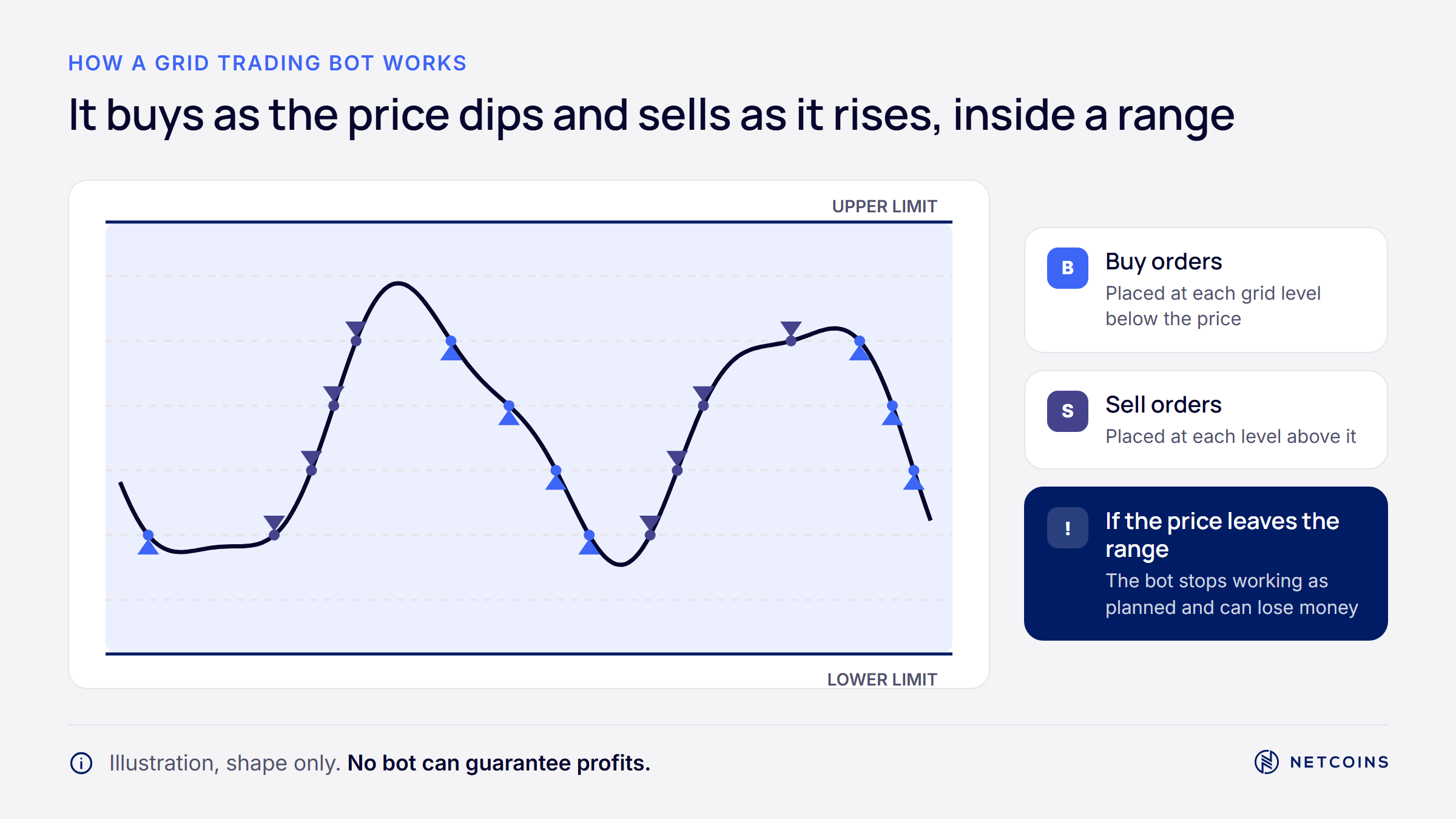
Two common types of real trading bots work like this:
- Grid bots: The user picks a price range and splits it into steps. The bot places buy orders near the bottom of the range and sell orders near the top. If the price moves sharply outside the range, the bot can hold losing positions.
- Dollar-cost averaging (DCA) bots: The bot buys a fixed amount of a crypto asset on a regular schedule, such as $50 CAD every week. This spreads purchases over time, but the asset can still lose value.
Both types need the user to choose the assets, the amounts, and the settings, and both can lose money. A bot can also fail if the platform it connects to has an outage, or if its settings no longer fit the market. Bots connect to trading platforms through an API key, which is a kind of digital permission. Giving any third party an API key with withdrawal rights can put funds at risk.
A fake auto-trading app works differently. It usually asks for no settings at all. It claims its "AI" or "quantum" technology trades for you and delivers steady profits. The trades shown on its dashboard are often made up, and the money deposited may never reach a real market.
Real automation is a tool, not a money machine. Any app that promises profit without effort or risk is a strong warning sign. Readers who want to learn how buying crypto normally works can start with this guide on how to buy Bitcoin in Canada.
How Are Fake AI Trading Apps Targeting Canadians?
Fake AI trading apps often reach Canadians through social media ads that use deepfake videos, which are AI-made videos that copy a real person's face and voice. The ads are made to look like news reports.
The losses are large. According to the Canadian Anti-Fraud Centre, as reported by CBC News, Canadians reported losing more than $388 million to cryptocurrency scams between January 2024 and September 2025, and only an estimated 5 to 10 percent of victims report the fraud. [Source] The real total is likely higher.
Scammers copy the likeness of people Canadians trust, including politicians, news anchors, and business leaders. CBC has reported on a Saskatchewan retiree who lost money after seeing a fake video that appeared to show the prime minister promoting a crypto platform. None of these public figures endorse the apps. Their faces and voices are copied without permission.
The ads often share a few features:
- A video or article that looks like a real news segment
- A public figure who seems to reveal a "secret" way to make money
- Claims that the platform is new, limited, or backed by the government
- A link to a sign-up page that asks for your name, email, and phone number
Deepfakes are getting harder to spot, so the safest approach is to treat any ad that promises easy crypto profits as a likely scam, no matter who appears in it. Real public figures do not use social media ads to share secret trading tools.
If you see one of these ads, you can report it to the social media platform and to the Canadian Anti-Fraud Centre. Sharing the warning with family members, especially older relatives, can help too, since these ads often target people with savings.
What About Quantum AI, Immediate Edge, and Bitcoin Code?
Canadian securities regulators have issued investor alerts about online entities using names such as "Quantum AI," "Immediate Edge," and "Bitcoin Code." These alerts generally state that the entities are not registered to trade or advise in that province.
For example, an alert listed in the Canadian Securities Administrators' database says that an entity called Quantum AI, found at several websites, is not registered in Ontario to engage in the business of trading in securities. [Source] An Ontario Securities Commission warning about "Immediate Edge Canada" says it is not registered in Ontario and lists other names it has used, including "Immediate Connect Canada" and "Bitcodeprime Canada." [Source] "Bitcoin Code" also appears in the Canadian Securities Administrators' alerts database as an alert from the British Columbia Securities Commission. [Source]
A few things are worth knowing about these names:
- Names change often. When one website is flagged, a similar one can appear under a slightly different name. A missing alert does not mean a site is safe.
- Similar names can be unrelated. Some legitimate businesses may use words such as "quantum" or "AI." Check the exact website and company, not just the name.
- "Bitcoin Code" is not Bitcoin. Bitcoin is an open-source network whose code anyone can review. An app called "Bitcoin Code" borrows the name, and it has no connection to the Bitcoin network itself.
Searching a name together with "review" can lead to pages that look independent but are made to sell the same app. It is safer to check registration directly and look for official alerts than to trust online reviews.
If an app you are looking at matches one of these names, or works the same way, stop before sending any money.
What Are the Red Flags of a Fake Auto-Trading App?
Fake auto-trading apps usually follow the same steps, from an ad to a sales call to a blocked withdrawal. Spotting any of these signs is a reason to stop.
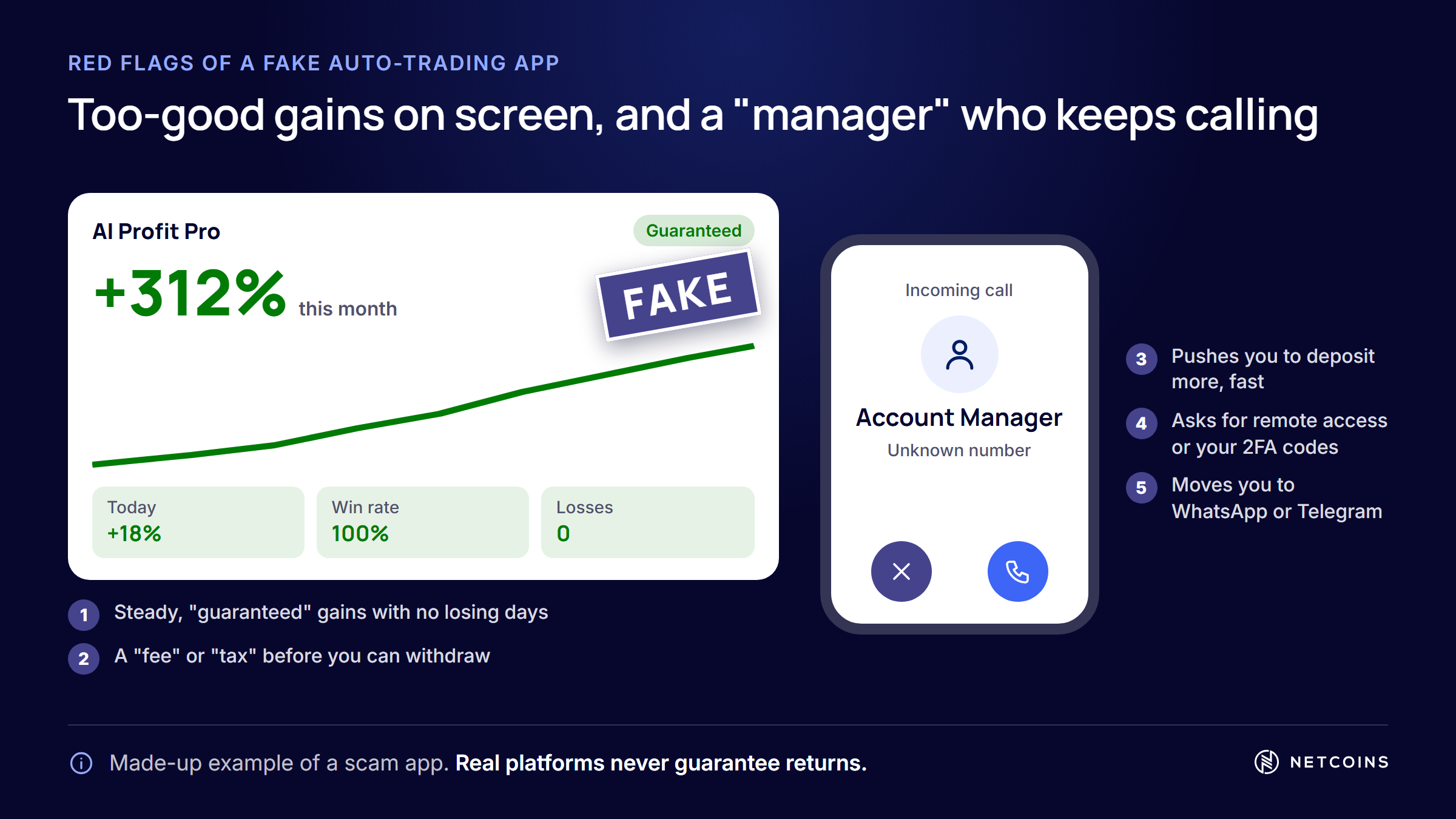
- The deepfake hook: An ad or fake news article shows a public figure praising an AI trading tool.
- The sign-up form: A landing page asks for your contact details and says spots are limited or closing soon.
- The fast sales call: Soon after, someone calling themselves an "account manager" or "trading specialist" phones you and pushes for a deposit.
- The small first deposit: You are asked for a modest first payment, which feels low-risk and builds trust.
- The fake dashboard: Your balance seems to grow quickly. The trades are often made up.
- Remote access requests: You are asked to install screen-sharing or remote desktop software "to help set up your account."
- The withdrawal wall: When you try to withdraw, you are told to pay a tax, fee, or "release charge" first. More fees follow.
Pressure is part of the design. Scammers create urgency so people act before thinking things through. They may say the offer ends today, or try to make you feel foolish for hesitating. Taking time, talking to someone you trust, and checking the platform yourself can break that pressure.
Promises are another clue. No legitimate trading tool can promise steady daily profits or remove all risk. Phrases such as "guaranteed returns," "no experience needed," or "the AI does everything" are warning signs.
Payment requests matter too. Be cautious if you are asked to pay with gift cards, send crypto to a personal wallet address, or wire money to an individual or an overseas company. A legitimate platform does not ask customers to pay fees to unlock their own money.
How Do Pig Butchering and Recovery Scams Connect to Fake Trading Apps?
Fake trading apps also appear in two other common scams: pig butchering, where scammers build trust over weeks before steering someone to a fake app, and recovery scams, which target people who have already lost money.
Pig butchering. The scam usually starts with a friendly message, a "wrong number" text, or a dating match. Over weeks or months, the scammer builds trust and talks about their own success with a special trading app or bot. They may let the victim withdraw a small amount at first to build confidence. Larger deposits follow. When the victim tries to withdraw a large amount, the account is frozen, fees are demanded, and the contact disappears.
Recovery scams. After a loss, victims may be contacted by someone claiming they can get the money back. They may pose as a lawyer, a hacker, a "blockchain investigator," or even a government official. They often ask for an upfront fee, or for a wallet's seed phrase, or for remote access to "sync" a wallet. Paying or sharing these details leads to a second loss.
A few facts help protect against recovery scams:
- Blockchain transactions generally cannot be reversed, and no hacker can force a scammer's wallet to return funds.
- Government agencies do not contact victims through messaging apps to demand fees.
- Anyone who asks for a seed phrase can take full control of that wallet.
For a broader look at these schemes and others, see this guide to common Bitcoin scams in Canada.
How Can Canadians Check a Platform and Protect Themselves?
The safest habits are simple: check a platform's registration yourself, ignore unsolicited investment offers, protect your accounts, and fund only through normal banking channels to the platform itself.
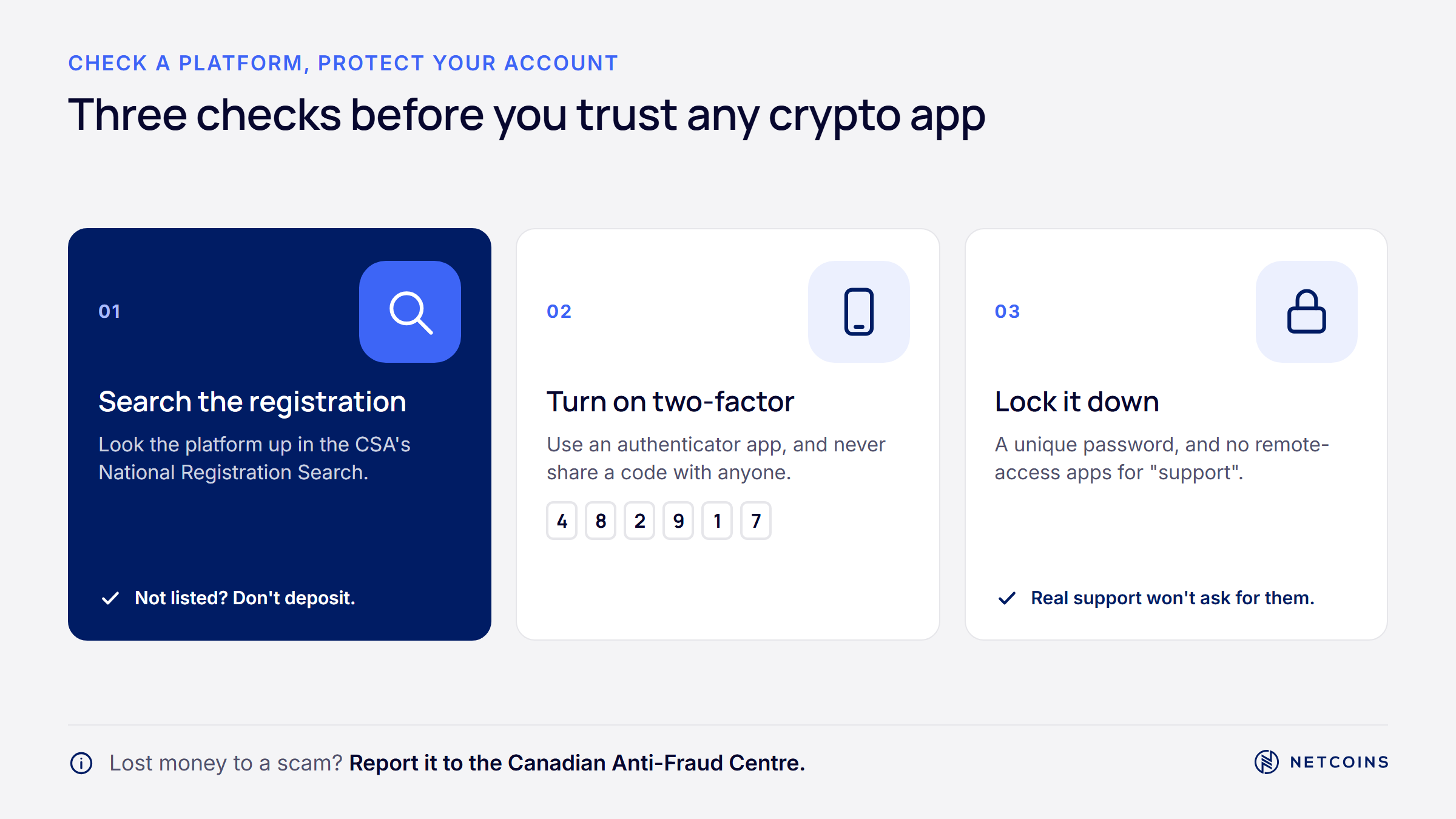
Before opening an account, you can look up a firm in the Canadian Securities Administrators' National Registration Search. Search for the exact company name yourself rather than using a link from an ad or a sales caller. Then check the platform's current custody, fee, and risk disclosures. Netcoins explains common safeguards, and their limits, in this guide to crypto platform security measures.
Account security matters too:
- Use a unique password for each account, stored in a password manager.
- Turn on two-factor authentication, ideally through an authenticator app rather than text messages.
- Never share your password, two-factor codes, or seed phrase with anyone.
- Never install remote access software at a stranger's request.
- Type website addresses yourself instead of clicking links in ads or messages.
When funding an account, send money only to the platform's own verified payment details, using normal methods such as Interac e-Transfer or bank wire. Be wary of any request to send money to a person, an overseas company, or a crypto address to "unlock" an account. Readers can learn how storage works in this guide to centralized crypto custody and self-custody.
If you think you have been targeted:
- Stop sending money and stop contacting the scammer.
- Contact your bank or the platform you used to send funds.
- Report the fraud to your local police and to the Canadian Anti-Fraud Centre.
- Keep records, including messages, website addresses, and transaction details.
Recovery of lost funds is not guaranteed, but reporting helps authorities track scam networks and can help protect others.
People Also Ask About AI Trading Bots in Canada
Are AI crypto trading bots legal in Canada? Using trading software is not illegal in itself, but who offers it and how matters.
Many "AI trading" apps advertised online have been named in regulator alerts as not registered to trade with Canadians. Before using any service, check the company in the National Registration Search and read its disclosures. Using a bot does not remove market risk, and any bot can lose money.
Is Quantum AI legit? Canadian securities regulators have issued alerts saying entities using the name "Quantum AI" are not registered in their provinces.
One alert listed by the Canadian Securities Administrators says an entity called Quantum AI is not registered in Ontario to trade in securities. [Source] Names and websites change often, so check registration yourself and treat any app promising easy profits with caution.
Can an AI trading bot guarantee profits? No, no trading bot can guarantee profits, because no software can predict market prices reliably.
Real bots follow rules the user sets and can lose money when markets move unexpectedly. An app that promises steady daily returns, or says its AI removes all risk, is showing a common sign of a scam.
Why do fake trading apps use celebrities? Scammers use deepfake videos of trusted public figures to make their apps seem credible.
The people shown have not endorsed the apps. Their faces and voices are copied with AI tools. Treat any ad that shows a public figure promising easy crypto profits as a likely scam, and report it.
What should I do if a trading app won't let me withdraw? Stop sending money, because demands for fees or taxes before a withdrawal are a common sign of fraud.
Contact your bank or the payment provider you used, keep records of everything, and report the fraud to your local police and the Canadian Anti-Fraud Centre. Be cautious of anyone who then offers to recover your money for a fee.
Frequently Asked Questions
How does a grid trading bot work? A grid trading bot places buy and sell orders at set price steps inside a range the user chooses. It buys as the price moves down within the range and sells as it moves up. If the price moves sharply outside the range, the bot can hold losing positions. Grid bots need the user to choose settings and to watch them, and they can lose money.
What is a DCA bot? A DCA bot buys a fixed amount of a crypto asset on a regular schedule, such as every week. This approach, called dollar-cost averaging, spreads purchases over time instead of buying all at once. It does not prevent losses, and the asset can lose value over the whole period. The user still chooses the asset, the amount, and the schedule.
What is a deepfake? A deepfake is a video or audio clip made with AI tools to copy a real person's face or voice. Scammers use deepfakes of politicians, news anchors, and business leaders to make fake investment ads look real. Deepfakes are getting harder to spot, so it is safer to treat any ad promising easy crypto profits as a likely scam, no matter who appears in it.
What is a crypto recovery scam? A crypto recovery scam targets people who have already lost money, by offering to get it back. The scammer may pose as a lawyer, a hacker, an investigator, or a government official, and asks for an upfront fee, a seed phrase, or remote access to a device. Blockchain transactions generally cannot be reversed by a private hacker, and paying or sharing these details usually leads to another loss.
Is the Bitcoin Code app related to Bitcoin? No, an app called "Bitcoin Code" is not part of the Bitcoin network. Bitcoin is an open-source network whose code anyone can review, while the app borrows the name to seem trustworthy. "Bitcoin Code" has appeared in Canadian securities regulator alerts. Check any app's registration yourself, and be cautious of online reviews that may be designed to sell it.
Quick Glossary
AI Trading Bot: Software that places trades automatically based on rules, sometimes marketed with AI features.
Auto-Trading App: An app that claims to trade for the user. Many advertised online are scams.
Grid Trading: A bot strategy that places buy and sell orders at set price steps within a range.
Dollar-Cost Averaging (DCA): Buying a fixed amount of an asset on a regular schedule.
Deepfake: A fake video or audio clip made with AI to copy a real person.
API Key: A digital permission that lets software connect to a trading account.
Pig Butchering: A long scam where trust is built over time before steering the victim to a fake investment.
Recovery Scam: A scam that targets past victims by falsely promising to get their money back.
Key Takeaways
- Real trading bots follow user-set rules, need attention, and can lose money. None can guarantee profits.
- Fake AI auto-trading apps often use deepfake ads of public figures and fake dashboards to take deposits.
- Canadian securities regulators have issued alerts about entities using names such as "Quantum AI," "Immediate Edge," and "Bitcoin Code."
- A demand for fees before a withdrawal, or an offer to recover lost money for a fee, is a common sign of fraud.
- Check registration yourself, protect your accounts, and report fraud to local police and the Canadian Anti-Fraud Centre.
Closing
AI can be a useful tool in trading, and it is also a powerful sales pitch for scammers. Knowing how real bots work, and how fake auto-trading apps operate, makes it easier to spot the difference before money is at risk. Checking registration, ignoring unsolicited offers, and refusing to pay fees to unlock your own money are simple habits that help. To learn how buying crypto normally works, see this step-by-step guide for Canadians on buying Bitcoin.

About Netcoins
Established in 2014 in Vancouver, British Columbia, Netcoins is a registered Restricted Dealer with the provincial securities commissions and a registered Money Services Business (MSB) with FINTRAC. Netcoins is owned by Surge Digital Inc. (formerly BIGG Digital Assets Inc.), a publicly traded company listed on the TSX Venture Exchange (TSXV: SRGE), and complies with applicable public company regulatory.
The information provided in the blog posts on this platform is for educational purposes only. It is not intended to be financial advice or a recommendation to buy, sell, or hold any cryptocurrency. Always do your own research and consult with a professional financial advisor before making any investment decisions. Cryptocurrency investments carry a high degree of risk, including the risk of total loss. The blog posts on this platform are not investment advice and do not guarantee any returns. Any action you take based on the information on our platform is strictly at your own risk. The content of our blog posts reflects the authors’ opinions based on their personal experiences and research. However, the rapidly changing and volatile nature of the cryptocurrency market means that the information and opinions presented may quickly become outdated or irrelevant. Always verify the current state of the market before making any decisions.