


TL;DR
Owning Bitcoin means you hold the asset directly, can trade it 24/7, and can move it to your own wallet. Owning a Bitcoin ETF means you hold fund units in an investment account, trade them during stock market hours, and pay the fund's ongoing management fees. Neither option is safer or better in general. Both follow a volatile asset, and you could lose money with either.
Many Canadians see "Bitcoin" in the name of an ETF and assume it is the same as owning Bitcoin. It is not. This guide explains, in plain language, what you actually own with each option, how costs and trading hours differ, and what risks each one carries. Whether you are in Toronto, Calgary, or Halifax, understanding these differences helps you make your own informed decision.
What Is the Difference Between Bitcoin and a Bitcoin ETF?
The main difference is what you own. Bitcoin is a decentralized digital asset that runs on the Bitcoin network. A Bitcoin ETF is an investment fund that holds Bitcoin and sells units of the fund on a stock exchange.
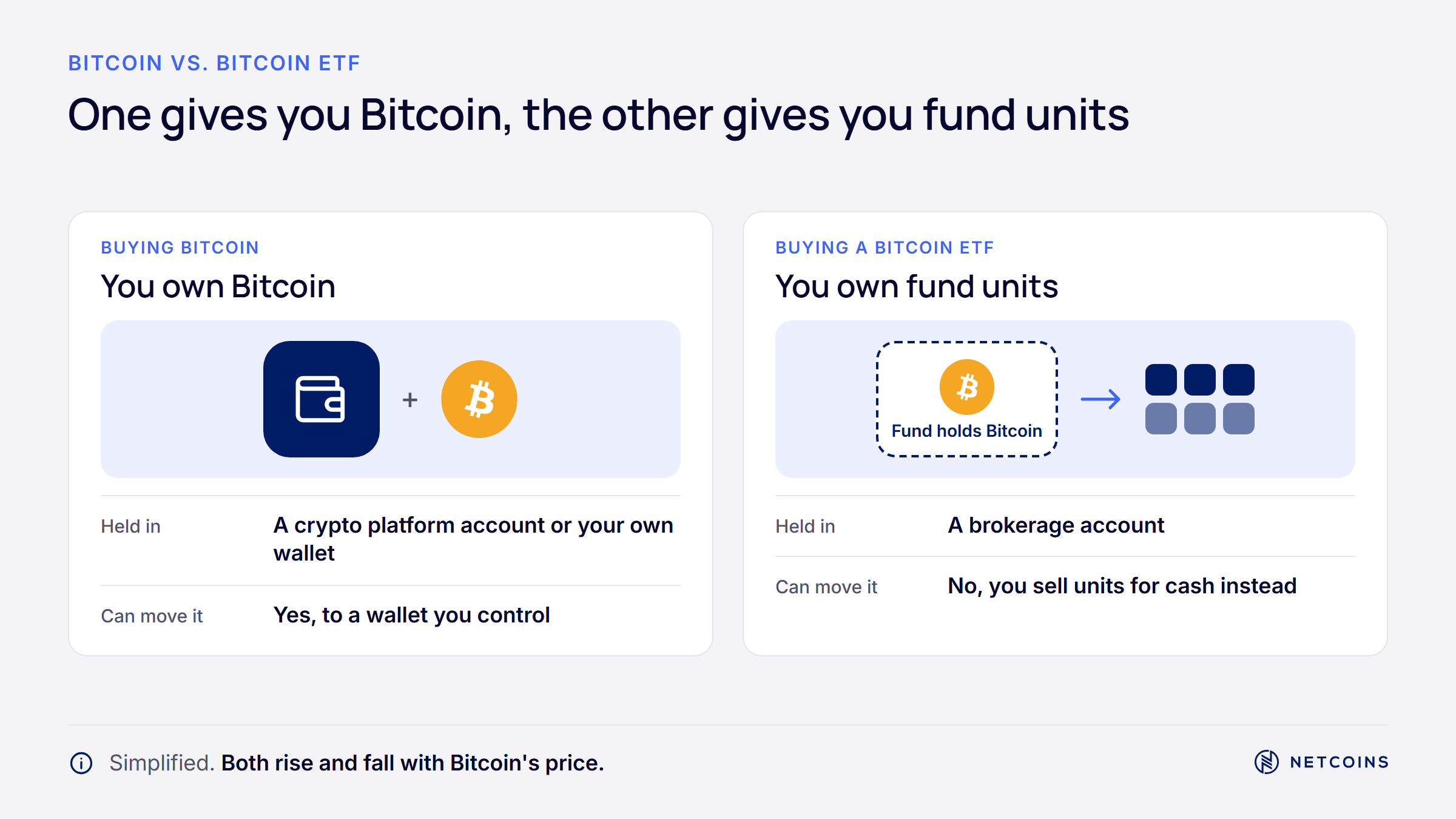
When you buy Bitcoin, you own the asset. If you hold it in a wallet you control, you hold the private keys. If you hold it on a crypto trading platform, the platform or its custodian holds it for you.
When you buy a Bitcoin ETF, you own units of a fund. The fund holds the Bitcoin, and a custodian stores it. You cannot send the fund's Bitcoin to a wallet or use it on the Bitcoin network. Your units go up or down with the fund's value.
Both options are designed to follow Bitcoin's price, so both are exposed to its volatility. The differences are in the details: how you buy, when you can trade, what you pay, and who holds the Bitcoin.
If you are new to Bitcoin itself, our guide on what Bitcoin is explains how the network works.
What Is a Bitcoin ETF?
An ETF, or exchange-traded fund, is an investment fund whose units trade on a stock exchange, like shares. A Bitcoin ETF is an ETF that holds Bitcoin, or in some cases Bitcoin-linked contracts, and aims to follow Bitcoin's price minus the fund's fees.
Canada played an early role. In February 2021, the Ontario Securities Commission cleared the launch of what Reuters described as the world's first Bitcoin ETF [Source]. North America's first Bitcoin ETF began trading on the Toronto Stock Exchange on February 18, 2021, according to The Canadian Press [Source].
There are two broad types:
- Spot Bitcoin ETFs hold actual Bitcoin through a custodian. Their value follows the price of the Bitcoin they hold.
- Futures-based Bitcoin ETFs hold contracts linked to Bitcoin's future price instead of Bitcoin itself. Their returns can differ more from Bitcoin's price because of how those contracts work.
Each fund has a prospectus and other documents that explain what it holds, its fees, and its risks. Reading these is the best way to understand a specific fund.
A Bitcoin ETF holds Bitcoin, not a basket of other cryptocurrencies. Some funds hold several crypto assets, but those are different products, often called crypto index funds. Check a fund's holdings rather than relying on its name.
What You Own: Bitcoin vs Bitcoin ETF Units
This is the core difference, so it helps to be specific.
With Bitcoin, you own:
- The digital asset itself, measured in Bitcoin, which can be divided into very small units.
- The ability, on most crypto trading platforms, to withdraw it to a wallet you control.
- The ability to send it on the Bitcoin network to another address.
With a Bitcoin ETF, you own:
- Units of an investment fund, held in an account at an investment dealer.
- A claim on the fund's value, not on specific Bitcoin.
- No ability to withdraw Bitcoin or send it on the network.
Here is a simple example with made-up numbers. Suppose you put $500 into Bitcoin and $500 into a Bitcoin ETF on the same day. If Bitcoin's price rises 10%, both holdings would rise by roughly 10%, before fees. If Bitcoin's price falls 30%, both would fall by roughly 30%. The ETF would also be reduced over time by its management fee, and its price can differ slightly from the value of the Bitcoin it holds.
The point is not that one is better. It is that you are buying two different things that move with the same asset.
2B. Rewritten article, part 2
Bitcoin ETF vs Traditional ETF
A Bitcoin ETF uses the same structure as a traditional ETF, but what it holds is very different.
What is the same:
- Both are investment funds whose units trade on a stock exchange.
- Both are bought and sold through an account at an investment dealer.
- Both charge an annual management fee, usually shown as a management expense ratio (MER).
- Both publish a prospectus and other documents describing holdings, fees, and risks.
What is different:
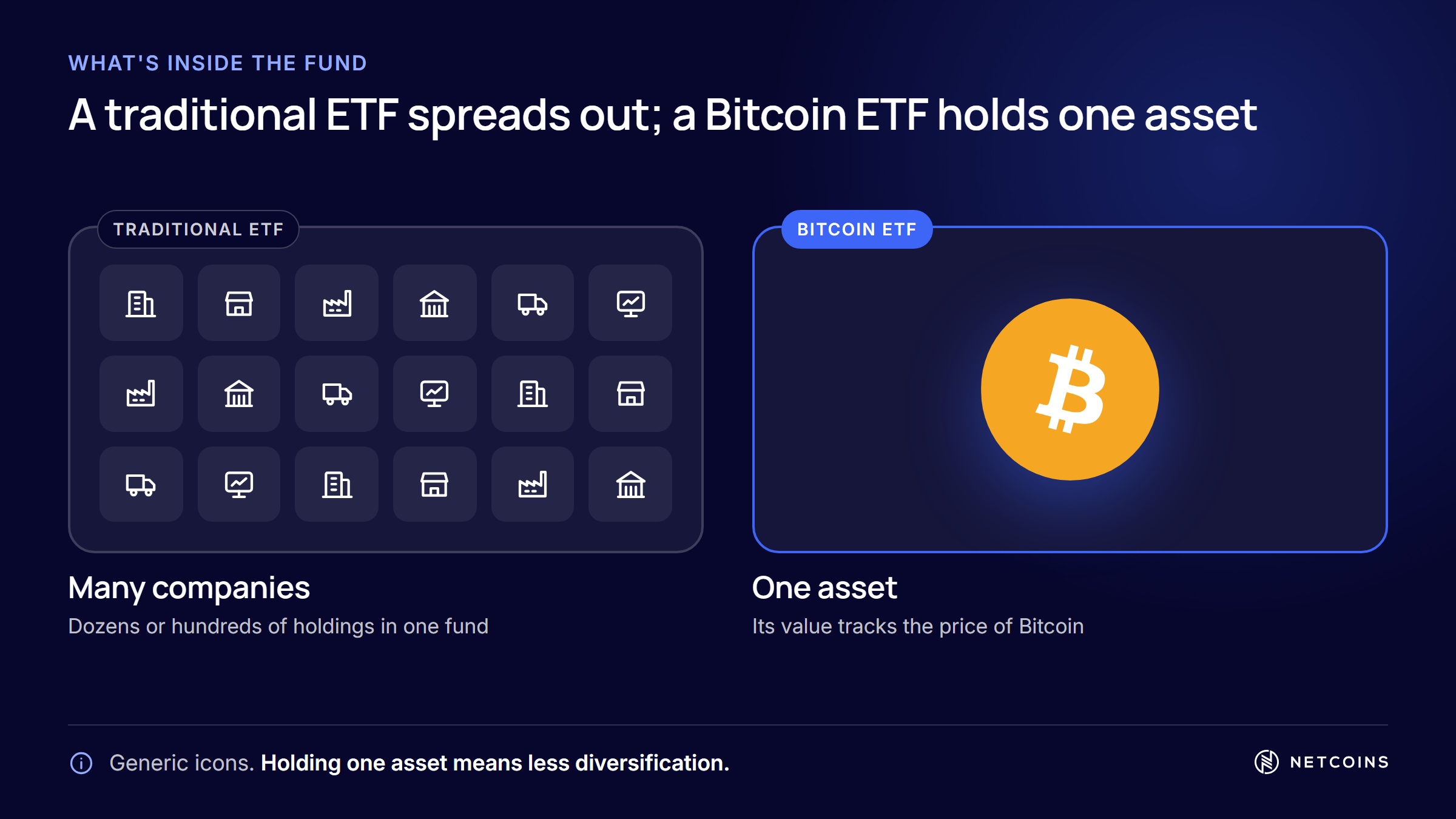
- Holdings. A traditional broad-market ETF often holds many stocks or bonds. A Bitcoin ETF holds one asset: Bitcoin or Bitcoin-linked contracts.
- Diversification. Because a Bitcoin ETF holds one asset, it does not spread risk the way a broad ETF of many companies does.
- Volatility. Bitcoin's price has historically moved much more sharply than many broad stock or bond markets, so a Bitcoin ETF's units can rise and fall sharply too.
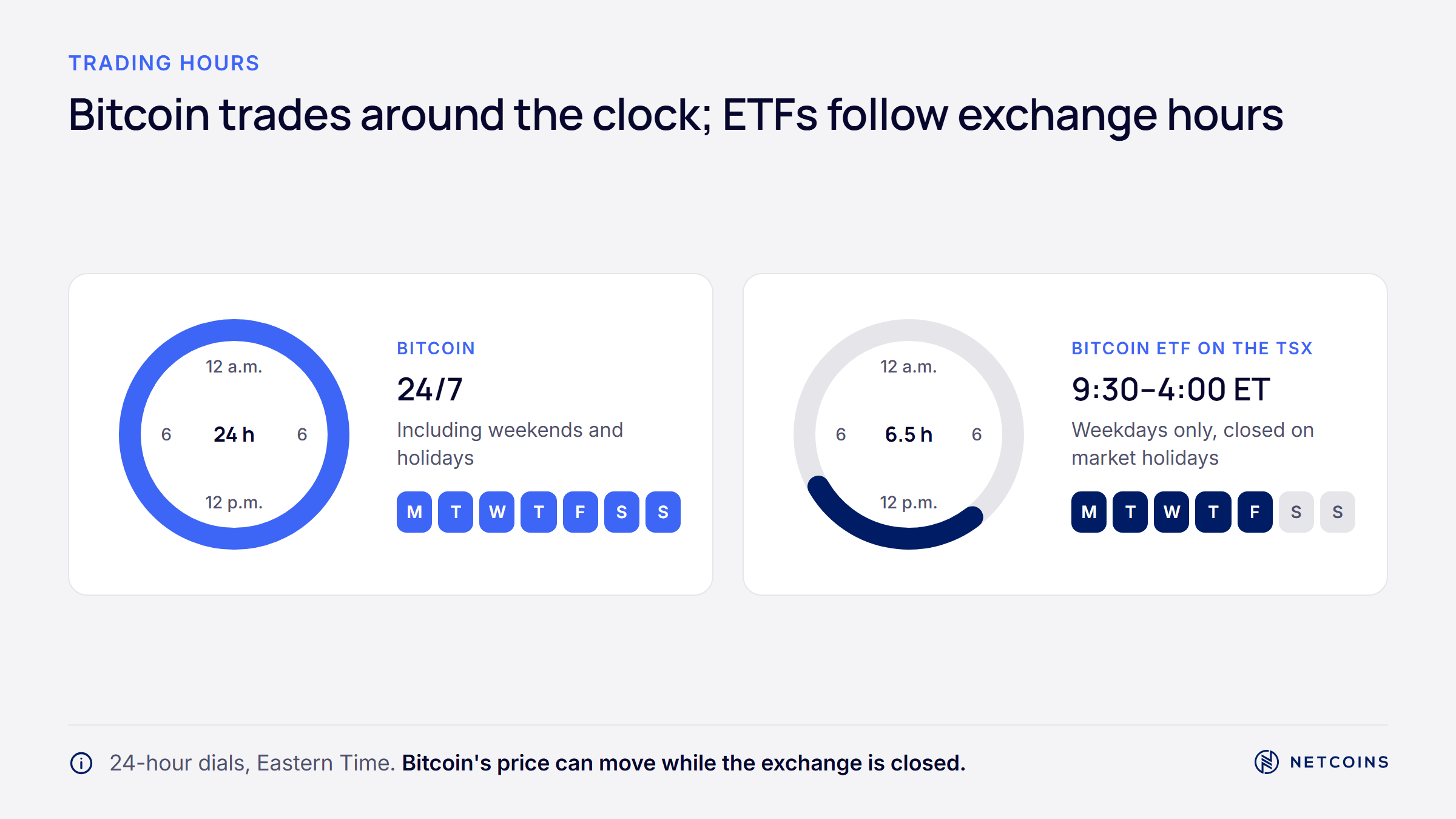
- Trading-hour mismatch. Bitcoin trades 24/7, but ETF units trade only when the stock exchange is open. If Bitcoin's price moves overnight or on a weekend, the ETF's price can open noticeably higher or lower on the next trading day.
A familiar ETF wrapper does not make the asset inside it less risky. A Bitcoin ETF carries Bitcoin's price risk plus the risks of the fund itself.
Costs, Trading Hours, and Access Compared
The table below compares the practical differences. Exact fees and hours depend on the platform, dealer, and fund you use.
Costs. With Bitcoin, you typically pay the platform's fees or spread when you buy or sell, plus network fees if you move Bitcoin to a wallet. For Netcoins, current fees are on the Netcoins fees page. With an ETF, the management fee is taken from the fund over time, whether or not you trade, and your dealer may charge commissions.
Hours. Bitcoin can be bought or sold at any hour. ETF units can only be traded while the exchange is open.
Access. Bitcoin is bought on a crypto trading platform after identity verification. ETF units are bought through an investment dealer account. Our step-by-step guide to buying Bitcoin in Canada explains the Bitcoin side, including funding from a Canadian bank account.
Taxes. Selling or trading either one can have tax consequences in Canada, and the rules depend on your situation and account type. Speak with a qualified tax professional.
Custody and Investor Protection
Both options rely on someone holding Bitcoin securely. The difference is who.
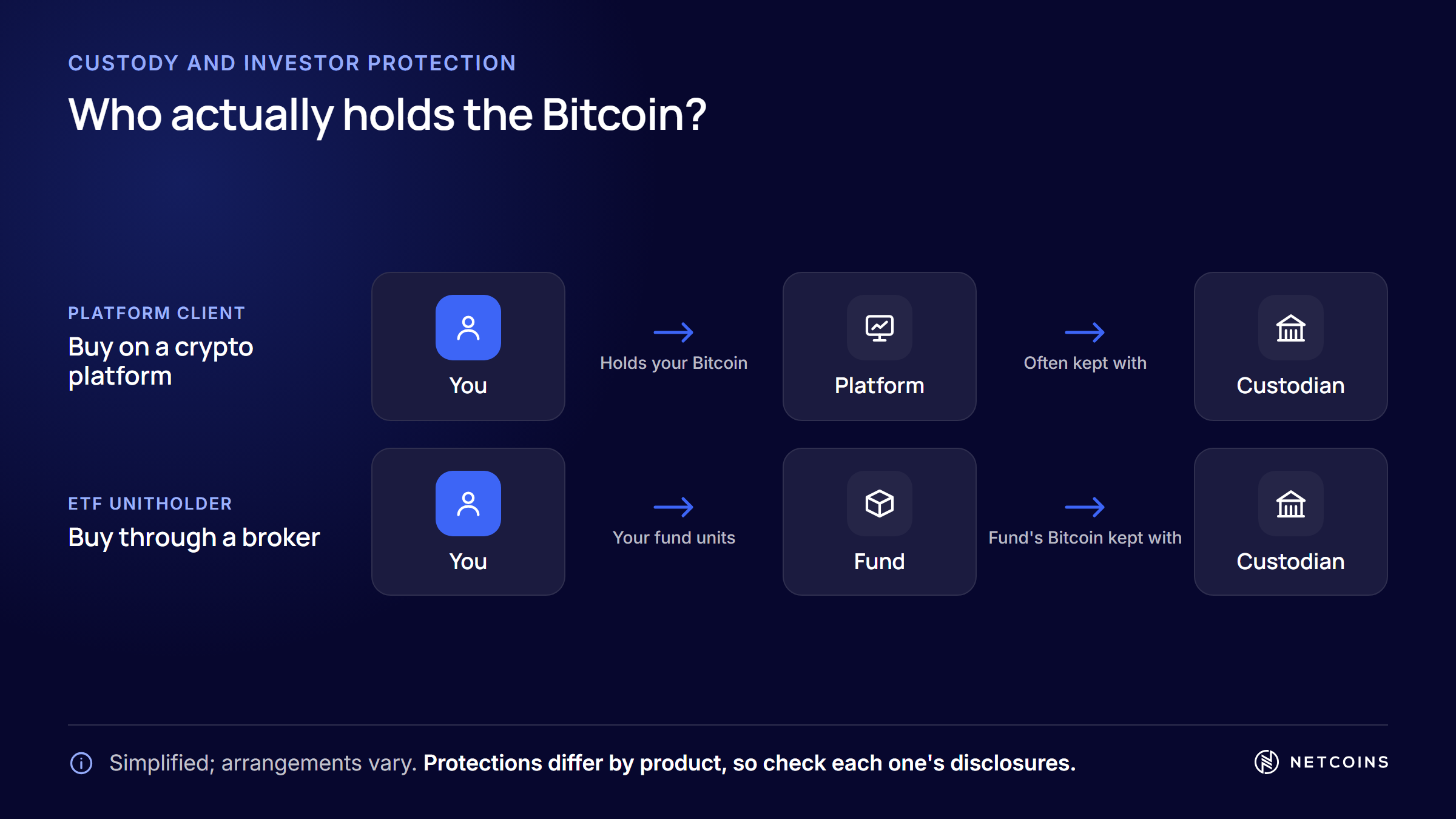
With Bitcoin on a crypto trading platform, the platform or its custodian holds it for you. At Netcoins, Fireblocks provides hot wallet infrastructure and BitGo cold storage holds the bulk of client assets [Source]. You can also move Bitcoin to your own wallet, which gives you direct control but makes you responsible for your keys.
With a Bitcoin ETF, the fund uses a custodian to hold its Bitcoin. You do not interact with the Bitcoin directly. You rely on the fund manager, its custodians, and your investment dealer.
On protection:
- Crypto assets are not covered by the Canadian Investor Protection Fund [Source] or by Canada Deposit Insurance Corporation deposit insurance [Source].
- CIPF never covers losses from price changes. If you have questions about how CIPF applies to ETF units held at a specific investment dealer, ask the dealer or CIPF directly.
No custody arrangement removes risk. A platform, fund, or custodian can face operational problems, cyberattacks, or financial failure. Our guide on crypto platform security measures explains what security can and cannot protect.
Risks of Owning Bitcoin vs a Bitcoin ETF
Both options carry Bitcoin's price risk. Bitcoin's value can fall sharply in short periods, and you could lose some or all of the money you put in.
Risks with owning Bitcoin:
- Platform risk. If you hold Bitcoin on a platform, you rely on it and its custodians.
- Self-custody risk. If you hold Bitcoin in your own wallet and lose your recovery phrase, you may lose it permanently.
- Scams. Bitcoin sent to a scammer usually cannot be recovered.
Risks with a Bitcoin ETF:
- Fees. The management fee reduces your return over time, even when Bitcoin's price is flat.
- Tracking difference. The ETF's price can differ from the value of the Bitcoin it holds, especially around market open and during volatile periods.
- Trading-hour gaps. You cannot trade units when the exchange is closed, even if Bitcoin's price is moving.
- Fund risk. You rely on the fund manager, its custodians, and its operations.
Whether you live in Winnipeg or Victoria, the questions are the same: what do you own, who holds it, what does it cost, and what happens if something goes wrong. Neither option removes Bitcoin's volatility.
People Also Ask About Bitcoin vs Bitcoin ETFs
Is a Bitcoin ETF the same as owning Bitcoin? No. Owning Bitcoin means you hold the digital asset itself, either on a crypto trading platform or in your own wallet. Owning a Bitcoin ETF means you hold units of an investment fund that holds Bitcoin. You cannot withdraw Bitcoin from an ETF or send it on the network. Both follow Bitcoin's price, so both carry its volatility, but they differ in ownership, fees, trading hours, and custody.
What is the difference between a Bitcoin ETF and a traditional ETF? Both are funds whose units trade on a stock exchange and charge a management fee. A traditional broad-market ETF often holds many stocks or bonds, which spreads risk. A Bitcoin ETF holds one asset, Bitcoin or Bitcoin-linked contracts, so it does not spread risk the same way and can be much more volatile. Bitcoin also trades 24/7, while ETF units trade only during exchange hours.
When did Canada get its first Bitcoin ETF? In February 2021, the Ontario Securities Commission cleared the launch of what Reuters described as the world's first Bitcoin ETF. North America's first Bitcoin ETF began trading on the Toronto Stock Exchange on February 18, 2021. Since then, other Bitcoin and crypto ETFs have launched in Canada. Each fund has its own prospectus describing holdings, fees, and risks.
Do Bitcoin ETFs have fees? Yes. Bitcoin ETFs charge an annual management fee, usually shown as a management expense ratio (MER), which is taken from the fund over time. Your investment dealer may also charge commissions to buy or sell units. Holding Bitcoin on a crypto trading platform has different costs, such as trading fees or spreads and network fees for withdrawals. Compare the full costs for your situation.
Is a Bitcoin ETF less risky than Bitcoin? Not in general. A Bitcoin ETF follows Bitcoin's price, so it carries the same price risk. It removes some risks, such as managing your own private keys, but adds others, such as fund fees, tracking differences, and trading-hour gaps. Both rely on custodians in different ways. Which risks matter more depends on your situation.
Frequently Asked Questions
Can I withdraw Bitcoin from a Bitcoin ETF? No. When you own Bitcoin ETF units, you own part of a fund, not specific Bitcoin. You cannot withdraw Bitcoin to a wallet or send it on the Bitcoin network. If you want to hold Bitcoin directly, you would buy Bitcoin itself, usually on a crypto trading platform, and can then move it to a wallet you control.
Can I trade Bitcoin ETFs on weekends? No. Bitcoin ETF units trade only when the stock exchange is open, on business days. Bitcoin itself trades 24/7. If Bitcoin's price moves on a weekend or overnight, the ETF's price may open higher or lower on the next trading day.
Does a Bitcoin ETF hold other cryptocurrencies? A Bitcoin ETF holds Bitcoin, or in some cases Bitcoin-linked contracts. It does not hold a basket of other cryptocurrencies. Some funds do hold several crypto assets, but those are different products. Always check a fund's prospectus or holdings rather than relying on its name.
What is a spot Bitcoin ETF? A spot Bitcoin ETF holds actual Bitcoin through a custodian, so its value follows the price of the Bitcoin it holds, minus fees. A futures-based Bitcoin ETF holds contracts linked to Bitcoin's future price instead. Futures-based funds can perform differently from Bitcoin's price because of how those contracts work.
Are Bitcoin and Bitcoin ETFs covered by CIPF or CDIC? Crypto assets are not covered by CIPF or by CDIC deposit insurance. CIPF never covers losses from price changes. If you have questions about how CIPF applies to ETF units held at a specific investment dealer, ask the dealer or CIPF directly.
Do I need a wallet to own a Bitcoin ETF? No. Bitcoin ETF units are held in an account at an investment dealer, like other ETF units. You never handle private keys. If you buy Bitcoin itself, you can keep it on a crypto trading platform or move it to a wallet you control.
Quick Glossary
- ETF (exchange-traded fund): An investment fund whose units trade on a stock exchange.
- Spot Bitcoin ETF: An ETF that holds actual Bitcoin through a custodian.
- Futures-based Bitcoin ETF: An ETF that holds contracts linked to Bitcoin's future price.
- MER (management expense ratio): The yearly cost of running a fund, shown as a percentage.
- Tracking difference: The gap between a fund's return and the return of the asset it follows.
- Custodian: A company that holds assets on behalf of a fund, platform, or its clients.
- Prospectus: A document that explains a fund's holdings, fees, and risks.
- Private key: A secret code that controls Bitcoin. Anyone who has it can move the funds.
Key Takeaways
- Owning Bitcoin means owning the asset. Owning a Bitcoin ETF means owning units of a fund that holds Bitcoin.
- Bitcoin trades 24/7 and can be withdrawn to a wallet. ETF units trade during exchange hours and cannot be withdrawn as Bitcoin.
- ETFs charge ongoing management fees. Bitcoin on a platform has trading, spread, and network costs.
- Both follow Bitcoin's volatile price. Neither is safer or better in general.
- Crypto assets are not covered by CIPF or CDIC, and both options rely on custodians.
Bitcoin and Bitcoin ETFs share a name and a price, but they are different products with different trade-offs. Knowing what you own, who holds it, and what it costs helps you decide what fits your situation. To learn how buying Bitcoin itself works, read our guide on how to buy Bitcoin in Canada step by step.

About Netcoins
Established in 2014 in Vancouver, British Columbia, Netcoins is a registered Restricted Dealer with the provincial securities commissions and a registered Money Services Business (MSB) with FINTRAC. Netcoins is owned by Surge Digital Inc. (formerly BIGG Digital Assets Inc.), a publicly traded company listed on the TSX Venture Exchange (TSXV: SRGE), and complies with applicable public company regulatory.
The information provided in the blog posts on this platform is for educational purposes only. It is not intended to be financial advice or a recommendation to buy, sell, or hold any cryptocurrency. Always do your own research and consult with a professional financial advisor before making any investment decisions. Cryptocurrency investments carry a high degree of risk, including the risk of total loss. The blog posts on this platform are not investment advice and do not guarantee any returns. Any action you take based on the information on our platform is strictly at your own risk. The content of our blog posts reflects the authors’ opinions based on their personal experiences and research. However, the rapidly changing and volatile nature of the cryptocurrency market means that the information and opinions presented may quickly become outdated or irrelevant. Always verify the current state of the market before making any decisions.


