TL;DR
Traditional cross-border business payments can take one to five business days and carry layered fees plus a currency conversion spread. USDC, a stablecoin that aims to track the US dollar, allows some businesses to settle international payments faster by moving value directly on a blockchain instead of through correspondent banks. USDC is not fiat currency, its value is not guaranteed, and it carries reserve, redemption, and regulatory risks of its own.
Canadian businesses with international suppliers, contractors, or partners regularly run into the same friction: slow wires, opaque exchange rates, and capital tied up in transit. Stablecoins such as USDC are increasingly discussed as an alternative settlement rail. This guide explains how USDC remittances actually work, what the cost comparison looks like without invented precision, how a Canadian business would acquire and send USDC, and the risks that belong in the same conversation as the benefits.
The Cost of Traditional Cross-Border Business Payments
Traditional cross-border payments are expensive and slow because they route through a chain of correspondent banks rather than moving directly between two parties.
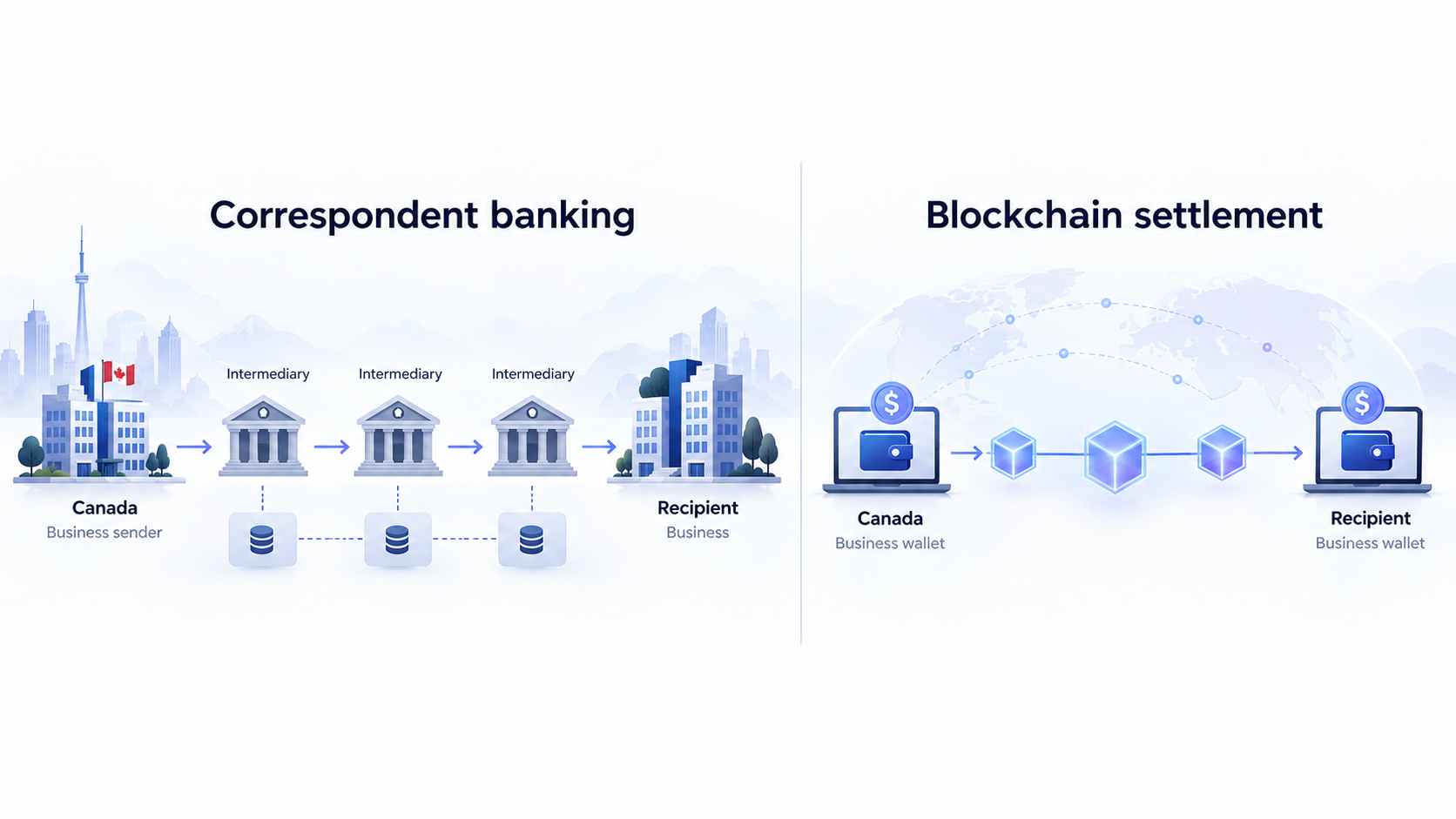
SWIFT, the messaging network most banks use for international payments, does not move money itself. It transmits payment instructions between banks, and the actual transfer of funds still depends on the correspondent banking relationships behind it, where banks hold pre-funded accounts in foreign currencies to make settlement possible. The Bank of England notes that a cross-border payment can cost up to ten times more than a comparable domestic payment [Source].
Each intermediary bank in the chain applies its own processing, compliance checks, and fees, and operates within its own banking hours and holidays. A payment initiated in Vancouver on a Friday afternoon can sit with an intermediary until the following business day purely due to time zones and weekend closures, independent of any problem with the payment itself.
The scale of this friction is well documented. The World Bank found the global average cost of sending a remittance was 6.36 percent in the third quarter of 2025, with banks the most expensive channel at close to 15 percent, both well above the international target of 3 percent [Source]. For a Canadian business paying international contractors or suppliers, that percentage applies to every transfer, every month.
For background on how these payment rails work, our explainer on how crypto payments and fiat on-ramps work in Canada covers the underlying mechanics, and our step-by-step guide to buying Bitcoin in Canada covers the fundamentals of acquiring digital assets before working with any stablecoin.
How USDC and Blockchain Settlement Work
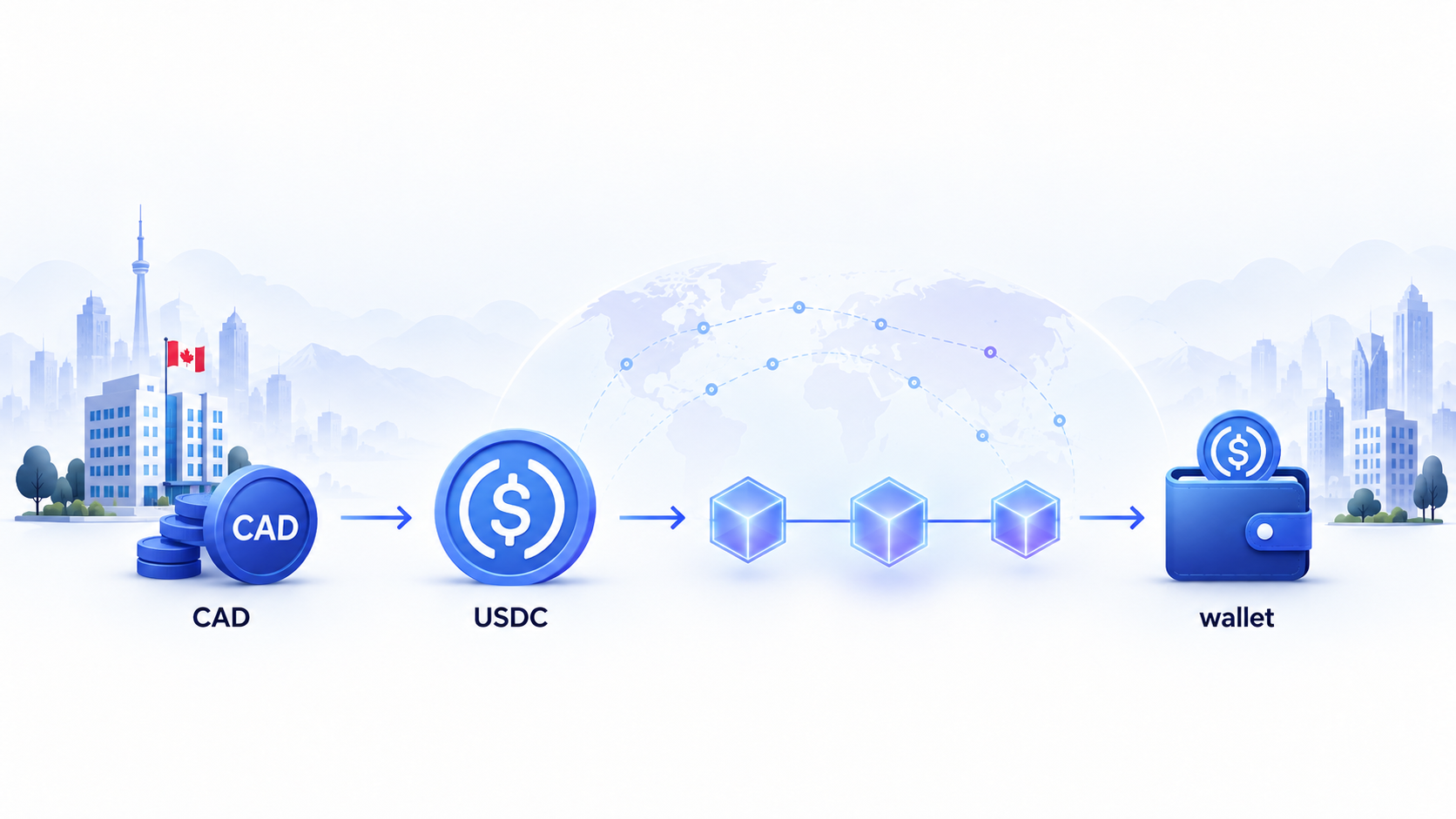
USDC is a stablecoin issued by Circle, designed to track the US dollar and backed by cash and short-term US Treasury holdings, with settlement occurring directly between wallets on a blockchain rather than through correspondent banks.
Circle publishes reserve composition and independent monthly attestations confirming that reserve assets are reported to meet or exceed circulating USDC supply [Source]. This is a meaningful transparency practice, though an attestation is a point-in-time snapshot rather than a continuous guarantee, and it does not eliminate the risks described later in this article.
When a Canadian business sends USDC, the transaction is broadcast to a network of independent computers that validate it against the shared ledger and record it permanently once confirmed. There is no intermediary bank taking custody of the funds mid-transfer. Settlement speed depends entirely on which blockchain network is used, and it ranges from roughly 12 seconds on Solana [Source] to a few seconds on Ethereum Layer 2 networks such as Base or Arbitrum.
Because these networks operate continuously, a transfer is not held up by weekends or banking holidays. That said, an on-chain transfer completing quickly is not the same as the full payment being finished. Converting CAD to USDC and USDC back to a recipient's local currency still involves platforms, spreads, and sometimes local banking rails at each end, so the total time and cost of a remittance depends on more than network speed alone. Our overview of what a blockchain is covers the underlying technology in more depth.
What the Cost Comparison Actually Looks Like
USDC settlement removes several layers of correspondent banking cost, but claiming an exact dollar figure per corridor overstates the precision that is actually available, since costs vary by provider, amount, and currency pair.
Rather than presenting invented per-corridor dollar ranges, it is more accurate to describe where the savings come from structurally:
- Fewer intermediary fees: correspondent banking layers flat charges from the sending bank, one or more intermediary banks, and the receiving bank. A blockchain transfer removes the intermediary layer, leaving the network fee plus whatever the sending and receiving platforms charge to convert currency.
- A different FX spread: traditional wires typically carry a markup over the mid-market exchange rate. Converting CAD to USDC and USDC to a destination currency still involves conversion costs on a Canadian platform and, often, a local exchange at the receiving end, so the spread does not disappear, it just applies at different points.
- Network fees that vary by chain: these can range from a small fraction of a cent on Layer 2 networks to a few dollars on Ethereum's base layer during periods of congestion, so which network is used matters for cost.
- No pre-funding requirement: correspondent banks hold capital in foreign accounts to enable settlement, a practice that ties up money. A blockchain transfer settles value directly, without one party pre-funding an account abroad.
The World Bank's remittance data gives the clearest apples-to-apples comparison available: an average cost of 6.36 percent through conventional channels, against bank channels averaging closer to 15 percent [Source]. Stablecoin settlement is not yet a significant share of that overall picture. The Financial Stability Board estimates stablecoin transfers made up less than 0.2 percent of total cross-border payments in 2025 [Source]. For a Canadian business, that means real savings are possible on a given transfer, but it is not yet a mainstream, universally cheaper channel, and results depend heavily on the specific providers and corridor involved. Any savings also come with USDC's own risks, including the possibility of losing some or all of its value, as set out in the stablecoin risk disclosure above.
A Hypothetical Scenario: Paying an International Team
The following is a hypothetical, illustrative scenario rather than a real case study, intended to show how the mechanics apply to a common Canadian business situation. Scenarios like this are relevant given that global remittance costs remain well above international targets, with the World Bank recording a global average of 6.36 percent in the third quarter of 2025 [Source].
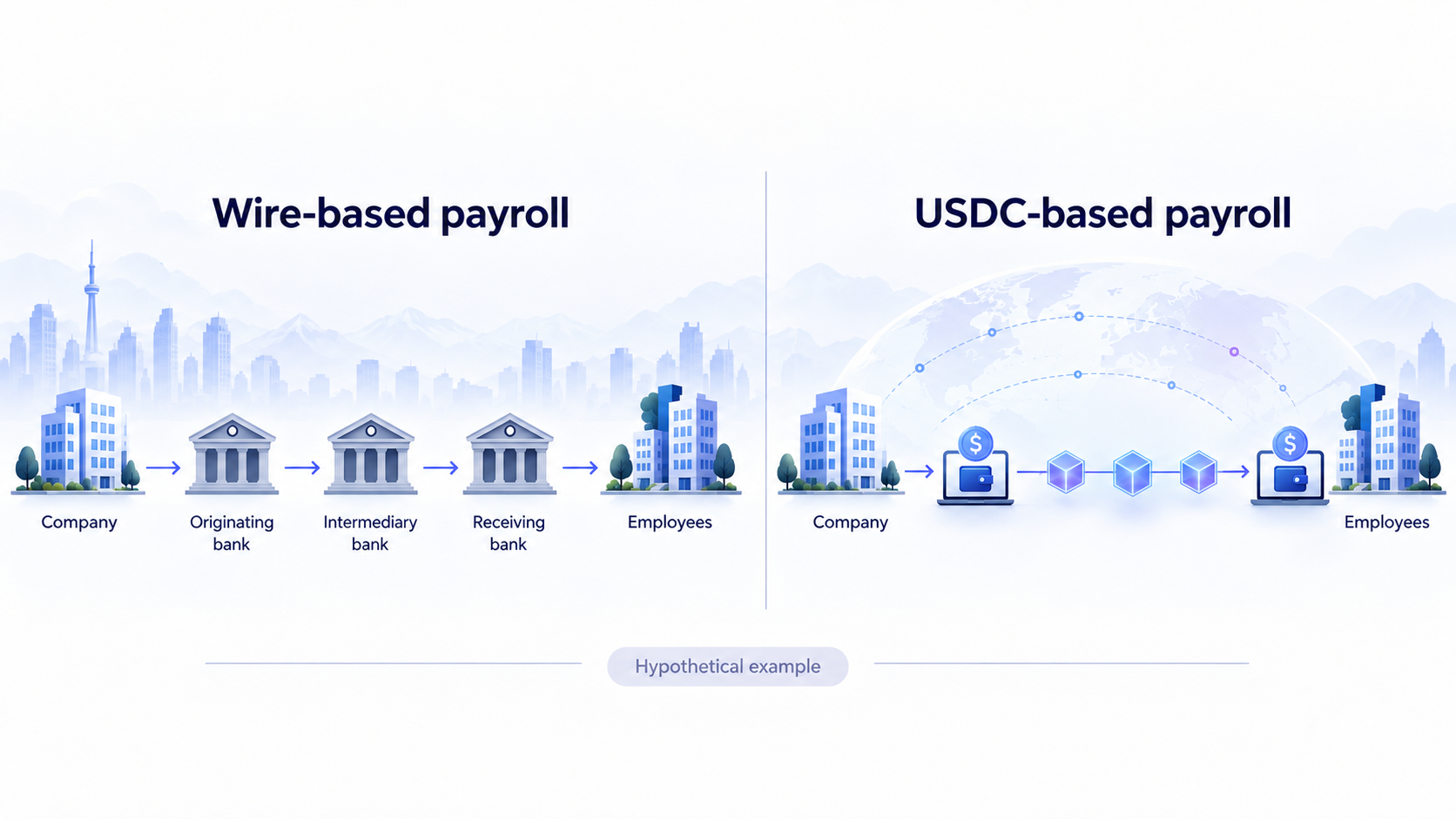
Consider a Toronto-based agency that pays contractors in the Philippines and Mexico monthly. Under a conventional wire process, the business would calculate the relevant exchange rates, initiate individual wires through its bank, and typically wait one to several business days for each to clear, often pre-funding payroll days ahead of the actual pay date to make sure contractors are paid on time.
Using a USDC-based process instead, the business would convert CAD to USDC on a Canadian crypto trading platform, then send USDC directly to each contractor's wallet, with settlement completing in seconds to minutes on the network used. Contractors would then convert USDC to their local currency through their own means, or hold it if they choose to. For as long as the business or its contractors hold USDC, they carry the risks set out in the stablecoin risk disclosure, including the possibility of losing some or all of its value.
The plausible benefits in this scenario are reduced pre-funding, since capital is not locked up days in advance, and faster contractor payment. The trade-offs are real too: the business takes on responsibility for verifying wallet addresses correctly, since blockchain transfers cannot be reversed if sent to the wrong address, and it introduces exposure to USDC's own risks, covered in the final section, in place of relying entirely on a bank's settlement guarantee. Whether this nets out favourably depends on transaction volume, corridor, and how a specific business weighs the trade-offs, and no single scenario applies universally.
Acquiring USDC as a Canadian Business
A Canadian business generally acquires USDC by opening a verified account with a Canadian crypto trading platform, funding it in Canadian dollars, and executing a trade to convert CAD into USDC before withdrawing it to a destination wallet. Before opening an account, check whether the platform is registered with the applicable Canadian securities regulators, and review its custody, fee, and risk disclosures. This process mirrors how individual Canadians acquire crypto assets, and the Bank of Canada found that around 10 percent of Canadians already held Bitcoin in 2023, with a median holding of about Can$500 [Source], indicating a base of Canadians already familiar with this kind of account-opening process.
Account verification and purchase limits
Account verification typically requires business registration details and identity verification for authorized signers. The verification level a business completes can affect how much it is able to deposit, trade, or withdraw on a platform. Verification is not the only limit that may apply, however.
Canadian securities rules can require registered crypto trading platforms to apply limits on how much of certain crypto assets a client may buy over a rolling 12-month period. Whether these limits apply, and at what level, generally depends on the client's investor category (for example, whether the client qualifies as an eligible or accredited investor), the province or territory where the client is located, and the specific crypto asset being purchased. Some crypto assets are treated differently from others under these rules.
This means a business should not assume that a given USDC purchase is, or is not, subject to a limit. The answer depends on current requirements, how the business account is classified, and the platform's terms, and it can change over time. Before building a recurring payment process around USDC, confirm directly with the platform which purchase limits apply to your business account, how they are calculated, and what happens if a planned payment would exceed them.
Once verified, the business funds the account using an available method, most commonly Interac e-Transfer for smaller amounts or wire transfer for larger ones.
After funds clear, the business places a spot order to convert CAD into USDC at the platform's quoted rate. From this point, the business holds USDC rather than Canadian or US dollars, and the risks in the stablecoin risk disclosure apply until the USDC is sent and converted. Before sending any meaningful amount, it is worth sending a small test transaction first and confirming the recipient received it, since blockchain transfers cannot be reversed once confirmed. Our guide to crypto custody in Canada covers wallet and custody considerations relevant to this step.
Once the destination address and network are confirmed, the business initiates the withdrawal, specifying the exact amount and the recipient's address. It is essential that the sender and recipient are using the same blockchain network for the transfer, since USDC exists on several different networks and sending to the wrong one can result in funds becoming difficult or impossible to recover. For the broader fundamentals of getting started with digital assets in Canada, see our complete guide to buying Bitcoin in Canada.
Funding a Corporate Account With Interac e-Transfer
Interac e-Transfer is a common way for Canadian businesses to fund a digital asset account domestically, offering faster processing than a wire for smaller amounts.
Bank of Canada survey work found that roughly half of Canadians had used Interac e-Transfer [Source], reflecting how embedded the service is in Canadian banking generally. Many Canadian financial institutions integrate it directly into commercial online banking, and on platforms that support Autodeposit, funds can be credited once the transfer clears, without additional manual steps.
Processing times and limits vary by platform and financial institution, and change over time, so confirming current details directly rather than relying on any fixed figure is the more reliable approach. Businesses should also be aware that daily sending limits on Interac e-Transfers apply and differ between personal and commercial account types, and that larger capital movements typically still require a wire transfer instead. These bank sending limits are separate from any crypto purchase limits a platform may be required to apply, which are covered in the previous section. Our guide to how Interac e-Transfer works for crypto in Canada covers the mechanics in more detail.
It is also worth noting that some Canadian financial institutions apply their own policies to transfers destined for crypto platforms, and these policies vary and can change. If a transfer is declined or delayed, contacting your financial institution directly is the most reliable way to understand what applies to your account.
Why Layer 2 Networks Matter for Small Payments
Layer 2 networks reduce the cost of sending USDC on Ethereum-based infrastructure by processing transactions off the main chain and settling a compressed record back to it, which matters for smaller and more frequent payments.
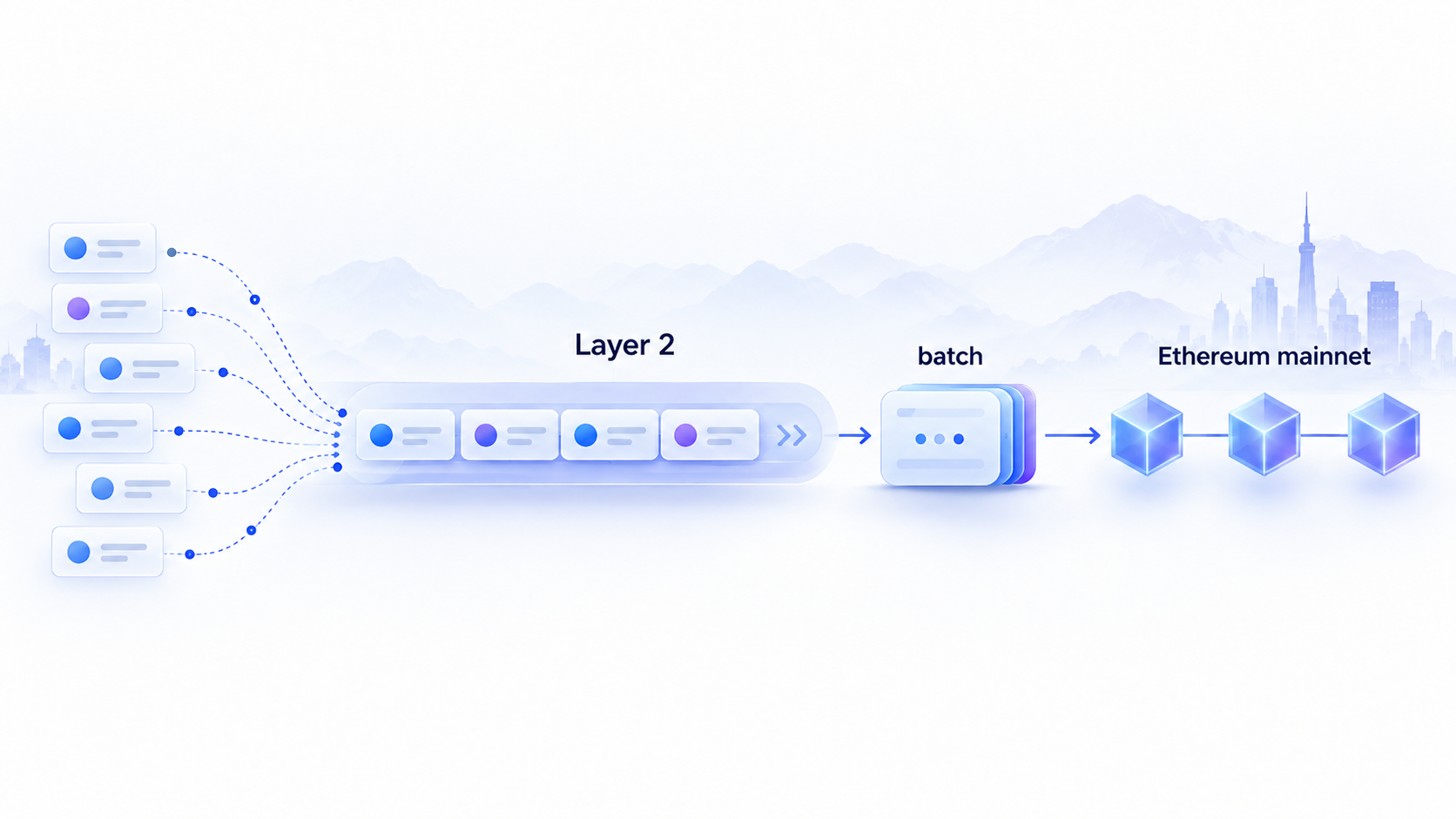
Ethereum's base layer can carry meaningful fees during periods of network congestion, which historically made small payments impractical. Networks such as Arbitrum, Optimism, and Base operate as separate processing layers that batch many transactions together before posting a summarized record to Ethereum's main chain.
A 2024 Ethereum network upgrade introducing a dedicated data channel for this batched information reduced Layer 2 transaction costs substantially. The Block reported that Ethereum transaction fees, particularly on Layer 2 networks like Base, fell to some of their lowest levels on record following this change, with fees on some networks commonly running well under a cent [Source].
For a Canadian business, this means a smaller payment, such as a modest contractor invoice, is not disproportionately eaten up by network fees the way it might have been on Ethereum's base layer previously. It also means the choice of network genuinely affects total cost, so confirming which network a recipient's wallet supports before sending is a practical step worth taking rather than an afterthought. Layer 2 networks also carry their own risks, including bridge, operator, and smart-contract risk.
Stablecoin Risk, Custody, and Operational Precautions
USDC is not the same as holding Canadian or US dollars, and understanding its specific risks is essential before using it for business payments.
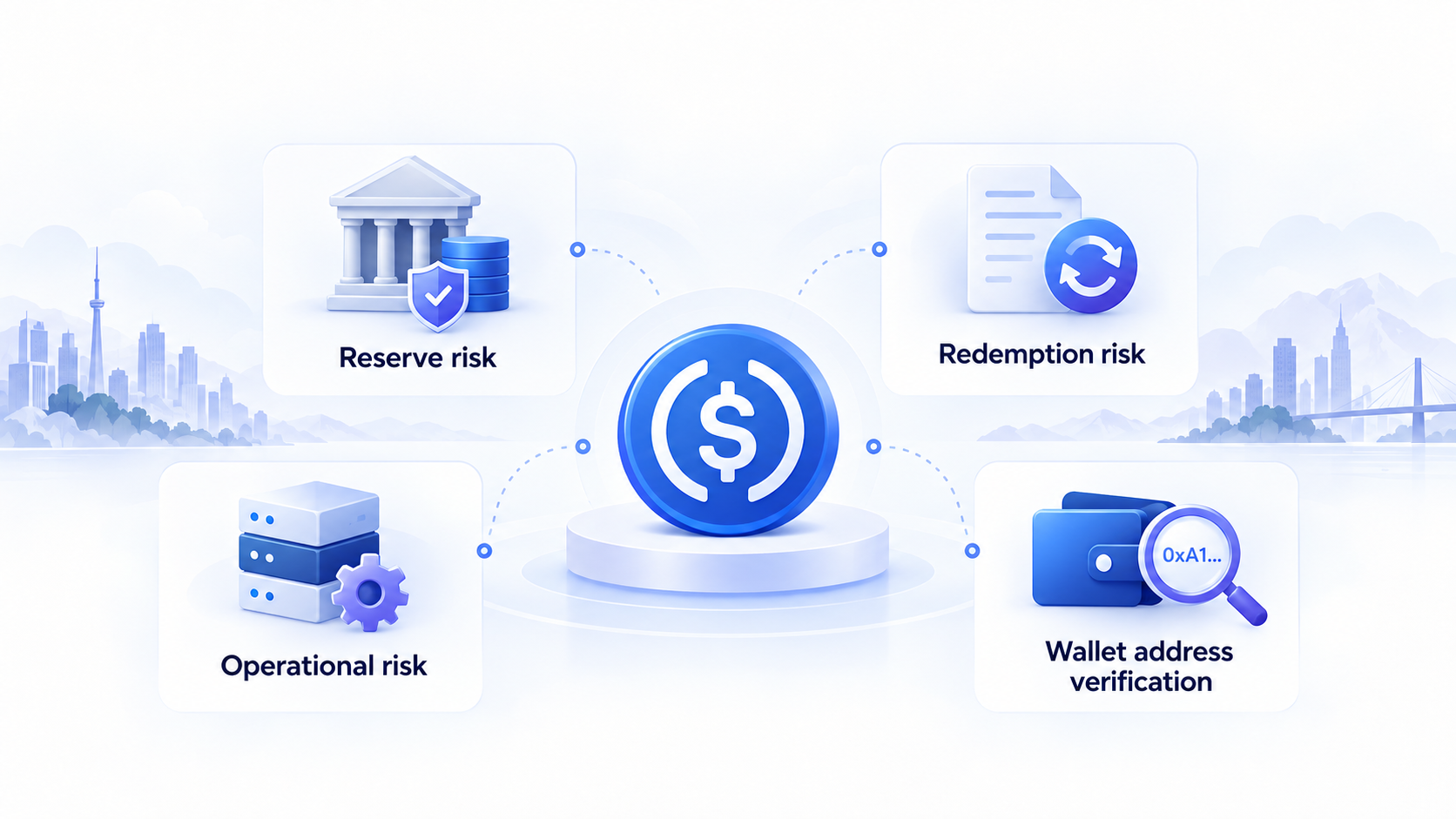
USDC is a value-referenced crypto asset. Its value depends on Circle maintaining sufficient reserves and honouring redemptions, which introduces reserve risk, redemption risk, liquidity risk, counterparty risk, and regulatory risk that a bank deposit does not carry in the same way. The issuer can also freeze USDC held at specific addresses, and holders can lose some or all of the value of their USDC. This is not a theoretical concern. In March 2023, USDC briefly lost its dollar peg, trading as low as roughly 87 cents, after Circle disclosed that a portion of its cash reserves were held at Silicon Valley Bank at the time of that bank's failure. USDC recovered its peg within days once the situation resolved [Source]. That event is a useful reminder that a stablecoin's stability depends on the soundness of the institutions and assets behind it, not on the label "stable" alone, and a future de-peg may not recover.
Operational risk sits alongside financial risk. Blockchain transfers cannot be reversed once confirmed, so an incorrect wallet address or a transfer to the wrong network can result in permanent loss of funds. Businesses should verify addresses carefully, ideally by comparing the full string rather than only the first and last characters, and send a small test amount before transferring a larger sum for a new recipient. Our guide to common Bitcoin scams in Canada covers tactics relevant to businesses handling crypto payments as well as individuals.
Custody is a further consideration. Crypto trading platforms use different custody arrangements, which may include third-party custody providers and keeping some private keys offline in cold storage. These arrangements differ between platforms and change over time, so businesses should review a platform's current published custody and risk disclosures rather than relying on a general description. No custody model removes all risk, including operational, custody, and counterparty risk, and a platform's registration status does not reduce the risks of holding USDC or any other crypto asset. Businesses that hold their own private keys instead take on full responsibility for securing them, and a lost key generally means permanently lost funds.
For businesses evaluating whether a stablecoin-based payment process fits their cross-border operations, Netcoins' cross-border solutions page outlines current service details. As with any platform or service, confirm current terms, fees, purchase limits, and supported networks directly before committing to a process built around them.
People Also Ask About USDC Remittances
How fast is a USDC transfer compared to a wire transfer?
A USDC transfer can settle on the blockchain in seconds to about 12 seconds, depending on the network, while a traditional international wire typically takes one to five business days to clear through correspondent banks. The wire delay comes from sequential processing across multiple intermediary institutions operating in different time zones and banking hours. That said, the full remittance, including converting currency at both ends, can take longer than the on-chain transfer time alone, so total settlement speed depends on more than the network.
Is it cheaper to send USDC or use a bank wire?
It can be, though the difference depends heavily on the specific corridor, amount, and providers involved rather than a fixed figure. Traditional wires carry layered intermediary fees plus a currency conversion spread, with the World Bank finding average global remittance costs around 6.36 percent and bank channels closer to 15 percent [Source]. USDC transfers avoid the intermediary layer but still involve platform conversion fees and network fees, so the actual savings vary by situation rather than following one universal number. Lower cost does not offset USDC's own risks, including the possibility of losing value.
Can a Canadian business buy USDC with Canadian dollars?
Yes. Canadian businesses can open a verified account on a Canadian crypto trading platform, fund it using Interac e-Transfer or a wire transfer, and execute a spot trade converting CAD into USDC. Check whether the platform is registered with the applicable Canadian securities regulators and review its custody, fee, and risk disclosures first. Supported funding methods, fees, verification requirements, and any applicable crypto purchase limits vary between platforms and account types and change over time, so confirm current details with a specific platform before setting up a recurring process.
Are blockchain transactions reversible if a mistake is made?
No. Once a blockchain transaction is confirmed, it cannot be reversed by the platform, the sender, or a bank. This places responsibility on the sender to verify the recipient's wallet address and network carefully before confirming a transfer. Because there is no chargeback mechanism at the network level, businesses sending payments this way should adopt address-verification practices, such as test transactions, as a standard part of their process.
What is the difference between USDC and highly volatile cryptocurrencies?
USDC is a stablecoin designed to track the value of the US dollar, backed by cash and short-term US Treasury holdings that Circle reports through independent monthly attestations. Unlike Bitcoin or Ethereum, its price is intended to stay close to one US dollar rather than fluctuate with market demand. It is not, however, risk-free. USDC has previously lost its peg temporarily during a banking crisis affecting its reserves, it remains a value-referenced crypto asset rather than fiat currency, and holders can lose some or all of its value.
Frequently Asked Questions
What is a "stablecoin sandwich" payment structure?
This describes a payment where a business converts its local fiat currency into a stablecoin, transfers the stablecoin across a blockchain, and the recipient converts it back into their own local currency at the other end. The stablecoin functions as an intermediary bridge for the transfer itself, while both parties still transact in their preferred currency before and after. This structure is used specifically to capture the speed of blockchain settlement without requiring either party to hold the stablecoin long-term.
Why are traditional foreign exchange spreads so high?
Foreign exchange spreads charged by banks reflect the cost of maintaining liquidity across a fragmented correspondent banking system, along with a built-in profit margin. Because these markups are applied as a percentage of the transfer amount, the absolute cost rises directly with the size of a payment. The World Bank's remittance data shows these costs remain well above internationally targeted levels for many payment corridors.
How do Layer 2 networks reduce the cost of sending USDC?
Layer 2 networks process transactions in a separate environment and post a compressed summary back to Ethereum's main chain, rather than recording every transaction individually on the base layer. A 2024 network upgrade specifically reduced the cost of posting that summarized data, which lowered fees on networks such as Base substantially. This makes smaller, more frequent payments more practical than they would be on Ethereum's base layer during busy periods.
How does Interac e-Transfer help fund a digital asset account?
Interac e-Transfer offers a domestic, bank-integrated way to move Canadian dollars into a digital asset platform, and it is widely used by Canadians generally. Processing times and limits vary by platform and financial institution and change over time, so confirming current specifics rather than assuming a fixed timeframe is the reliable approach. Larger amounts typically still require a wire transfer due to Interac sending limits.
What causes delays in the SWIFT payment network?
SWIFT itself only transmits payment instructions rather than moving money, so delays arise from the correspondent banks that actually settle the transfer. Each institution in the chain applies its own compliance screening and processing, operates within its own banking hours, and observes local holidays, all of which compound across a multi-bank routing path to produce delays that can extend to several business days.
Has USDC ever lost its peg to the US dollar?
Yes. In March 2023, USDC traded as low as roughly 87 cents after Circle disclosed that part of its cash reserves were held at Silicon Valley Bank when that bank failed. USDC recovered its peg within days as the situation was resolved. This event is a reminder that a stablecoin's value depends on the soundness of its reserves and the institutions holding them. De-pegging is a real risk rather than a hypothetical one, a future de-peg may not recover, and holders can lose some or all of the value of their USDC.
Quick Glossary
- Stablecoin: A digital asset designed to track the value of a reference currency, most often the US dollar. It is not fiat currency, its value is not guaranteed, and holders can lose some or all of its value.
- USDC: A stablecoin issued by Circle, backed by cash and short-term US Treasury holdings, with reserves reported through independent monthly attestations.
- Correspondent Banking: A network of banks that hold accounts for one another in foreign currencies to facilitate cross-border payments, requiring pre-funded balances abroad.
- SWIFT: A global messaging network banks use to transmit payment instructions. It does not move money itself.
- Layer 2 Network: A blockchain scaling solution that processes transactions off a main chain and settles a summarized record back to it, reducing fees and increasing throughput.
- Peg (De-peg): A stablecoin's intended fixed value relative to its reference currency. A de-peg occurs when the market price moves away from that intended value, as USDC did briefly in March 2023.
- Attestation: An independent accountant's point-in-time report confirming that a stablecoin issuer's reported reserves meet or exceed the circulating supply. It is not a continuous guarantee or a full audit.
- Finality: The point at which a blockchain transaction is considered permanently recorded and cannot be reversed.
Key Takeaways
- Correspondent banking is the main source of cross-border payment cost and delay: intermediary banks, pre-funding requirements, and banking-hour restrictions add both fees and multi-day settlement times.
- USDC settles directly between wallets on a blockchain: this can meaningfully reduce settlement time and remove intermediary fee layers, though conversion costs at each end still apply.
- Cost savings are real but not fixed or universal: they depend on the specific corridor, providers, and network used, and stablecoins remain a small share of total cross-border payment volume.
- USDC carries its own risks: it is a value-referenced crypto asset, not fiat currency, it briefly lost its dollar peg in March 2023, and holders can lose some or all of its value.
- Check limits and operational details before you build a process: confirm which verification and crypto purchase limits apply to your business account, and verify wallet addresses and networks before sending, since blockchain transfers cannot be reversed.
Closing
USDC remittances offer Canadian businesses a genuinely different way to settle international payments, with real potential to reduce the delay and layered cost of correspondent banking for some transfers. That potential comes with trade-offs worth taking seriously: USDC is not fiat currency, its stability depends on Circle's reserves and operations, it has de-pegged before under real-world stress, and holders can lose some or all of its value. Blockchain transfers are also irreversible, which makes careful verification a necessary part of the process rather than an optional precaution. For businesses exploring this path, understanding both the mechanics and the risks before building a process around them is the more useful starting point than treating it as a straightforward upgrade. For further background, see our guide to how Interac e-Transfer works for crypto in Canada or our overview of cryptocurrency for beginners.

About Netcoins
Established in 2014 in Vancouver, British Columbia, Netcoins is a registered Restricted Dealer with the provincial securities commissions and a registered Money Services Business (MSB) with FINTRAC. Netcoins is owned by Surge Digital Inc. (formerly BIGG Digital Assets Inc.), a publicly traded company listed on the TSX Venture Exchange (TSXV: SRGE), and complies with applicable public company regulatory.
The information provided in the blog posts on this platform is for educational purposes only. It is not intended to be financial advice or a recommendation to buy, sell, or hold any cryptocurrency. Always do your own research and consult with a professional financial advisor before making any investment decisions. Cryptocurrency investments carry a high degree of risk, including the risk of total loss. The blog posts on this platform are not investment advice and do not guarantee any returns. Any action you take based on the information on our platform is strictly at your own risk. The content of our blog posts reflects the authors’ opinions based on their personal experiences and research. However, the rapidly changing and volatile nature of the cryptocurrency market means that the information and opinions presented may quickly become outdated or irrelevant. Always verify the current state of the market before making any decisions.