
TL;DR Bitcoin has a market value because people and institutions are currently willing to buy and hold it. Its supply is capped at 21 million coins, which is a design difference from fiat currencies, though a capped supply does not by itself create or guarantee value. Bitcoin is highly volatile, its price depends entirely on ongoing demand, and substantial or complete loss is possible. The idea of digital money can feel abstract to Canadians used to physical cash, polymer bills, and banking apps. The value of any currency ultimately comes from collective acceptance of its utility, portability, and scarcity. This article explains the mechanics behind Bitcoin, the arguments people make about where its value comes from, the criticisms of those arguments, and the risks involved. It is not a case for or against holding it.
The Evolution of Money and Value
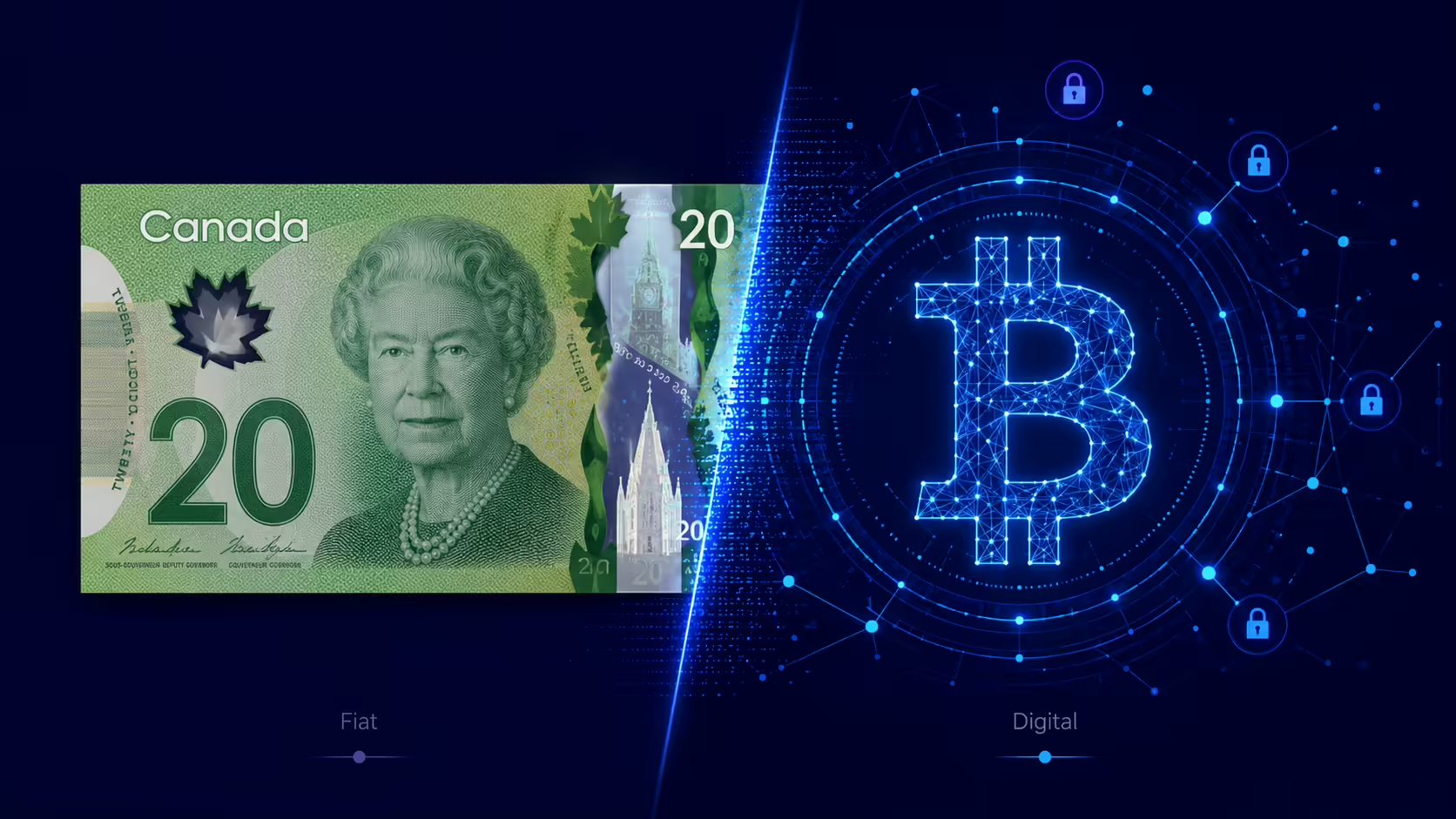
Value is a mix of social consensus and functional utility. Throughout history, societies have assigned value to many different items based on their ability to help people trade and store wealth over time.
Money is essentially a tool that solves the inefficiencies of bartering. In a barter economy, trading a cow for a custom pair of shoes requires a coincidence of wants, meaning both people must want exactly what the other offers at the same moment. To fix this, humans adopted intermediate items of value. These included cowrie shells, glass beads, salt, and eventually precious metals like gold and silver. They held value because they were hard to produce, widely desired, and reasonably easy to carry.
Modern fiat currency, such as the Canadian Dollar (CAD), does not have intrinsic physical value the way a gold coin does. A polymer twenty-dollar bill costs only cents to produce. It holds value because it is legal tender and because the public trusts the central bank to manage the money supply. The Bank of Canada aims to keep inflation near 2 percent, though it can move well outside that, peaking at 8.1 percent in June 2022 [Source]. When prices rise, each dollar buys a little less.
Bitcoin operates on a different model. Instead of a central bank managing supply, its rules are set in open-source software and maintained by a global network of computers. Whether that model is better or worse than central banking is a matter of ongoing debate among economists, and both approaches carry different risks.
Supporters argue the network can serve the classic functions of money, acting as a unit of account, a medium of exchange, and a store of value, with rules that are transparent and difficult to change. Critics counter that Bitcoin's volatility undermines all three functions, particularly its use as a unit of account, and that a fixed supply can encourage hoarding rather than spending. Its market value is not tied to a physical commodity or to any issuer's obligation, which means there is no underlying asset or guarantor to fall back on if demand falls away. To go deeper on the underlying technology, see our explainer on what a blockchain is.
Digital Scarcity and the 21 Million Hard Cap
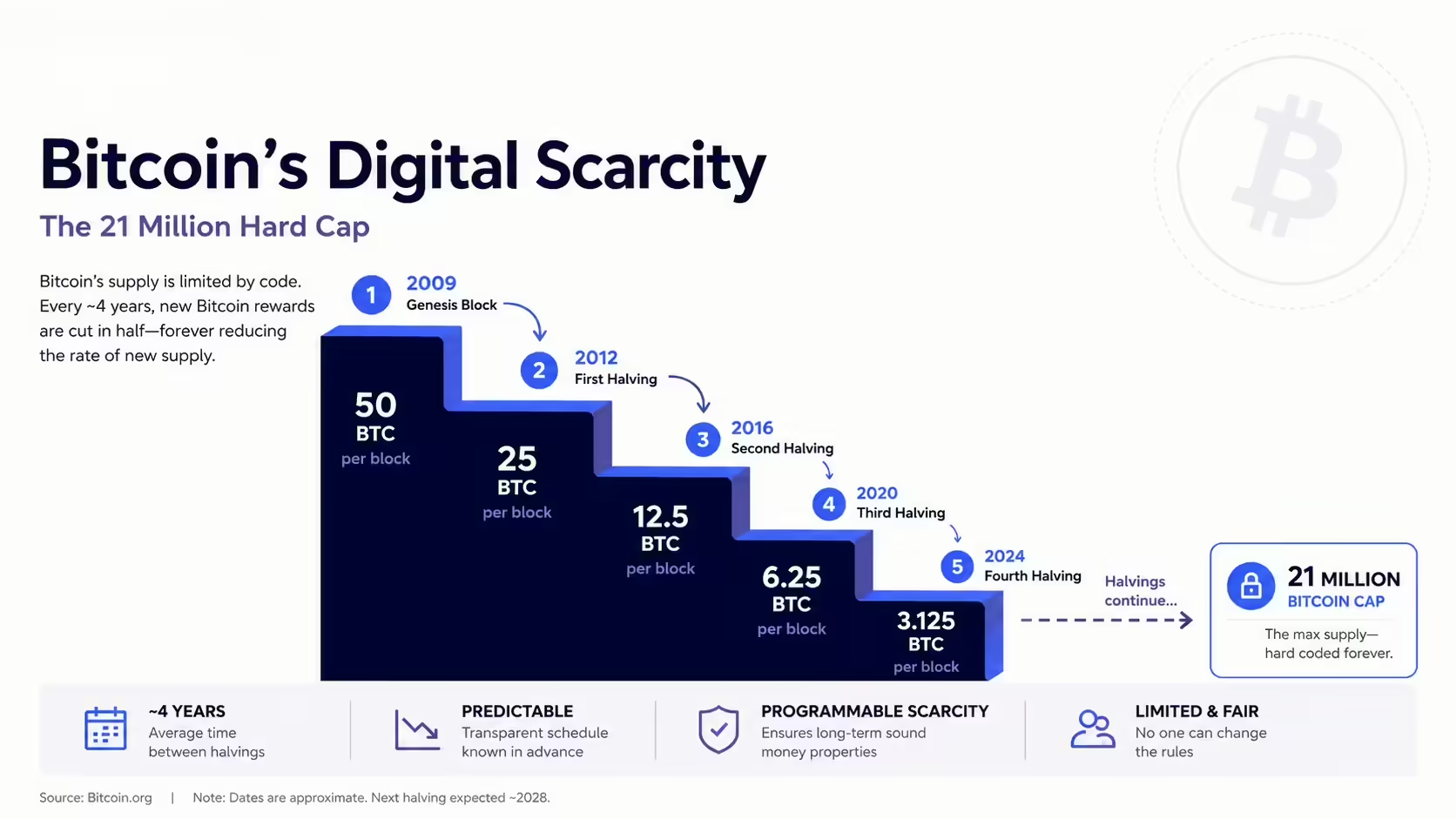
Bitcoin maintains scarcity through a hard-coded limit that ensures only 21 million coins will ever exist.
Fiat currencies are designed so that supply can be adjusted by a central bank. When the money supply expands faster than the economy grows, the purchasing power of each existing dollar tends to fall. Central banks describe this flexibility as a policy tool that lets them respond to recessions and shocks, while critics view it as a source of erosion in savings. Both descriptions are part of a long-standing economic debate.
Bitcoin uses a different design: a fixed supply enforced by code. The protocol sets a hard cap of 21 million coins, and roughly 20.1 million have already been mined, close to 95 percent of the total [Source]. This rule is not set by a CEO or board. It is enforced by thousands of independent participants running the software worldwide. A fixed supply is a design choice with trade-offs rather than an inherent advantage, since it also removes any ability to respond to economic conditions.
New supply is released on a predictable, decreasing schedule. Roughly every four years, or every 210,000 blocks, the network goes through an event called the Halving. In April 2024, the block reward dropped from 6.25 to 3.125 coins, with the next reduction expected around 2028 [Source]. After the 2024 Halving, new issuance fell to roughly 450 coins per day, and the annual growth of supply dropped below 1 percent [Source].
This issuance schedule is predictable, and anyone can read the code to see roughly how many coins will exist in future years. Some commentators describe the asset as a form of digital gold, though that comparison is contested and Bitcoin has behaved very differently from gold during periods of market stress. An unknown number of early coins are believed to be permanently lost, for example through misplaced keys, so the coins actually available may be lower than the headline figure. Most importantly, scarcity alone does not create or guarantee value. Many scarce things have little or no market value, and Bitcoin's price can fall sharply, including to a fraction of its previous level, if demand weakens.
Decentralization and the Proof-of-Work Consensus

Decentralization describes how control over the network is distributed rather than held by a single party.
If one company, government, or server controlled the network, that entity could change the rules, freeze accounts, or issue more coins. Bitcoin spreads its public ledger, the blockchain, across a global network of independent computers called nodes. This design is intended to avoid a single point of failure, though decentralization is a matter of degree and elements such as mining and development activity remain concentrated among a relatively small number of participants.
The network is secured by an energy-intensive process called Proof-of-Work (PoW). Specialized computers known as miners compete to solve difficult cryptographic puzzles that require raw processing power. The first miner to find the correct solution earns the right to add the next block of transactions to the chain and receives the block reward, currently 3.125 coins per block, which incentivizes miners to keep securing the network [Source].
The energy spent on Proof-of-Work is what makes altering the ledger costly. To reverse a transaction or rewrite history, an attacker would generally need to control more than 50 percent of the network's computing power, which at current scale would require substantial hardware and electricity. Smaller Proof-of-Work networks have experienced such attacks, so the deterrent depends on the network maintaining its scale rather than being absolute.
Network security is separate from the risks an individual holder faces. Technical security does not protect against price declines, lost or stolen private keys, exchange or custodian failure, scams, or loss of access, and it does not guarantee that Bitcoin will hold any particular value. Canadians can learn to spot common frauds in our guide to common Bitcoin scams in Canada, and can read more about how Bitcoin mining works.
Utility as a Global, Borderless Payment Network
Utility is one component of monetary value, and Bitcoin can function as a borderless payment and settlement network, with significant practical limitations.
The blockchain offers a way to move value globally with fewer intermediaries. Traditional international wire transfers can take several business days, carry fees, and are limited by borders, exchange rates, and banking hours. Bitcoin transactions can be sent to anyone, anywhere, at any time, and the network does not observe national holidays, weekends, or borders. The network supports an active global market that trades around the clock, with daily trading volumes often in the tens of billions of dollars [Source].
The limitations are substantial and should be weighed alongside those capabilities. Bitcoin transactions are irreversible, so funds sent to a wrong or mistyped address are generally unrecoverable, and there is no chargeback process or central party to appeal to. Network fees vary with demand, and during periods of congestion both fees and confirmation times can rise sharply, which can make small payments impractical. Converting between CAD and Bitcoin involves exchange fees and spreads at both ends, so a transfer is rarely free. Price volatility during the time a payment is in transit can change the value received. Access also depends on internet connectivity, functioning exchanges, and local rules, which differ by country and can change.
Ongoing work aims to make the network more practical for smaller payments. Layer 2 systems, such as the Lightning Network, run on top of the main blockchain to enable faster, lower-cost transactions. These systems introduce their own trade-offs, including liquidity requirements, channel management, and reliance on additional software.
Whether Bitcoin is cheaper or faster than traditional rails depends entirely on the corridor, the amounts involved, the fees charged by the exchanges or providers at each end, and network conditions at the time. It is not universally lower cost, and for many routine domestic payments conventional methods remain simpler and cheaper. To see how Canadians move money in and out of crypto, read about how crypto payments and fiat on-ramps work in Canada.
Network Effects and Institutional Adoption
Network effects describe how a system can become more useful as more people participate in it.
This idea, often called Metcalfe's Law, is frequently applied to the internet, social media, and telecom. It is also cited in discussions of Bitcoin, which launched in 2009 under the pseudonym Satoshi Nakamoto. Applying the concept to an asset's price is contested, since a larger user base can increase usefulness without establishing what any unit should be worth. You can read more in our piece on the Satoshi Nakamoto mystery.
Participation has broadened over time. Retail investors, funds, and some publicly traded companies have taken positions in the asset. Bitcoin's total market value has at times reached roughly 1.3 trillion US dollars [Source]. That figure measures price multiplied by supply at a moment in time. It is not a measure of quality, safety, or suitability, and it can fall as quickly as it rises.
The participation of institutions or large companies should not be read as validation, endorsement, or evidence that Bitcoin is a sound holding for any individual. Institutions have different time horizons, risk tolerances, capital bases, and reasons for holding an asset than retail investors do, and they have been wrong about assets before. In Canada, the Bank of Canada reported that around 10 percent of Canadians owned Bitcoin in 2023, with a median holding worth about Can$500 [Source]. That others hold an asset says nothing about whether it is appropriate for you.
Netcoins Inc., whose parent company BIGG Digital Assets trades on the TSX Venture Exchange (TSXV: BIGG), is registered as a Restricted Dealer in Canada and with FINTRAC as a money services business. Broader participation can improve market liquidity, but it does not reduce volatility, establish a price floor, or guarantee future demand. For a comparison of two networks, see our guide to Bitcoin versus Ethereum.
How Bitcoin Compares to the Canadian Dollar
.avif)
Comparing Bitcoin and the Canadian Dollar against the traditional properties of money shows they perform differently, with each having strengths and weaknesses.
Economists generally describe money as needing several traits: durability, portability, divisibility, fungibility, and acceptability. Neither asset scores well on all of them, and the traits matter differently depending on what someone is trying to do.
On durability, physical bills wear out and must be replaced, though the Canadian Dollar as a unit of account persists regardless. Bitcoin exists as data spread across a global ledger, which persists as long as the network has participants, internet access, and power. That ledger durability is separate from the durability of an individual's holdings, which can be lost permanently if private keys are lost.
On portability, moving large amounts of cash across borders is physically cumbersome and subject to reporting rules, while Bitcoin can be represented by a recovery phrase or a hardware wallet. This portability cuts both ways: the same properties that make it easy to move also make it easy to lose or to have stolen irreversibly, with no institution able to reverse the transfer or restore access.
On divisibility, the Canadian Dollar divides into 100 cents, and a single bitcoin divides into 100 million smaller units called satoshis [Source]. On fungibility, each Canadian dollar is interchangeable, and the network treats each unit the same during transactions, though the public ledger means individual coins carry a visible transaction history that some parties may treat differently.
On acceptability and stability, the Canadian Dollar is clearly ahead for daily use in Canada. It is legal tender, accepted essentially everywhere, and holds a relatively stable value in the short term, which matters for wages, rent, and pricing. Bitcoin is not accepted at most Canadian retailers, and its volatility makes it difficult to use as a unit of account. This is why the debate over whether Bitcoin is money continues, a topic we cover in is Bitcoin real money in Canada. Some people describe Bitcoin as a long-term hedge against inflation. That view is contested, is not established by evidence, and carries the risk that the asset declines substantially in value.
The Role of Cryptographic Trust in Digital Assets
Trust is the invisible foundation of every functioning economic system.
In the traditional system, users place trust in institutions. They trust central banks to manage inflation, commercial banks to safeguard deposits, and payment processors to move funds accurately. Human institutions can and sometimes do experience errors, mismanagement, or failures, and history includes examples of banks failing and currencies losing value.
Bitcoin aims to replace some of that institutional trust with verifiable rules and cryptography. The software governing the network is open-source, so anyone can download, read, and audit it. Every transaction is recorded on a public ledger that is designed to be extremely difficult to alter. Because the code is open, independent developers around the world can review it for flaws or hidden behavior. Anyone can also verify the total supply, currently about 20.1 million coins, directly from the public record [Source].
This shift from trusting institutions toward verifying rules is central to how supporters describe the system. Participants do not need to trust the person on the other side of a transaction, and they do not need a bank to confirm the funds exist. The network verifies each transfer through consensus among its participants.
This design reduces reliance on any single actor, but it does not remove trust so much as relocate it. Users still rely on the correctness of the software, on miners and developers continuing to act in the network's interest, and often on exchanges, custodians, or wallet providers. Verifiable rules do not protect against price declines, lost keys, scams, provider failure, or changes in access, and they do not give the asset any guaranteed value. In Canada, using a registered platform and strong security practices can reduce some personal risks, though no approach removes them.
Future Outlook for Digital Value
The market value of Bitcoin moves with supply and demand, and its supply schedule is fixed and predictable.
Because new issuance is capped and now grows at under 1 percent per year, changes in demand are the main driver of price [Source]. When demand rises, price tends to rise, and when demand falls, price tends to fall. Bitcoin has historically been highly volatile, with large swings in both directions, and past patterns do not predict future results. No one can reliably forecast its price.
While short-term prices are influenced by sentiment, adoption cycles, and broader financial markets, the underlying network keeps operating as programmed, producing blocks roughly every ten minutes regardless of market conditions. The technology functions the same whether prices are rising or falling.
Access for Canadians has developed alongside the wider market. For example, how Interac e-Transfer works for crypto explains one common funding method. Some investors also hold other crypto assets, such as those on Proof-of-Stake networks where users can stake crypto to earn rewards, which carries its own risks including lock-up periods and potential loss. Canadian stablecoins are another category, covered in our guide to Canadian stablecoin custody. Stablecoins are value-referenced crypto assets rather than fiat currency, and their value is not guaranteed, so reserve, redemption, liquidity, counterparty, and regulatory risks apply.
To be direct about the limits of everything above: scarcity, adoption, decentralization, and security are design characteristics and observations about the present. None of them guarantee that Bitcoin will hold value, and none of them predict future performance. Bitcoin has no cash flows, no issuer obligation, and no underlying asset, so its price depends entirely on what others are willing to pay at a given moment. It has experienced declines of more than 70 percent from previous highs in past cycles, and substantial or complete loss of the amount invested is possible. Anyone considering it should assess their own circumstances and risk tolerance, and may wish to consult a qualified, independent financial professional.
People Also Ask About What Gives Bitcoin Its Value
Is Bitcoin backed by anything physical? No, Bitcoin is not backed by any physical commodity, issuer, government, or guarantor. There is no underlying asset and no entity obliged to redeem it for anything. Its market price rests entirely on what buyers are currently willing to pay. Supporters point to the network's computing power, cryptography, and capped supply as reasons people assign it value, while critics note that the absence of any backing or cash flow means there is no floor beneath the price if demand falls away.
Can Bitcoin lose all its value? In theory, any asset or currency can lose its value if demand disappears. Bitcoin is highly volatile and has experienced large drawdowns in the past, so meaningful losses are possible. Its value depends on continued global demand for a decentralized, censorship-resistant network, which no one can guarantee. Factors that support it include a large network of users and node operators and a long operating history, but none of these ensure any particular future value. Only invest what you can afford to lose.
Why does Bitcoin have value if it is not physical? Monetary value depends on scarcity, demand, and utility rather than physical form. Most fiat money today exists only as digital entries in bank databases, and Bitcoin exists as data on a distributed ledger. Its digital nature can make it more portable and divisible than physical commodities. However, being digital does not make it stable, and its price can move sharply, so its value reflects ongoing demand rather than any built-in floor.
How does the Halving affect Bitcoin? The Halving is a programmed event that cuts the creation of new coins by about 50 percent roughly every four years. This steadily reduces the rate of new supply over time. In the past, some Halvings were followed by higher prices and others by declines, and market conditions differ each cycle. Because many factors influence price, a Halving does not guarantee any particular outcome, and past price behavior does not predict future results.
Who controls the value of Bitcoin? No single person, company, or government controls Bitcoin's value. The price is set by open-market supply and demand across many exchanges worldwide. Buyers and sellers determine the current market price based on what they are willing to pay and accept at a given moment. The network's rules, such as the 21 million cap, are enforced by its participants, but the price itself is decided by the market, which is why it can be volatile.
How does Bitcoin differ from other crypto assets? Bitcoin was the first crypto asset and has the longest operating history and the largest market value. It uses Proof-of-Work, while many other networks use Proof-of-Stake or other designs, and it has a fixed supply cap where many others do not. Bitcoin's scripting is deliberately limited, so networks such as Ethereum support a wider range of applications. These are design differences with different trade-offs, not a ranking, and each carries its own risks.
Frequently Asked Questions
What happens when all 21 million Bitcoins are mined? Once the 21 million cap is reached, estimated to occur around the year 2140, no new coins will be created. Miners will no longer receive newly minted block rewards. Instead, they will be compensated through transaction fees paid by users. This fee-based model is designed to keep incentivizing the security of the network after new issuance ends. Because the final coins are released slowly, the practical impact will unfold gradually over more than a century.
How is Bitcoin different from the Canadian Dollar? The Canadian Dollar is a fiat currency managed by the Bank of Canada, whose supply can expand over time, which generally reduces purchasing power gradually. Bitcoin is decentralized and disinflationary, with a fixed supply cap and no central manager. The Canadian Dollar is legal tender and accepted everywhere in Canada, while Bitcoin is not. Bitcoin is also far more volatile, so it behaves very differently from a national currency used for everyday spending.
Does a lack of intrinsic physical value make Bitcoin a bubble? Critics argue that without physical utility, Bitcoin is speculative. Proponents counter that modern fiat money also lacks physical backing and holds value through trust and demand. They point to Bitcoin's utility as a way to store and transfer value without intermediaries. This remains a genuine debate. Bitcoin's history includes sharp booms and busts, so investors should weigh both perspectives and be aware of the high volatility before forming a view.
Why do some businesses choose to accept Bitcoin as payment? Businesses that accept it commonly cite reasons such as avoiding chargeback fraud, since transactions are irreversible, and reaching customers who prefer to pay in crypto. Whether settlement costs are lower than card processing depends on the specific processor, volume, and conversion arrangements, and it is not lower in all cases. Offsetting considerations include price volatility, conversion and network fees, accounting complexity, and secure handling, which is why many businesses convert received crypto to fiat promptly and why acceptance remains limited.
How does the network's energy consumption relate to its value? The energy used in Proof-of-Work acts as a security cost that protects the network. The high cost of mining makes it very expensive for a bad actor to rewrite the ledger or double-spend coins, which supports trust in the system. This security is one reason many participants value the network. Energy use is also a subject of ongoing debate around environmental impact, and approaches to sourcing that energy continue to evolve.
Can governments shut down the Bitcoin network? Because the network is spread across thousands of independent nodes in many countries, no single government can shut it down on its own. Individual countries can restrict trading or mining within their own borders, which can affect local access. The global network itself, however, can keep operating as long as computers and internet connections exist elsewhere. This distributed design is a core reason the network is considered resilient.
Is Bitcoin mainly used for illegal activities? Bitcoin has been used for both legitimate and illicit purposes, and we are not able to substantiate a reliable breakdown of the proportions here. Estimates vary widely depending on methodology and who produces them. What can be stated factually is that Bitcoin's base-layer transactions are recorded on a public ledger, so activity leaves a permanent, analysable trail rather than being anonymous. Analytics firms and investigators use this to trace flows, though techniques exist that make tracing harder.
Quick Glossary
Decentralization: The distribution of control and data away from a single central entity toward a wide network of independent participants.
Fiat Currency: Government-issued money, such as the Canadian Dollar, that is not backed by a physical commodity and relies on trust and legal status.
Halving: A programmed event roughly every four years that reduces the reward miners receive for adding a block by about 50 percent, slowing the creation of new coins.
Node: A computer connected to the network that stores a copy of the blockchain and independently verifies transactions and blocks.
Proof-of-Work (PoW): A consensus method where miners spend real computing energy to solve puzzles, securing the network and validating transactions.
Satoshi: The smallest unit of a bitcoin. There are 100 million satoshis in one whole coin.
Scarcity: An economic principle where limited supply, paired with demand, supports the value of an asset.
Store of Value: An asset that people use to preserve wealth over time, though its ability to do so can vary and is not guaranteed.
Key Takeaways
- Scarcity is a design choice, not a value guarantee: the 21 million cap limits new supply, but scarcity alone does not create or sustain value, and it carries its own trade-offs.
- Decentralization is a matter of degree: distributing the ledger reduces single points of failure, though mining and development remain relatively concentrated.
- Payment utility comes with real limitations: transactions are irreversible, fees and confirmation times vary with congestion, address errors are unrecoverable, and access depends on connectivity and local rules.
- Institutional participation is not validation: other people or companies holding an asset says nothing about whether it is appropriate for any individual.
- None of these features guarantee value: Bitcoin has no cash flows, issuer, or underlying asset, its price depends entirely on demand, and substantial or complete loss is possible.
- Value depends on demand and carries risk: Bitcoin is highly volatile and can lose value, so its price reflects ongoing demand rather than any guarantee.
Closing
Questions about what gives Bitcoin value do not have a single settled answer. Supporters point to its capped supply, decentralized design, and use as a payment network. Critics point to the absence of cash flows, an issuer, or any underlying asset, and to volatility that undermines its use as money. Both views are part of an ongoing debate, and this article is intended to set out the mechanics and the arguments rather than to advocate a position. Bitcoin's price is driven entirely by demand and can fall substantially, so anyone weighing it should understand the risks and consider independent professional advice. To continue learning about the underlying technology, see our explainer on what a blockchain is or our overview of cryptocurrency for beginners.

About Netcoins
Established in 2014 in Vancouver, British Columbia, Netcoins is a registered Restricted Dealer with the provincial securities commissions and a registered Money Services Business (MSB) with FINTRAC. Netcoins is owned by Surge Digital Inc. (formerly BIGG Digital Assets Inc.), a publicly traded company listed on the TSX Venture Exchange (TSXV: SRGE), and complies with applicable public company regulatory.
The information provided in the blog posts on this platform is for educational purposes only. It is not intended to be financial advice or a recommendation to buy, sell, or hold any cryptocurrency. Always do your own research and consult with a professional financial advisor before making any investment decisions. Cryptocurrency investments carry a high degree of risk, including the risk of total loss. The blog posts on this platform are not investment advice and do not guarantee any returns. Any action you take based on the information on our platform is strictly at your own risk. The content of our blog posts reflects the authors’ opinions based on their personal experiences and research. However, the rapidly changing and volatile nature of the cryptocurrency market means that the information and opinions presented may quickly become outdated or irrelevant. Always verify the current state of the market before making any decisions.