
TL;DR
Cardano is a proof-of-stake blockchain whose native coin, ADA, is used for fees, staking, and governance votes. Its eUTXO accounting model lets users calculate fees before sending a transaction, and delegating ADA to a stake pool does not move the coins out of your wallet. Staking rewards vary, ADA is volatile, and every feature carries risks such as software, wallet, and smart contract risk.
Cardano is a smart contract blockchain with a research-heavy design, and ADA is the coin that powers it. The terms can sound technical, from eUTXO to DReps. This guide explains the basics in plain language, including staking, fees, and governance, and what they mean for Canadians who hold or are curious about ADA. It also covers the risks, since ADA is volatile and every feature has trade-offs.
What Is Cardano and What Is ADA?
Cardano is a public, proof-of-stake blockchain that supports smart contracts and custom tokens, and ADA is its native cryptocurrency. ADA is used to pay network fees, delegate to stake pools, and vote on governance proposals.
Cardano was founded in 2017 by Charles Hoskinson, who also co-founded Ethereum. [Source] The network is named after Gerolamo Cardano, a 16th-century Italian mathematician. ADA is named after Ada Lovelace, often described as the first computer programmer. Three organizations have historically supported the project. IOG (Input Output Global) builds core software, the Cardano Foundation is a Swiss non-profit focused on ecosystem standards, and Emurgo focuses on commercial adoption.
The maximum supply of ADA is capped at 45 billion. [Source] A supply cap describes how many coins can exist. It says nothing about price, and the value of ADA can rise or fall.
Interest in crypto is growing in Canada. In the Ontario Securities Commission's 2025 Crypto Assets Survey, released July 28, 2026, 25 percent of 2,360 respondents said they owned crypto assets or crypto funds. [Source] Ownership in that survey includes funds, so it does not show how many Canadians hold ADA specifically.
Cardano's developers describe the project as research-driven. Design ideas are written up as academic papers and reviewed by outside researchers before code is released, and the team uses formal methods, which apply mathematical logic to check that software behaves as intended. A research-first process can take longer than releasing features quickly. Peer review and formal methods can reduce certain kinds of errors, but they do not remove software bugs, market risk, or the chance that a feature does not work as planned.
Canadians who want to learn how crypto purchases work can start with this guide on how to buy Bitcoin in Canada. Anyone interested in ADA specifically can read about how to buy ADA in Canada and compare each platform's custody, fee, and risk disclosures first.
How Does Ouroboros Proof-of-Stake Work?
Ouroboros is the proof-of-stake protocol Cardano uses to agree on which blocks are added to the chain. Instead of miners competing with computing power, stake pool operators are selected to produce blocks based on how much ADA is delegated to their pools.
In proof-of-stake, the chance that a pool is chosen to produce a block is proportional to the stake behind it. Cardano divides time into epochs, and each epoch lasts five days. [Source] The stake distribution is fixed for an epoch, and rewards are calculated from it. Cardano does not rely on proof-of-work mining, so it does not use the computational mining process associated with proof-of-work networks.
Ouroboros has gone through several versions, each described in academic research. Early versions set out the basic proof-of-stake design. Later versions, including Praos and Genesis, addressed how blocks are produced in a decentralized way and how new participants can join the network safely. Researchers describe the protocol as provably secure, which means its security claims are proven under stated assumptions, such as the share of stake held by honest participants. Those assumptions may not always hold in the real world.
Proof-of-stake carries its own risks. Stake can concentrate in a small number of pools. Pool operators can have outages or run faulty software. A flaw in node software could affect many users at once. Protocol upgrades, called hard forks, change the rules and require node operators to update.
For Canadian ADA holders, delegation rewards are paid in ADA, not Canadian dollars. The CAD value of those rewards moves with the ADA price, so it can differ from one epoch to the next. Delegating also involves choosing a wallet and a stake pool, which adds user-error risk.
For readers who want more background on the technology underneath, Netcoins explains what a blockchain is in plain language.
How Does Cardano's Two-Layer Design Work?
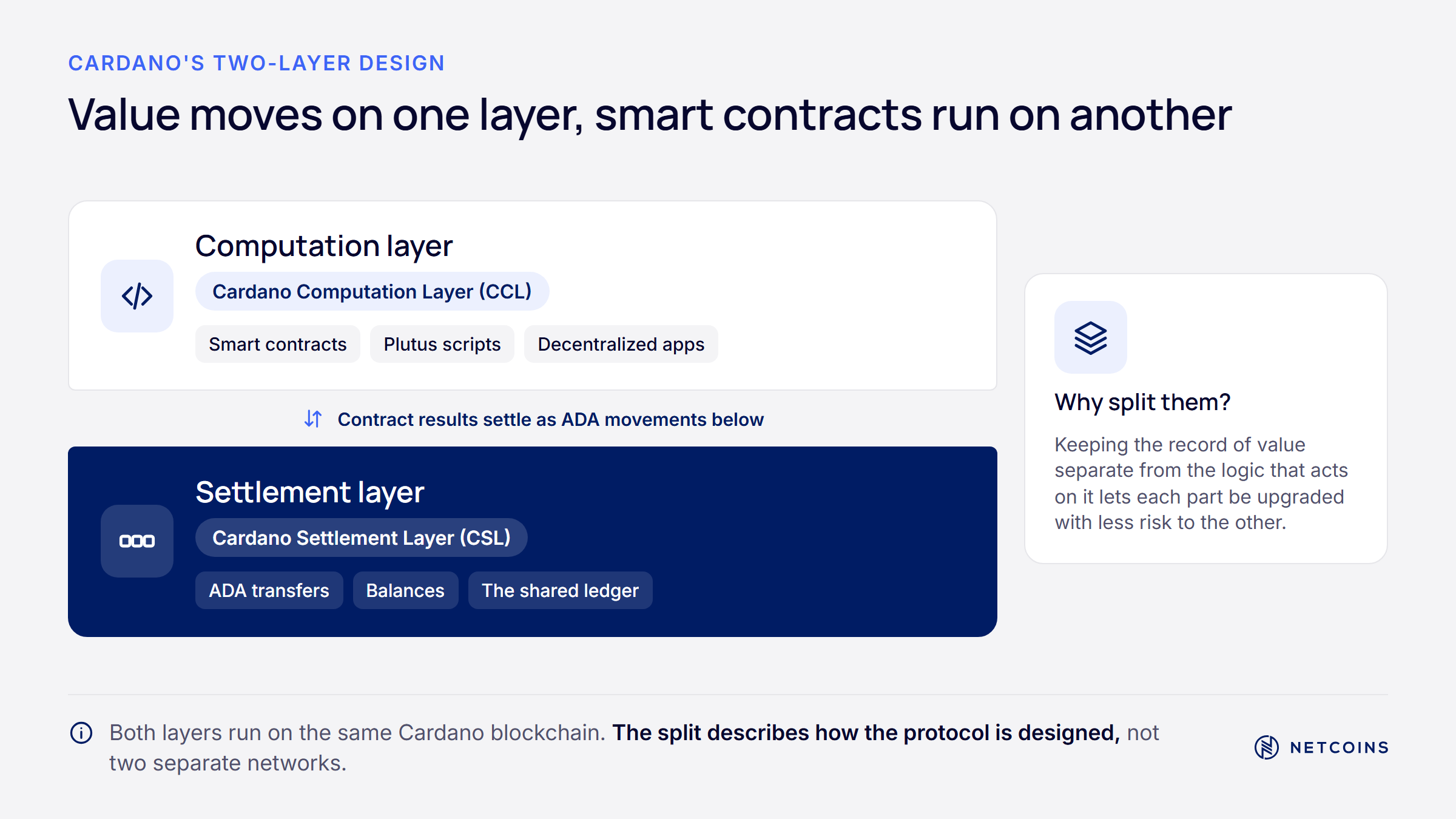
Cardano separates how value moves from how smart contracts run. The Cardano Settlement Layer (CSL) handles ADA transfers and the ledger of balances, and the Cardano Computation Layer (CCL) runs smart contracts and decentralized applications. [Source]
In a single-layer design, token transfers and contract execution share the same environment. Cardano splits them into two layers:
- Cardano Settlement Layer (CSL): Processes ADA transactions and tracks the ledger of balances.
- Cardano Computation Layer (CCL): Executes smart contract logic and supports decentralized applications.
The design aim is modular upgrades. Engineers can change the computation layer, such as the tools developers use, without rewriting the rules for the settlement layer where balances are tracked. In theory, this makes the network easier to maintain over many years.
Layering is a design choice, not a guarantee. Congestion, software bugs, and upgrade problems can still happen on any blockchain. Cardano upgrades usually arrive as hard forks, which need node operators and the wider community to coordinate. A failed or delayed upgrade can affect users, developers, and applications.
The layers matter in practice for what a person is doing. A Canadian sending ADA between two wallets is using the settlement layer. Someone using a decentralized application on Cardano also relies on the computation layer. In both cases the fee is paid in ADA, so its CAD cost depends on the ADA price at the time.
Understanding these layers does not make any use of Cardano safe by default. Decentralized applications are built by independent teams, and each one has its own smart contract risk, operational risk, and user-error risk. Readers should review how any application works, who built it, and whether it has been independently audited before they use it. An audit lowers some risks but does not remove them.
What Is the eUTXO Model and How Do Cardano Fees Work?
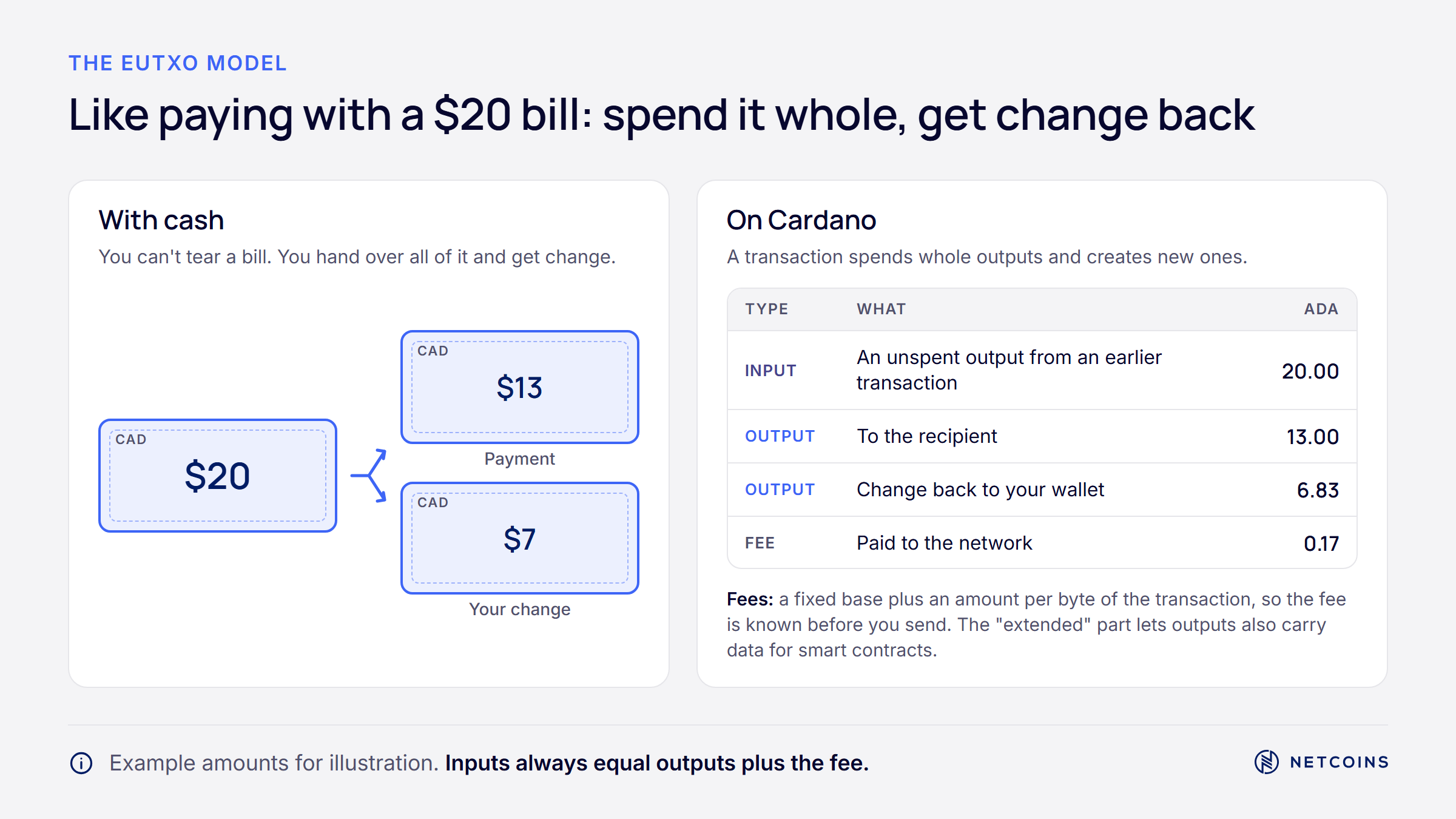
The eUTXO (extended Unspent Transaction Output) model is how Cardano tracks who owns what. Instead of keeping account balances that are edited in place, Cardano tracks individual outputs, similar to bills and coins.
Imagine paying $12 CAD with a $20 bill. You hand over the whole bill and get $8 back as change. In the UTXO model, a transaction consumes an existing output and creates new ones, one for the recipient and one back to the sender as change. Cardano's extended version lets outputs carry extra data and spending rules, which smart contracts use. Ethereum uses an account model instead, where balances are updated in place. Each design has trade-offs.
Cardano fees follow a linear formula based on transaction size, with extra charges when a transaction runs smart contract scripts. According to Cardano's developer documentation, this lets users calculate the exact fee before submitting a transaction. [Source] Fees are paid in ADA, so their CAD cost still changes with the ADA price.
Transactions that run smart contract scripts must include collateral. Collateral is forfeited only if the script fails during the second validation phase, and the collateral parameter is currently 150 percent of the fee on mainnet. [Source] So it is not accurate to say a failed transaction never costs anything. Wallets can check scripts before submitting them, which lowers the chance of a failure but does not remove it.
Because each output can be spent only once, eUTXO also creates a concurrency challenge. If many users try to spend the same output at the same moment, only one transaction succeeds and the others must be rebuilt. Developers use design patterns, such as splitting application state across several outputs, to work around this.
The model can reduce exposure to some kinds of smart contract bugs, because scripts only see the inputs given to them in a transaction. It does not prevent coding mistakes. Smart contracts on any network can have flaws, so anyone using decentralized applications should treat them as carrying smart contract risk.
How Does Staking ADA Work?
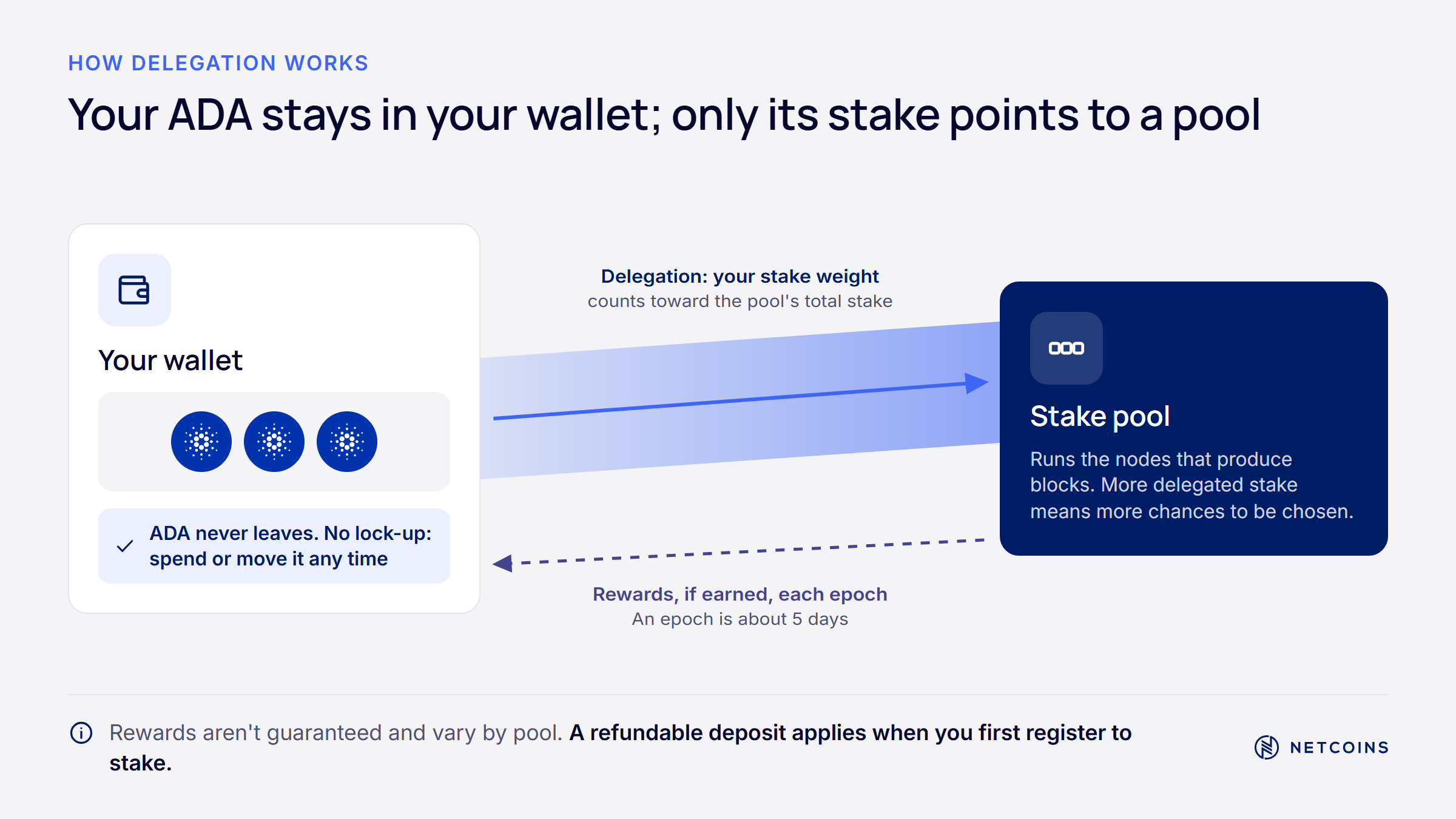
Staking ADA means delegating the voting weight of your ADA to a stake pool. The pool produces blocks in proportion to the stake delegated to it, and delegators can receive protocol-generated staking rewards. Rewards vary and are not guaranteed.
According to Cardano's developer documentation, delegation is non-custodial. The ADA never leaves the holder's wallet, and there is no lock-up, so it stays spendable. [Source] Cardano's glossary also states that there is no slashing, so a delegator's ADA is not confiscated as a penalty. [Source] If a pool underperforms, the effect is missed rewards for that period. That does not make staking risk-free. Wallet security, software errors, phishing, and user mistakes still apply, and the ADA price can fall while ADA is delegated.
Timing works differently from what many beginners expect. The first rewards arrive after an initial delay of roughly 15 to 20 days, and then arrive each epoch, about every five days, as long as the pool produces blocks. [Source] Registering a stake address requires a refundable deposit, currently 2 ADA. [Source] Moving ADA out of a delegated wallet changes the balance counted at snapshots, which can affect rewards.
Since the Plomin hard fork in January 2025, ADA holders must delegate to a DRep, or choose one of the predefined options, to withdraw staking rewards. Rewards continue to accrue either way. [Source] Pools can also become oversaturated. Past a certain size, rewards per ADA drop, which is meant to encourage delegation to smaller pools. [Source]
ADA staking is usually done from a self-custody wallet. Self-custody gives more direct control, and it also adds responsibility. Losing a recovery phrase can mean permanent loss of access. Readers who hold ADA on a crypto trading platform should check that platform's own staking terms, since platform processing can differ from the protocol's rules.
For background on how staking works in general, see this explainer on what crypto staking is.
How Does Cardano Governance Work After Voltaire Began?
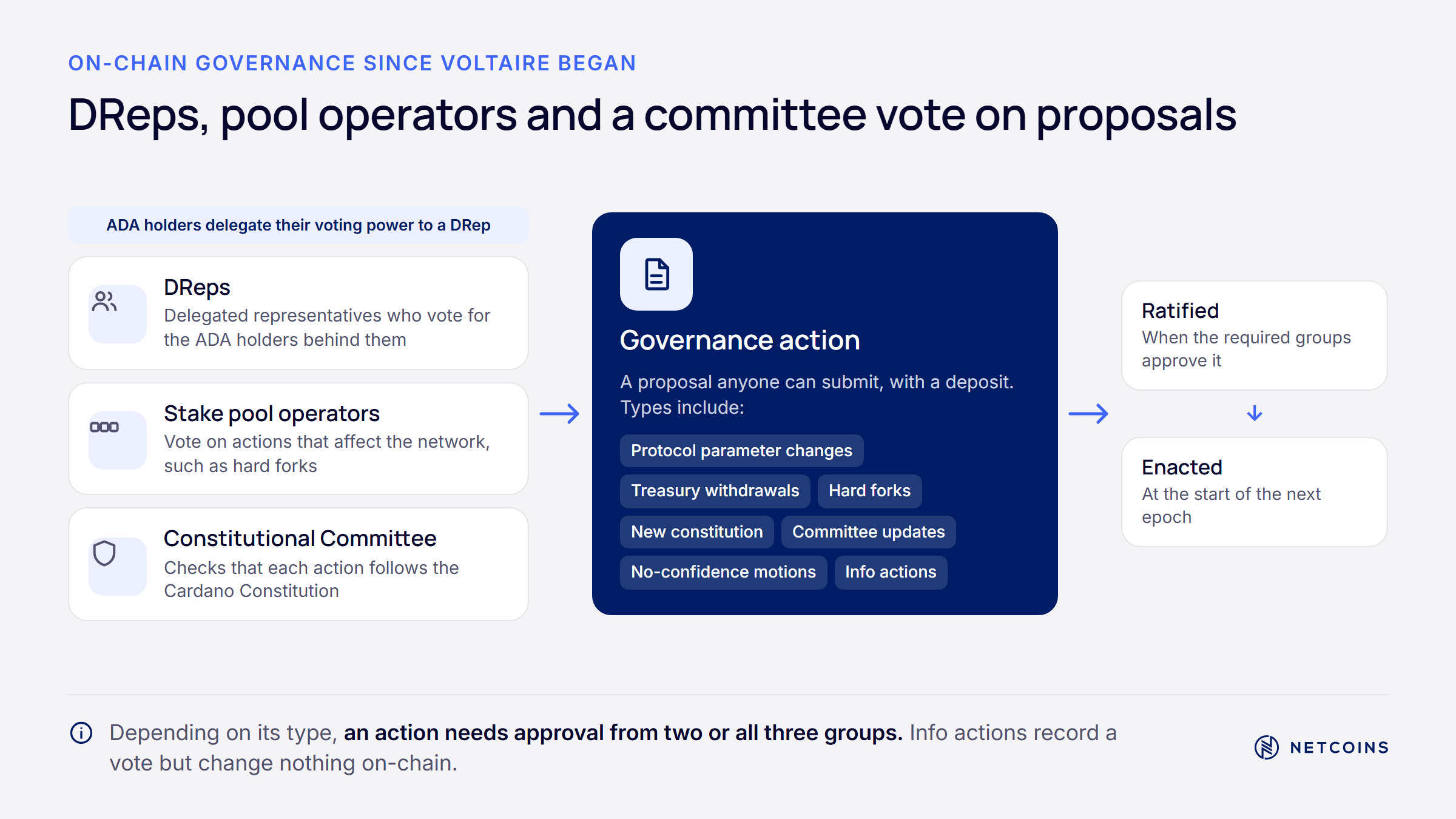
Cardano governance lets ADA holders vote on protocol changes and treasury spending through on-chain actions, either directly or through delegated representatives called DReps. This is the focus of Voltaire, the roadmap phase for governance and treasury management. [Source]
The change happened in stages. The Chang hard fork on September 1, 2024 activated the Conway ledger era and switched on the first batch of on-chain governance features defined in CIP-1694. [Source] The Plomin hard fork on January 29, 2025 enabled the remaining governance actions and activated the DRep role. [Source] A later hard fork, van Rossem in July 2026, was the first proposed and ratified entirely through the on-chain process. [Source]
Three groups share decisions under this system:
- DReps: Registered representatives that ADA holders can choose to vote on their behalf. Holders can also vote directly.
- Stake pool operators: The operators who run block-producing nodes, who vote on certain kinds of actions.
- Constitutional Committee: A group that reviews whether ratified actions fit the Cardano Constitution.
Intersect is a member-based organization that hosts committees and working groups for the Cardano community and publishes governance updates. Its knowledge base explains how proposals move from idea to vote.
Decentralized governance does not remove risk. Voting power can concentrate among large holders or popular DReps, participation can be low, and decisions can be disputed or delayed. Governance outcomes can also change how the network works, and individual holders may disagree with the result.
Canadians who hold ADA on a crypto trading platform may not control voting or DRep delegation directly, because the platform may hold the keys. It is worth reading a platform's terms to see whether it supports governance participation and how it handles staking rewards. Holders who want direct participation usually use a self-custody wallet, which carries the added responsibilities described above.
What Are Native Tokens, Smart Contracts, and Scaling Tools on Cardano?
Cardano supports custom tokens at the ledger level, smart contracts written in languages such as Plutus and Aiken, and scaling projects such as Hydra and Mithril. Each adds capability and adds its own risks.
On Cardano, custom tokens such as NFTs are tracked by the same ledger rules used for ADA, so a simple transfer does not need a smart contract. A single transaction can carry ADA and several tokens at once. A Canadian moving a token between wallets pays the fee in ADA, and its CAD cost depends on the ADA price at that time.
Smart contracts on Cardano are compiled to Plutus Core, which nodes run. Developers write in higher-level languages such as Plutus, which is based on Haskell, or Aiken, which was created to be easier for newer developers. Both compile down to Plutus Core. [Source] Better tools can help developers, but testing and independent audits remain important, since a badly written contract can lose funds.
- Hydra: A layer-2 scaling protocol. A group of participants opens a Hydra Head, an off-chain channel that follows the same eUTXO rules, and only the final balances are recorded on the main chain.
- Mithril: A protocol that lets nodes and wallets check a snapshot of the chain using stake-based threshold signatures, so new nodes can sync faster.
- Ouroboros Leios: A research-stage proposal to raise base-layer throughput. Its timing and results are not confirmed, so check Cardano's official roadmap for current status.
New protocols add complexity. Layer-2 tools and cross-chain tools can add operational, smart contract, and bridge risk, and a feature described in research may behave differently once it is live. Readers should not assume that a scaling tool lowers cost or raises speed for every use.
Before using any application built on these tools, read its documentation and risk disclosures, and only use amounts you could afford to lose.
People Also Ask About What Is Cardano
What is Cardano used for?Cardano is used to send ADA, run smart contracts, issue custom tokens, and take part in on-chain governance.
Fees on the network are paid in ADA, and holders can delegate ADA to stake pools. Applications built on Cardano vary in what they do, and each carries its own smart contract and operational risks. Usage also differs from one application to the next, so a feature available in one app may not exist in another. Check each project's documentation before using it.
How is Cardano different from Ethereum?Both are smart contract networks, but they use different designs.
Cardano uses an eUTXO accounting model, while Ethereum uses an account model. Cardano also describes a research-first development process. The two networks differ in ecosystem size, tools, and developer communities, and neither is better for every purpose. For a broader comparison, see this article on Bitcoin vs Ethereum. Both networks carry smart contract, software, and market risk.
How many ADA coins will exist?The maximum supply of ADA is capped at 45 billion. [Source]
A fixed maximum supply describes how many coins can exist. It does not predict or imply a price, and ADA can lose value. Most of the supply was created at launch, and the remainder is released over time through staking rewards. Supply rules can only change through the network's governance process, which holders and operators may disagree on.
What is the Ouroboros protocol?Ouroboros is the proof-of-stake consensus protocol that secures Cardano.
It selects stake pool operators to produce blocks in proportion to the ADA delegated to their pools, using verifiable randomness. It was developed through academic research and has gone through several versions. Researchers describe it as provably secure under stated assumptions, and real-world conditions may differ. Like any protocol, it can be affected by software bugs, outages, and stake concentration.
Can I buy Cardano in Canada?Yes, ADA is available on some Canadian crypto trading platforms, including Netcoins, which has an ADA page.
According to Netcoins, an account can be funded with a crypto deposit, an Interac e-Transfer, or a bank wire. [Source] Before choosing any platform, check whether it is registered with the applicable Canadian securities regulators and review its custody, fee, and risk disclosures. For funding details, see how Interac e-Transfer works for crypto in Canada.
Frequently Asked Questions
Does staking lock my ADA?According to Cardano's documentation, delegating ADA does not lock it, and the ADA stays in your own wallet and remains spendable. Delegation means assigning the voting weight of your ADA to a stake pool, not sending the coins to the pool. Rewards can be delayed at first, and moving ADA can change the balance counted at snapshots. Staking is not risk-free, because wallet security, software errors, and price changes still apply, and platform staking terms may differ from the protocol's rules.
What happens to transaction fees on Cardano?Transaction fees on Cardano are collected and distributed among the stake pools that produced blocks during an epoch, rather than going to the pool that handled each transaction. Fees are calculated from transaction size, with added charges when scripts run. They are paid in ADA, so their cost in Canadian dollars changes with the ADA price. Pool operators and delegators may receive a share through the protocol's reward process, which can vary.
What is the Chang hard fork?The Chang hard fork was the network upgrade that activated the Conway ledger era and the first batch of on-chain governance features defined in CIP-1694. A later hard fork, Plomin, enabled the remaining governance actions and the DRep role. Together they moved Cardano toward community-driven decision making. Governance changes can alter how the network works, and participation and outcomes vary, so holders may disagree with results.
Who controls Cardano?No single company controls Cardano, but influence is shared among several groups. ADA holders can vote directly or through DReps, stake pool operators vote on certain actions, and a Constitutional Committee reviews whether ratified actions fit the Cardano Constitution. Organizations such as IOG, the Cardano Foundation, Emurgo, and Intersect still play important roles in development and coordination. Voting power can concentrate, so influence is not always evenly spread.
What is a DRep?A DRep, or Delegated Representative, is a registered participant who votes on Cardano governance proposals on behalf of ADA holders who delegate to them. Holders can also vote directly or choose one of the predefined options. Delegating to a DRep does not move ADA out of the holder's wallet. DReps vary in how they vote and how active they are, so holders should review a DRep's stated approach before delegating.
Quick Glossary
ADA: The native cryptocurrency of Cardano, used to pay fees, delegate to stake pools, and vote on governance.
eUTXO: Extended Unspent Transaction Output, the accounting model Cardano uses to track ownership as individual outputs that can carry data and spending rules.
Ouroboros: The proof-of-stake protocol that selects stake pool operators to produce blocks on Cardano.
Epoch: A five-day period on Cardano during which the stake distribution is fixed and rewards are calculated.
Stake Pool: A node operated by a pool operator that produces blocks in proportion to the ADA delegated to it.
Delegation: Assigning the voting weight of your ADA to a stake pool or DRep without moving the coins out of your wallet.
DRep: A Delegated Representative who votes on Cardano governance proposals on behalf of ADA holders.
Native Token: A custom token tracked directly by Cardano's ledger using the same rules as ADA.
Key Takeaways
- Cardano is a proof-of-stake blockchain with ADA as its native coin, used for fees, delegation, and governance votes.
- The eUTXO model lets users calculate fees before sending, but script transactions require collateral that can be forfeited if a script fails.
- Delegating ADA keeps the coins in your wallet with no lock-up and no slashing, though rewards vary, start after a delay, and carry wallet, software, and price risk.
- Governance moved on-chain in stages, with the Chang hard fork in September 2024 and the Plomin hard fork in January 2025.
- ADA is volatile, and every Cardano feature carries trade-offs, so it helps to read project documentation and platform disclosures first.
Closing
Cardano combines a research-driven design with features such as eUTXO accounting, delegation, and on-chain governance. Each feature comes with trade-offs, and none of them removes market, software, or user-error risk. Canadians who want to learn more can read this step-by-step guide for Canadians on buying crypto, or review the ADA page to see how Netcoins describes funding and trading ADA.

About Netcoins
Established in 2014 in Vancouver, British Columbia, Netcoins is a registered Restricted Dealer with the provincial securities commissions and a registered Money Services Business (MSB) with FINTRAC. Netcoins is owned by Surge Digital Inc. (formerly BIGG Digital Assets Inc.), a publicly traded company listed on the TSX Venture Exchange (TSXV: SRGE), and complies with applicable public company regulatory.
The information provided in the blog posts on this platform is for educational purposes only. It is not intended to be financial advice or a recommendation to buy, sell, or hold any cryptocurrency. Always do your own research and consult with a professional financial advisor before making any investment decisions. Cryptocurrency investments carry a high degree of risk, including the risk of total loss. The blog posts on this platform are not investment advice and do not guarantee any returns. Any action you take based on the information on our platform is strictly at your own risk. The content of our blog posts reflects the authors’ opinions based on their personal experiences and research. However, the rapidly changing and volatile nature of the cryptocurrency market means that the information and opinions presented may quickly become outdated or irrelevant. Always verify the current state of the market before making any decisions.