TL;DR
Some high-net-worth Canadians use OTC desks to trade large crypto orders at a quoted price instead of placing them on a public order book. Custody setup, settlement terms, and performance reporting also matter at this scale. Each approach carries risks, and crypto is generally not covered by CIPF or deposit insurance, so it helps to understand how the mechanics work before choosing a provider.
Moving $5,000 of crypto is a very different task from moving $500,000. Large orders can affect prices, and bigger balances raise questions about storage and reporting. In a 2023 KPMG and CAASA survey, 39 percent of Canadian institutional investors reported direct or indirect crypto exposure, up from 31 percent in 2021. [Source] This guide explains OTC trading, slippage, custody, and reporting in plain language.
What Is OTC Crypto Trading for High-Net-Worth Canadians?
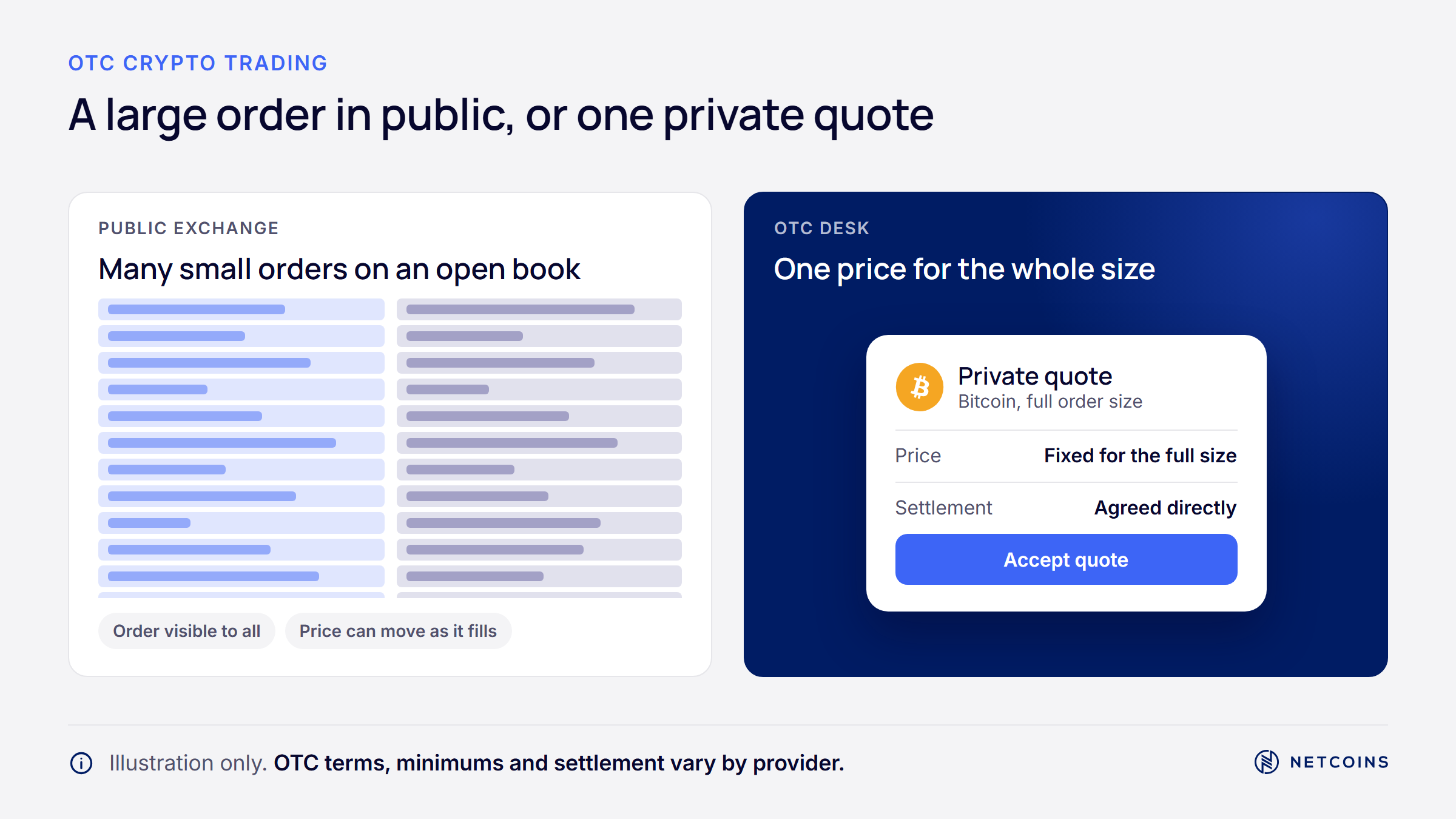
Over-the-counter (OTC) crypto trading is a private way to buy or sell large amounts of crypto through a trading desk instead of a public order book. The desk gives the client a quote for the full amount. The price is only fixed once both sides confirm the trade.
On a public order book, buy and sell orders are visible to everyone. That works well for everyday amounts. A family office, corporate treasury, or individual placing a $500,000 CAD order is in a different position, because a large order can move the price it is trying to buy at. An OTC desk acts as a private counterparty. It quotes one price for the whole block, so the client can see the cost in CAD or USD before deciding whether to confirm.
That quote is not free of cost. It usually includes the desk’s spread or margin, and it may be wider or narrower than the price shown on a public screen at that moment. Some desks charge a separate fee instead. A quote is generally valid only for a short window. If the market moves before the client confirms, the desk may change or withdraw the quote, so execution at a particular price is not guaranteed. Investors can ask for the all-in price, any fees, and the quote’s validity window in writing.
OTC trading also adds counterparty and settlement risk. The investor depends on the desk to honour a confirmed trade and to settle it. Settlement timing depends on the funding method, the asset, and bank processing, and it can be delayed. Minimum trade sizes, supported assets, and funding methods differ by desk, so it is worth checking each provider’s published terms. Netcoins describes its OTC trading services for large-volume clients on its website.
The KPMG and CAASA survey above gathered responses from 31 institutional investors and 34 financial services organizations, so it is a small sample. [Source] It shows interest among Canadian institutions, not what any individual investor should do. Readers who are new to the basics can start with this guide on how to buy Bitcoin in Canada before reading about large-order execution.
Why Do Large Crypto Orders Face Slippage?
Slippage happens when a large order uses up the available sell orders at the current price, so the rest of the order fills at progressively higher prices. The average price paid ends up higher than the price first shown on screen.
An order book is a list of people willing to sell and the prices they ask. Imagine a hypothetical $250,000 CAD market order for Bitcoin. If only $10,000 of Bitcoin is offered at the displayed price, the matching engine moves to the next seller, who asks for slightly more. This repeats until the order is filled. The final average price can be meaningfully higher than the opening quote.
Here is a simple hypothetical, not market data. If that $250,000 CAD order fills at an average price 1 percent above the screen price, the extra cost is $2,500 CAD. The real figure depends on how much liquidity is available at that moment, which changes with the coin, the time of day, and market conditions. Thinly traded coins usually have less depth than large ones.
Slippage is one reason large buyers consider alternatives. Some split a big order into smaller pieces over time, which can reduce price impact but leaves the investor exposed to price moves while the orders work. Others use limit orders, which set a maximum price but may not fill. An OTC quote is another option, since the price for the block is agreed before the trade is confirmed.
None of these options removes risk. A quoted OTC price includes the desk’s spread or margin, and prices can move between a request for a quote and the moment a trade is confirmed. Investors can ask how long a quote stays valid and what happens if the market moves during that window.
Slippage matters less for small amounts. Someone buying a few hundred dollars of Bitcoin through a trading platform is unlikely to move the market. The step-by-step guide to buying Bitcoin in Canada covers that standard process, while larger orders raise the execution questions described here.
How Does Custody Work for Large Crypto Portfolios?
Custody is how the private keys that control crypto are stored and managed. At larger balances, investors often look at custody setups that avoid depending on a single person, device, or password.
If a private key sits on one phone or one hardware device, losing it can mean losing access to the assets with no way to recover them. A family office or holding company managing significant balances may weigh that risk against the added responsibility of running its own security. Self-custody gives more direct control, but it also puts the full burden of safekeeping, backups, and succession planning on the owner.
Custody providers offer an alternative. Many use setups where several approvals are needed before assets can move, and where key material is spread across different systems or locations. Netcoins’ custody page states that it uses Fireblocks for its hot wallet infrastructure and BitGo cold storage for the bulk of client assets. How a specific account is held, and what protections apply, should be confirmed in Netcoins’ current custody and risk disclosures rather than assumed.
Using a custodian does not remove risk. It replaces some risks with others. Investors remain exposed to operational risk, such as software or process failures, and to cybersecurity risk, such as hacks or theft. There is also insolvency risk: if a platform or custodian runs into financial or legal trouble, clients may face delays or losses in getting assets back. Crypto held this way is generally not covered by CIPF or deposit insurance. Questions worth asking include how assets are segregated, who can authorize withdrawals, how keys are recovered, and whether any insurance applies and what it does and does not cover.
Canadian families and companies may also need to think about continuity. If the person who holds access is unavailable, someone needs a documented and lawful way to reach the assets. Custody terms, estate documents, and company authorization rules should line up, and legal and accounting professionals can help with that.
For a plain-language comparison of the two storage models, see this guide to centralized crypto custody and self-custody.
What Is the Difference Between MPC and Cold Storage?
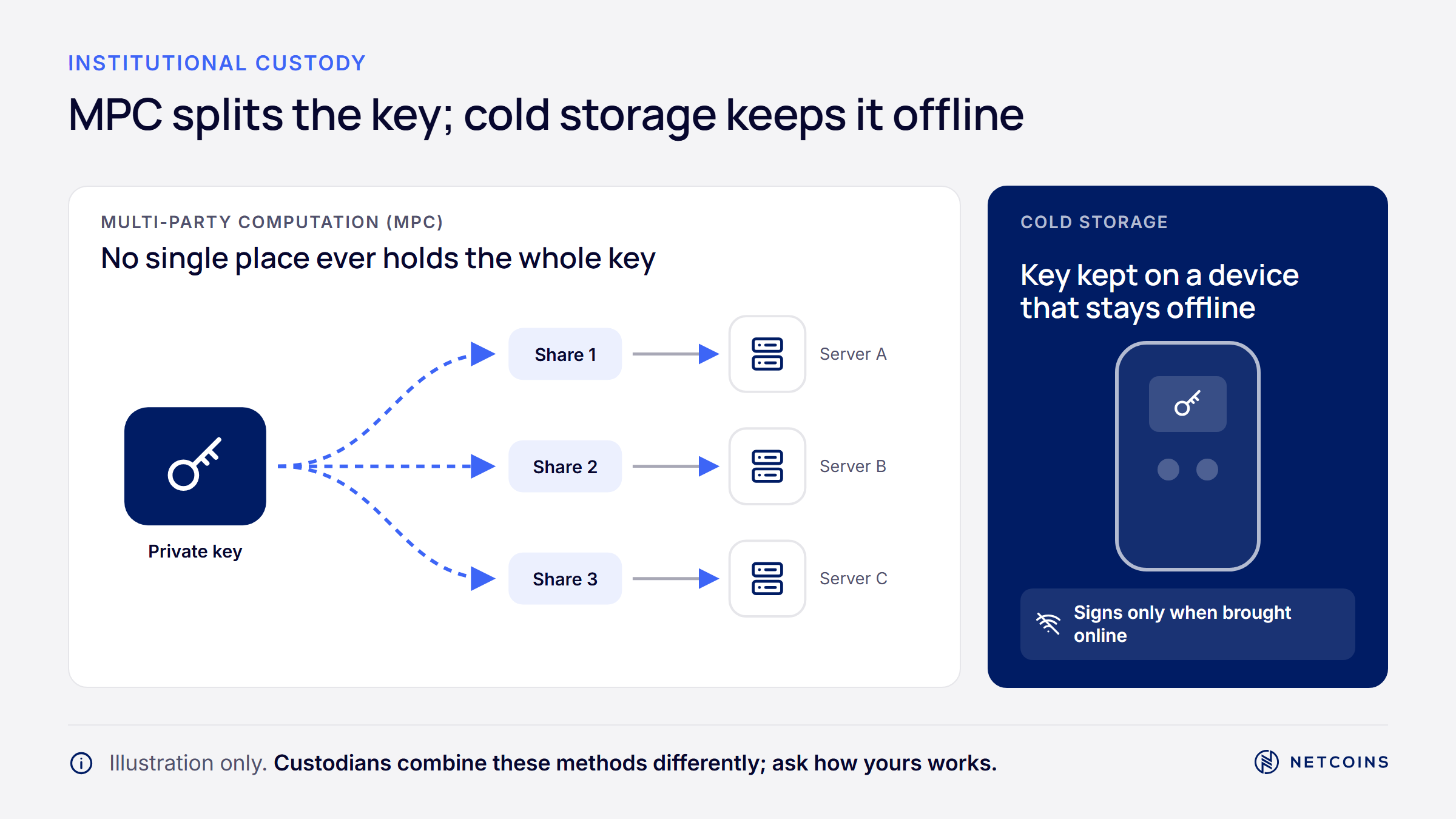
Multi-Party Computation (MPC) splits the ability to sign a transaction across several systems, so no single system holds a complete key. Cold storage keeps keys on devices that are kept offline. They are different tools with different trade-offs.
- MPC: The signing power is divided into separate shares held on different servers. To approve a transaction, those systems work together without assembling the full key in one place. This setup is usually connected to a network, so it suits wallets that need to move assets more often, such as for trading or settlement.
- Cold storage: Keys are generated and stored on devices that stay offline, which removes the exposure that comes from being connected to the internet. Moving assets out usually takes deliberate, manual steps and several approvals. This suits holdings that are meant to sit for long periods.
- Speed: MPC wallets can usually sign faster. Cold storage is slower by design.
- Exposure: MPC wallets are online, so they face online threats. Cold storage lowers that exposure, but physical risks, human error, and process failures still apply.
- Compatibility: MPC is generally designed to work across many networks. Multi-signature cold storage depends on the specific blockchain supporting that approach.
Some providers combine both. A smaller portion of assets sits in a connected wallet for active needs, and the rest sits offline. Netcoins’ custody page describes this kind of split, with Fireblocks for hot wallets and BitGo for cold storage. Clients of any provider, including Netcoins, can ask how assets are divided between connected and offline storage and what that means for withdrawal timing.
Neither approach makes assets immune to loss. A software bug, a cyberattack, a compromised employee, a lost device, or a mistake in a recovery process can still cause problems. Security is a matter of layers and good processes, and it depends on how a specific provider runs its systems.
A useful question for any provider is how long a withdrawal takes from each type of storage. An investor who needs same-day access to funds should know which assets sit where before placing a large order.
How Do Investors Track Crypto Portfolio Performance?
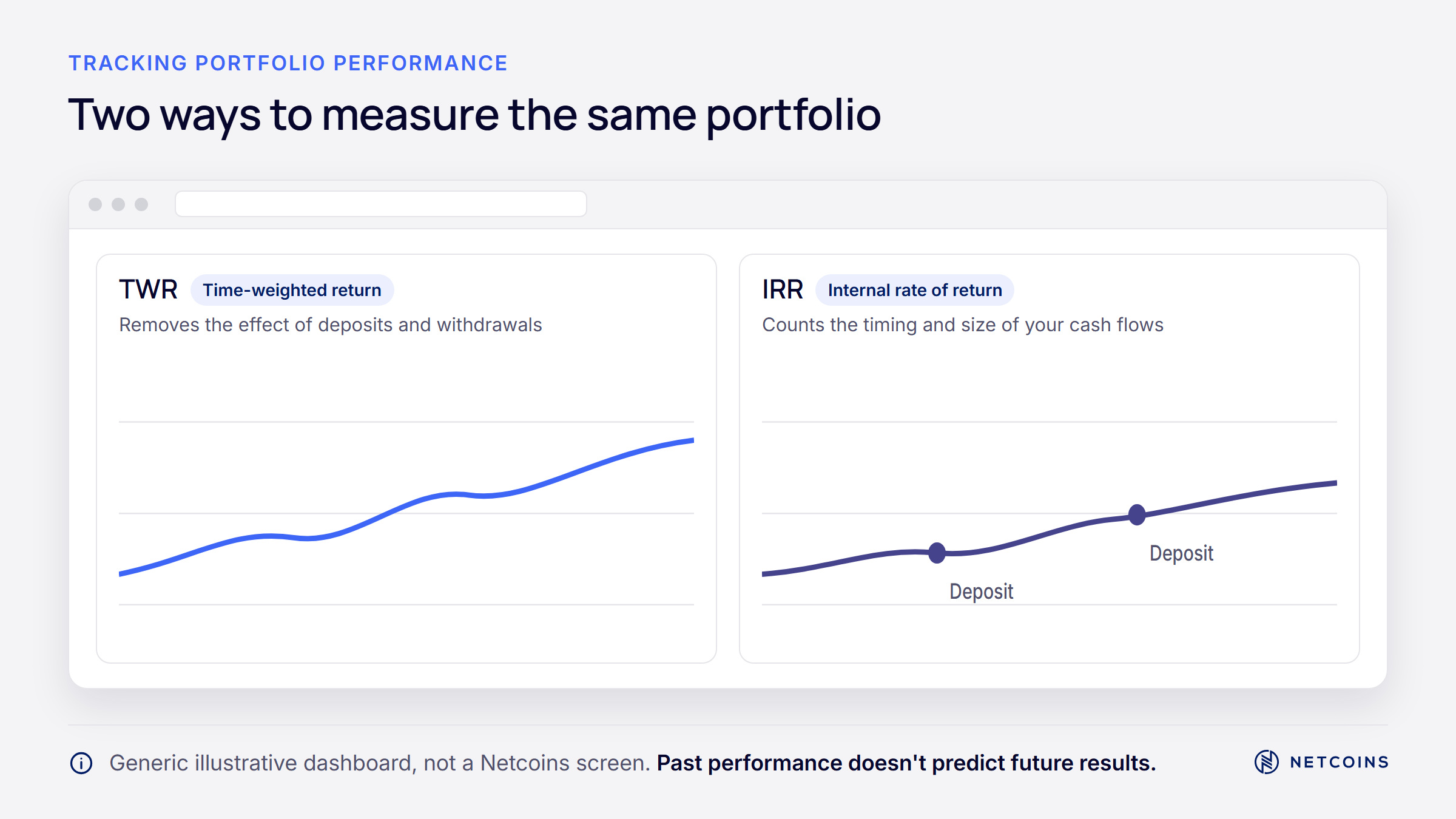
Investors with large portfolios often track crypto performance using two measures: Time-Weighted Return (TWR) and Internal Rate of Return (IRR). They answer different questions, and using both can give a fuller picture.
A basic account screen usually shows the current value and a simple gain or loss against the purchase price. That can be misleading when money moves in and out. If an investor deposits $1,000,000 CAD just before a price drop, the balance looks large even though the assets lost value.
- Time-Weighted Return (TWR): Measures the growth of the underlying assets while removing the effect of deposits and withdrawals. It is often used to compare performance against a benchmark, such as the S&P/TSX Composite Index, regardless of when cash was added or removed.
- Internal Rate of Return (IRR): Also called a money-weighted return. It accounts for the size and timing of every cash flow, so it reflects the investor’s own experience, including the effect of when money was added or withdrawn.
For example, two investors could hold the same assets and see the same TWR. If one added money before a decline and the other added money after, their IRR would differ.
Past returns do not predict future results. Both measures describe what already happened, and they depend on the data and prices used. Different tools may calculate them slightly differently, so it is worth asking how a report is built.
Family offices and private investors often combine crypto data with other holdings such as real estate or private investments, using their own reporting software or an accountant. Reporting features vary widely between providers. Some offer basic balance summaries, transaction histories, and account statements, while others provide more detailed analytics. Do not assume a provider offers a specific report. Ask which reports it actually provides.
Before choosing a provider, it helps to ask what formats are available, how often reports update, and whether data can be exported to other software. Complete transaction histories also help accountants and advisers who work with the investor.
What Is Delivery Versus Payment in Large Settlements?
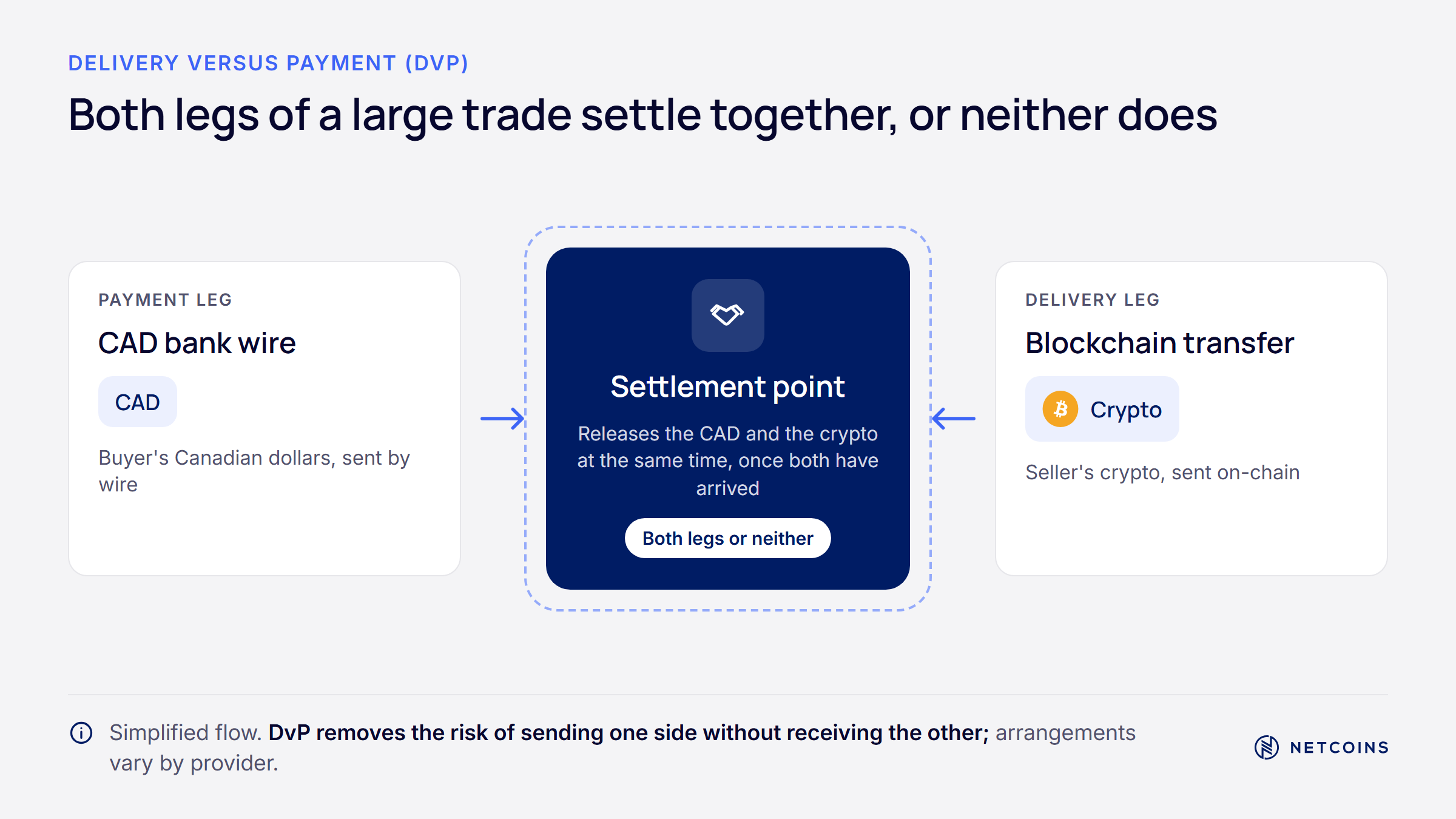
Delivery versus Payment (DvP) is a settlement method that links the transfer of an asset to the transfer of payment, so one only happens if the other does. Its aim is to reduce settlement risk, which is the chance that one side delivers and the other does not.
With large trades, settlement risk is a real concern. If a buyer sends $1,000,000 CAD and the seller never delivers the crypto, the loss could be significant. In traditional securities markets, DvP is a common way to manage this. In crypto, true simultaneous settlement between a bank transfer and a blockchain transfer is harder, because they run on separate systems with different timing.
In practice, many OTC desks manage this risk through process and trust rather than a single automated step. They may set agreed sequences, require funds to arrive before the crypto is released, or operate as the direct counterparty. These approaches reduce risk but do not remove it. The investor still relies on the desk’s integrity, systems, and financial strength, and could face losses if the desk becomes insolvent during settlement. Anyone planning a large trade can ask how settlement works step by step, who sends first, and what happens if something goes wrong.
Funding method matters in Canada. Large amounts are often sent by bank wire, while Interac e-Transfer may suit smaller amounts, subject to bank and platform limits. Wire cut-off times can affect when funds count as received, so a trade requested late in the day may settle the next business day. Settlement timelines vary by desk, currency, and bank, and nobody can promise a specific timeline in advance. For a walkthrough of the smaller-account route, see this guide on how Interac e-Transfer works for crypto in Canada.
Another question is how the trade is documented. A written confirmation that records the price, amount, fees, and settlement terms gives both sides something to refer back to if there is a dispute.
People Also Ask About Crypto for High-Net-Worth Investors in Canada
What is the minimum amount for OTC crypto trading in Canada?
Each OTC desk sets its own minimum, so there is no single threshold across Canada.
Minimums depend on the desk, the asset, and the funding method. Some desks focus on large trades, while others serve a wider range of clients. Before requesting a quote, it helps to check the desk’s published requirements and ask whether smaller amounts are better handled through a standard trading platform, where order sizes may be less likely to affect prices.
How is crypto stored for large portfolios?
Large portfolios are often held with a custodian or in self-managed setups that need several approvals to move assets.
Common tools include Multi-Party Computation (MPC), which splits signing power across systems, and cold storage, which keeps keys offline. Each has trade-offs in speed, exposure, and complexity. Neither removes risk, and crypto is generally not covered by CIPF or deposit insurance. Investors can ask providers about segregation of assets, withdrawal procedures, recovery processes, and any insurance, including what it does and does not cover.
Do family offices invest in crypto?
Some Canadian institutional investors report crypto exposure, but the available data does not isolate family offices.
The 2023 KPMG and CAASA survey found that 39 percent of institutional investors reported direct or indirect exposure to crypto assets. [Source] That survey covered institutional investors and financial services organizations, with 31 institutional investor responses. It does not show how many family offices hold crypto, and each family office makes its own decisions.
What is slippage in large crypto trades?
Slippage is the gap between the expected price of a trade and the average price at which it actually fills.
It happens when an order is large relative to the orders available at the displayed price. The remainder of the order fills at less favourable prices. Slippage varies with the coin, the time of day, and market conditions. Splitting an order, using limit orders, or requesting an OTC quote are approaches that investors consider, and each has its own risks.
Can a Canadian corporation buy crypto?
Corporations and holding companies can open business accounts with platforms that offer them, subject to the platform’s onboarding requirements.
Providers usually ask for corporate documents, details about ownership, and information about who is authorized to act for the company. Terms and available services differ by provider. Companies often speak with their legal and accounting professionals before buying crypto, because internal approvals, record-keeping, and reporting needs depend on the situation.
Frequently Asked Questions
Why use an OTC desk instead of a public order book?
An OTC desk quotes one price for a large block, which can reduce the price impact that a big order may have on a public order book.
The quote usually includes the desk’s spread or margin, so it may not always be cheaper than the public price, and it is only firm once both sides confirm the trade. The investor also takes on counterparty risk, since they rely on the desk to settle. Some investors compare an OTC quote with the public price at the same moment, and ask how long the quote stays valid.
What does custody mean for large crypto holdings?
Custody is the way private keys are stored and managed, including who can approve a transaction.
For large holdings, providers may require multiple approvals and spread key material across systems or locations. This can reduce reliance on one person or device, but it does not remove risk. Operational failures, cyberattacks, insider misconduct, and insolvency of a platform or custodian can still occur, so it helps to review a provider’s current custody and risk disclosures.
Is crypto covered by CIPF or deposit insurance?
Crypto assets are generally not covered by the Canadian Investor Protection Fund (CIPF) or by deposit insurance.
CIPF protection is designed for eligible client property held at member investment firms, and deposit insurance covers eligible deposits at member financial institutions. Crypto held on a crypto trading platform or with a custodian generally falls outside both. If a platform or custodian fails, there may be no fund that steps in to cover losses. Investors can read a provider’s custody and risk disclosures to understand how assets are held and what could happen in an insolvency.
What is the difference between TWR and IRR?
Time-Weighted Return (TWR) measures the growth of the assets themselves, while Internal Rate of Return (IRR) reflects the size and timing of the investor’s own deposits and withdrawals.
TWR removes the effect of cash flows, which makes it useful for comparing against a benchmark. IRR includes cash flows, so it shows the investor’s personal result. Both describe past performance only and do not predict future results. Reports can be calculated differently, so ask how a provider builds them.
How quickly do large OTC trades settle?
Settlement time varies by desk, currency, funding method, and bank cut-off times, so there is no standard timeline.
Some desks describe same-day settlement for certain trades, but timing depends on when funds arrive and which banks are involved. A request made late in the day, or near a holiday, may settle later. Before trading, it helps to ask for the expected settlement steps and timing in writing.
Can I fund a large OTC trade with an Interac e-Transfer?
It depends on the platform and the bank, because Interac e-Transfer limits are set by each institution and can be lower than the size of a large trade.
Many large trades use bank wires instead. Wires can take longer and may carry fees, and cut-off times matter. Investors can check limits with their bank and the platform before planning a transfer, and ask which funding methods the desk accepts for trades of their size.
Quick Glossary
- Over-the-Counter (OTC) Trading: A private way to trade large amounts of crypto through a desk that quotes a price, instead of using a public order book.
- Slippage: The difference between the expected price of a trade and the average price it fills at, often caused by a large order using up available orders.
- Order Book: A live list of buy and sell orders on a trading platform, showing the prices people are willing to accept.
- Multi-Party Computation (MPC): A cryptographic method that splits signing power across several systems so no single system holds a complete key.
- Cold Storage: A way of storing private keys on devices that are kept offline, which limits exposure to online threats.
- Delivery versus Payment (DvP): A settlement method that links the transfer of an asset to the transfer of payment, so one happens only if the other does.
- Time-Weighted Return (TWR): A performance measure that tracks the growth of investments while removing the effect of deposits and withdrawals.
- Internal Rate of Return (IRR): A performance measure that accounts for the size and timing of every deposit and withdrawal.
Key Takeaways
- OTC desks quote a price for a large block, which can reduce price impact. The quote includes the desk’s spread or margin, is only firm once confirmed, and the investor takes on counterparty and settlement risk.
- Slippage can raise the average price of a large order on a public order book. Splitting orders, limit orders, and OTC quotes each have trade-offs.
- Custody options such as MPC and cold storage reduce some risks but not all. Operational, cybersecurity, insolvency, and user-error risks remain.
- Crypto assets are generally not covered by CIPF or deposit insurance.
- TWR and IRR answer different questions, and both describe past performance only. Settlement timing and funding methods vary, so confirm steps and documentation in writing before a large trade.
Closing
Large crypto trades raise questions that smaller purchases rarely do, from price impact and settlement steps to custody and reporting. Understanding how OTC quotes, storage setups, and performance measures work makes it easier to ask providers the right questions and to compare their answers. Every option carries risks, crypto is generally not protected by CIPF or deposit insurance, and custody, cybersecurity, and insolvency risks apply at any size. When comparing providers, check whether a platform is registered with the applicable Canadian securities regulators and review its custody, fee, and risk disclosures. Registration does not mean a regulator has approved or endorsed a platform, and it does not make crypto lower risk. To learn more about how Netcoins describes its service for large-volume clients, visit Netcoins Private Wealth.

About Netcoins
Established in 2014 in Vancouver, British Columbia, Netcoins is a registered Restricted Dealer with the provincial securities commissions and a registered Money Services Business (MSB) with FINTRAC. Netcoins is owned by Surge Digital Inc. (formerly BIGG Digital Assets Inc.), a publicly traded company listed on the TSX Venture Exchange (TSXV: SRGE), and complies with applicable public company regulatory.
The information provided in the blog posts on this platform is for educational purposes only. It is not intended to be financial advice or a recommendation to buy, sell, or hold any cryptocurrency. Always do your own research and consult with a professional financial advisor before making any investment decisions. Cryptocurrency investments carry a high degree of risk, including the risk of total loss. The blog posts on this platform are not investment advice and do not guarantee any returns. Any action you take based on the information on our platform is strictly at your own risk. The content of our blog posts reflects the authors’ opinions based on their personal experiences and research. However, the rapidly changing and volatile nature of the cryptocurrency market means that the information and opinions presented may quickly become outdated or irrelevant. Always verify the current state of the market before making any decisions.